
Africa’s artificial intelligence conversation is often framed around talent pipelines, datasets, startups, and algorithms. These are important—but they are not foundational.
Every serious AI economy, without exception, rests on abundant, reliable electricity.
AI systems do not run on vision statements or innovation hubs. They run on megawatts, resilient grids, and long-term energy planning. In this sense, some of the most consequential “AI infrastructure” in Africa today is not digital at all. It is concrete, turbines, transmission lines, and hydropower reservoirs.
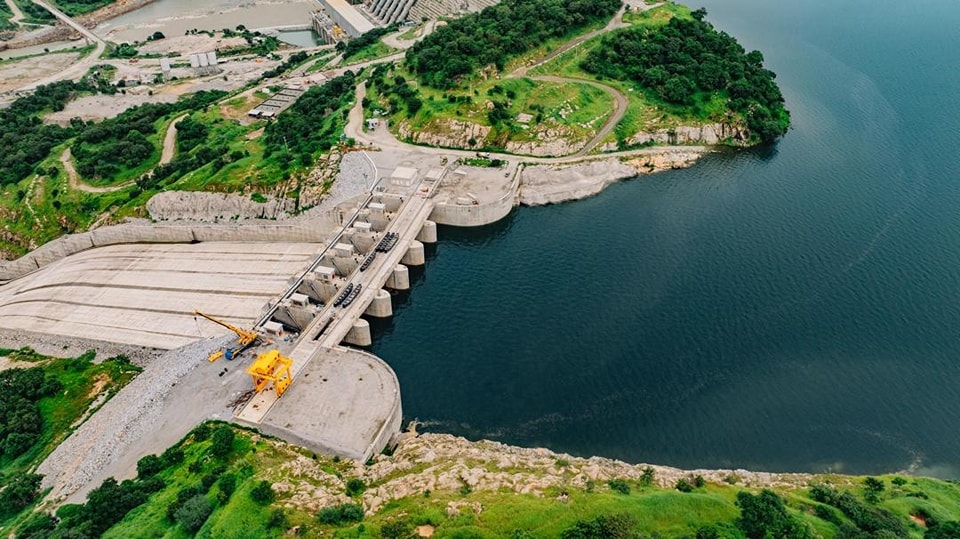
Few projects illustrate this reality more clearly than Ethiopia’s Grand Ethiopian Renaissance Dam (GERD). And few companies are more quietly embedded in Africa’s digital future than Webuild, the Italian engineering firm that designed and constructed it.
GERD: More Than a Hydropower Project
With a capacity of roughly 6,000 megawatts, GERD is Africa’s largest hydroelectric facility. For years, public debate focused almost exclusively on Nile geopolitics: Ethiopia, Egypt, Sudan, water security, and regional diplomacy. These concerns remain legitimate and unresolved—but they are no longer the full story.
Since the completion of construction in July 2025 and its official inauguration in September 2025, GERD has entered a new phase: operational reality.
Today, GERD must also be understood as:
- A continental-scale energy anchor
- A catalyst for data centers and high-performance computing
- A foundational asset in Africa’s emerging AI and digital economy
Reliable baseload power is the non-negotiable requirement for:
- Large-scale data centers
- Cloud availability zones
- AI model training
- Telecom network expansion
- Digitally intensive industries
GERD has materially altered Ethiopia’s energy landscape—and, by extension, the digital possibilities of the Horn of Africa.
Webuild’s Role: Europe’s Quiet Infrastructure Influence
Webuild is rarely mentioned in African technology discourse. That omission is revealing.
Unlike Chinese state-backed contractors or US technology firms, Webuild represents a distinct European mode of influence in Africa’s digital future:
- Build strategic infrastructure
- Avoid ownership of data or platforms
- Exit the spotlight once construction is complete
In GERD, Webuild did not:
- Control cloud services
- Own digital platforms
- Deploy surveillance systems
- Capture downstream data value
Yet its work enables all of them.
This is why infrastructure firms matter profoundly in the AI era. They do not shape software ecosystems directly—but they define what becomes structurally possible. Their influence is long-term, indirect, and often underestimated.
Whether intentional or not, this form of engagement creates durable influence without overt digital dominance.
Why Reliable Hydropower Is Essential for AI in Africa
AI workloads are energy-intensive, continuous, and unforgiving of instability. They require:
- Predictable baseload power
- Low downtime
- Scalable capacity
- Competitive electricity pricing
For much of Africa, unreliable grids have been the hidden constraint behind stalled digital ambitions.
GERD has changed that equation.
Since becoming operational, Ethiopia’s installed electricity capacity has roughly doubled to around 10,000 MW, transforming the country from a power-constrained economy into one with surplus potential—especially renewable surplus.
This shift matters because AI cannot scale on diesel generators or intermittent power. Hydropower, unlike solar or wind alone, offers continuity—making it uniquely attractive for data centers and compute-heavy operations.
GERD is not just an energy project. It is an AI-enabling asset.
The Energy → Data → AI Chain (Now Playing Out in Real Time)
The relationship between energy and AI is not theoretical. It follows a clear sequence:
- Large-scale energy infrastructure
- Enables data centers and telecom networks
- Which attract cloud services and compute-intensive industries
- Which make AI deployment viable at scale
For years, African AI discussions began at step four. GERD operates decisively at step one.
Since GERD’s completion, Ethiopia has already begun to see:
- An influx of high-performance computing and crypto-mining facilities
- Large-scale data center interest drawn by cheap, renewable electricity
- Expansion by firms such as Raxio and other regional data center developers
- Projects reportedly ranging from 70 MW to several hundred megawatts, sized explicitly for compute-heavy workloads
This is no longer speculative. The infrastructure is being used.
GERD’s Role in Ethiopia’s Emerging Data Center Ecosystem
Ethiopia is rapidly becoming an unlikely—but logical—destination for energy-hungry digital infrastructure.
Why?
- Competitive electricity pricing
- Renewable power at scale
- Improving telecom liberalization
- Strategic geographic position in East Africa
Facilities linked to high-performance computing, AI training, and crypto mining have explicitly cited GERD-powered hydropower as a core attraction.
This mirrors a broader continental trend. Africa’s data center market is projected to triple by 2030, with energy reliability—not latency—as the primary differentiator for new sites.
GERD places Ethiopia firmly inside this emerging map.
Europe, China, and the United States: Different Models, Same Stakes
Multiple external actors shape Africa’s digital future—but through very different approaches.
- China often delivers integrated systems: energy, telecoms, cloud-adjacent infrastructure, and digital services bundled together, frequently involving firms like Huawei.
- The United States dominates the platform layer: hyperscale cloud services, AI models, and global digital standards.
- Europe, through firms like Webuild, plays a quieter role—constructing foundational infrastructure without directly controlling platforms or data.
These models are not conspiratorial; they are structural.
The result is not outright dependency, but long-term influence shaped by who controls which layer of the stack.
GERD places Europe firmly within Africa’s digital foundation—not as a platform owner, but as an indispensable enabler.
GERD as a Geopolitical Asset in the AI Era
GERD’s strategic importance did not end with its inauguration. It intensified.
As AI adoption, electrification, and industrial digitization accelerate, large-scale renewable energy assets are becoming:
- Bargaining tools in regional diplomacy
- Magnets for foreign digital investment
- Anchors of economic sovereignty
At the same time, downstream concerns—particularly from Egypt and Sudan regarding Nile water flows—remain active and politically sensitive. These tensions underscore a central truth of the AI era:
energy security, data security, and geopolitical stability are now intertwined.
GERD sits at that intersection.
Lessons for Africa’s AI Strategy
For African governments and technology planners, the implication is unavoidable:
AI strategies that ignore energy infrastructure are incomplete, and digital sovereignty cannot be achieved without:
- Control over power generation
- Strategic infrastructure partnerships
- Long-term planning beyond election cycles
Infrastructure firms may not speak the language of AI—but they shape the terrain on which AI succeeds or fails. Therefore, GERD demonstrates that Africa’s digital future is being constructed years before algorithms are deployed.
The Future Was Poured in Concrete First
Africa’s AI conversation will continue to highlight startups, talent, and innovation hubs. These stories matter—but they are not the foundation.
Before there were data centers, there were turbines.
Before there was compute, there was power.
The completion of GERD—and Webuild’s role in delivering it—reveals a deeper truth:
Africa’s AI future is already underway, built first in concrete, steel, and flowing water.