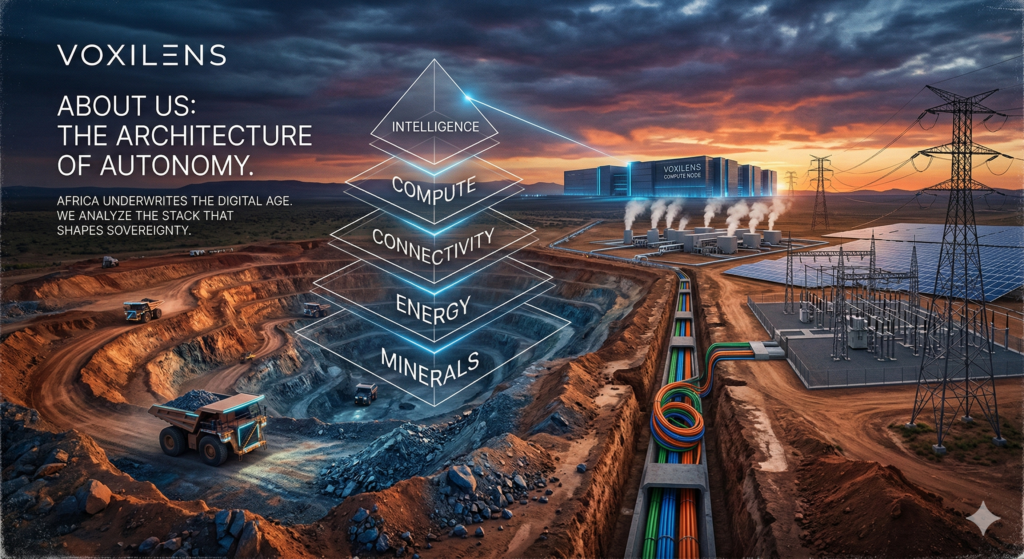
The Architecture of Autonomy
The digital age is physical. It runs on strategic minerals, high-voltage power systems, subsea fiber networks, and the cooling infrastructure of Tier IV data centers. Before intelligence scales, infrastructure must stabilize.
Voxilens exists to study that foundation.
The Core Lens: Mapping the Geopolitical Stack
Technology is not a single industry; it is a vertical stack of dependencies. We analyze Africa and the world’s position across every layer:
- Resources: Lithium, Cobalt, Gold, Uranium, Copper, Diamonds, and Rare Earths.
- Energy: Grid resilience and the power required for compute.
- Connectivity: Terrestrial fiber and subsea cable architecture.
- Compute: The geography of data centers and cloud sovereignty.
- Policy: Non-aligned digital standards and technology financing.
What happens in Kolwezi’s cobalt mines connects directly to what happens in Nvidia’s supply chain. What happens to Africa’s subsea cables connects directly to who owns the AI systems trained on African data.
The gap between participation and structural influence is the central theme of our work.
What We Are (And What We Are Not)
Voxilens is designed for clarity, not noise.
- We are not a startup news site or a repository for venture capital press releases.
- We are a platform for long-form structural analysis.
We focus on the intersection of defense-adjacent technologies, geopolitics, and public budgets. We look at how the shift toward a multipolar global order is forcing Africa and other continents like Asia to make infrastructure choices that will define its strategic autonomy for decades.
From the Founder
Voxilens was built from a simple observation: Africa and the rest of the world is not peripheral to the digital economy; it underwrites it.
From the battery metals powering the global EV transition to the fiber cables anchoring regional connectivity, the continent sits at the base of the global technology system. Understanding this position requires depth, context, and systems thinking.
We don’t predict the future; we analyze the systems that will create it. The future of technology will not be decided by code alone—it will be decided by power, minerals, compute, and policy.
The stack is global. The intelligence it produces is contested. The conversation begins here.
The conversation begins here.
Our Audience
Voxilens is written for those who think in decades, not quarters:
- Policymakers navigating strategic infrastructure.
- Researchers examining the physical layers of the internet.
- Investors tracking structural shifts over market cycles.
- Technologists interested in the foundations of their craft.
Start Here: A Guide to the Stack
If you are new to Voxilens, the best way to understand our work is to follow the journey of a single electron—from the mine to the cloud. Start with these foundational pillars.
I. The Physical Foundation (Minerals & Energy)
Before code is written, minerals must be extracted. These pieces explore the paradox of being the world’s “battery” while building local leverage.
- [Zimbabwe’s Lithium Paradox]: How the battery-AI convergence is forcing a new conversation on economic agency.
- [Zambia’s Copper Paradox]: Investigating why the country powering the global internet infrastructure still faces its own digital hurdles.
- [Olkaria’s Green Cloud]: How Kenya is leveraging geothermal energy to anchor the next generation of African data centers.
II. The Architecture (Infrastructure & Connectivity)
The digital economy isn’t “in the air”—it is under our feet and beneath the sea. This section analyzes who owns the physical pathways of African data.
- [The Physical Tech Stack]: A primer on the continuum from cobalt to cloud gravity.
- [Who Owns Africa’s Internet?]: An analysis of subsea cable dominance and the quest for terrestrial fiber sovereignty.
- [Ghana’s Digital Crossroads]: A case study on the trade-offs of rapid infrastructure scaling.
III. The Strategic Layer ( AI, Policy & Geopolitics)
In a multipolar world, technology is statecraft. These articles examine how African nations navigate the competition between global powers.
- [ The AI Frontier] Tracking the global scorecard of AI investment and the competition for compute and data.
- [The U.S. vs. China in Africa’s Digital Race]: Beyond the headlines—mapping the physical footprint of competing digital ecosystems.
- [Infrastructure & Sovereignty]: Analyzing how Chinese and Western tech investments are building the digital backbone of the African continent.
- [Strategic Minerals & Non-Aligned Tech Policy]: The definitive Voxilens guide on using resource wealth as diplomatic leverage.
The Big Question
If you only have five minutes, read our core thesis: [Who Owns Africa’s Data in the Age of Global AI?] This piece synthesizes our entire philosophy—from the minerals that build the chips to the policy that protects the data.