
Zambia produces the copper that powers global AI and fiber networks, but its own digital growth is stalled by an “energy trap.” Discover how the 2026 Lobito Corridor and solar-bypass strategies are finally breaking the cycle.
In a co-working space in Lusaka, a software developer watches her screen freeze. The cloud she relies on—somewhere between Cape Town and Dublin—has not failed. Zambia’s electricity has. The lights dim, the ceiling fan slows and, within seconds, the room falls silent. Load shedding.
Five hundred kilometres north, in the Copperbelt, the excavators do not pause. Floodlit pits carve through ore that will travel thousands of miles to power data centres, electric vehicles and artificial-intelligence clusters. The metal leaving Zambia will help keep the world connected and decarbonised. Yet at home, even keeping a modem online can be uncertain.
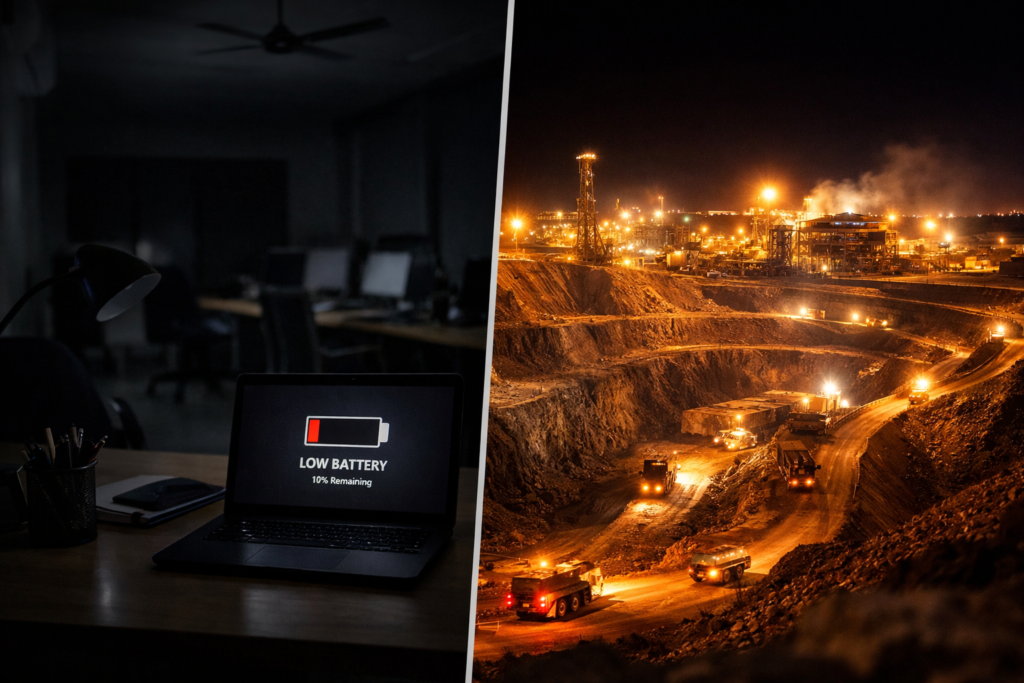
Split image showing a dark office space with a laptop on low battery in Lusaka (left) contrasted with brightly lit copper mining operations at night in the Copperbelt (right)
This is Zambia’s copper paradox. The country is a significant supplier of a mineral essential to modern digital infrastructure, yet it struggles to sustain reliable digital infrastructure of its own. The contradiction is not technological. Nor is it simply the familiar “resource curse”. It lies in something more prosaic: electricity, capital allocation and policy incentives.
Copper does not carry internet traffic; fibre optics do.
But copper carries the power that keeps fibre networks alive, that energises data centres and that feeds the servers training artificial-intelligence models. Extracting that copper is itself energy-intensive. In Zambia, where power supply is finite and heavily skewed toward hydropower, mining and digital development draw from the same limited pool.
The result is a quiet competition. Each additional megawatt directed to extraction is a megawatt unavailable for domestic computation. In a world racing toward electrification and AI expansion, Zambia finds that the metal underpinning the digital age can also constrain its participation in it.
Understanding this tension requires looking beyond commodity prices and into the wires and grids where geology meets bandwidth.
Copper’s Real Role in Digital Infrastructure: Less Central Than You Think
To understand Zambia’s position, we need to be precise about where copper actually matters in modern internet infrastructure.
Fiber optic networks—the backbone of the internet—use copper, but not primarily for data transmission. Here’s the breakdown:
Where Copper Is Essential
- Power delivery systems: Undersea fiber cables require electrical power for signal repeaters (optical amplifiers) every 50-100 km. These use copper conductors running alongside the fiber to deliver DC power from shore stations. On a 20,000 km transoceanic cable, this represents thousands of kilometers of copper.
- Data center infrastructure: A single hyperscale data center can contain 50-100 kilometers of copper cabling for:
- Power distribution units (PDUs)
- Uninterruptible power supplies (UPS)
- Generator backup systems
- Grounding and lightning protection
- Short-range interconnects between racks
- Mobile base stations: 4G and 5G towers require copper for power feeds, grounding, and some legacy backhaul connections.
- Last-mile connections: In many markets, copper still carries broadband to homes (DSL, cable internet), though this is declining rapidly.
The AI Amplification: The recent boom in artificial intelligence has intensified copper demand dramatically. A single AI training cluster (like those running GPT-4 or Claude) requires 30-50 MW of continuous power delivery—all copper-intensive infrastructure.
OpenAI’s reported plans for data centers drawing 1+ gigawatts would require more copper for power distribution than entire cities. However, AI companies don’t source copper directly; they contract with server manufacturers (NVIDIA, Dell, HPE) and infrastructure providers who purchase components from global suppliers (Schneider Electric, Eaton, Vertiv) sourcing copper on commodity markets.
Zambian ore, once refined in China or India, enters these supply chains indistinguishably from Chilean or Peruvian copper—capturing only the extraction margin.
Where Copper Is Obsolete
- Long-distance data transmission: Fiber has completely replaced copper for backbone networks. A single fiber strand can carry 100+ Tbps; copper maxes out around 10 Gbps over short distances.
- Data center interconnects: Modern hyperscale facilities use almost exclusively fiber between buildings and optical transceivers within server racks.
- New construction: Telecom companies are actively removing copper networks (AT&T announced plans to eliminate all copper by 2029).
The upshot: Copper is critical for powering digital infrastructure, not for carrying data itself. This distinction matters enormously for understanding Zambia’s strategic position.
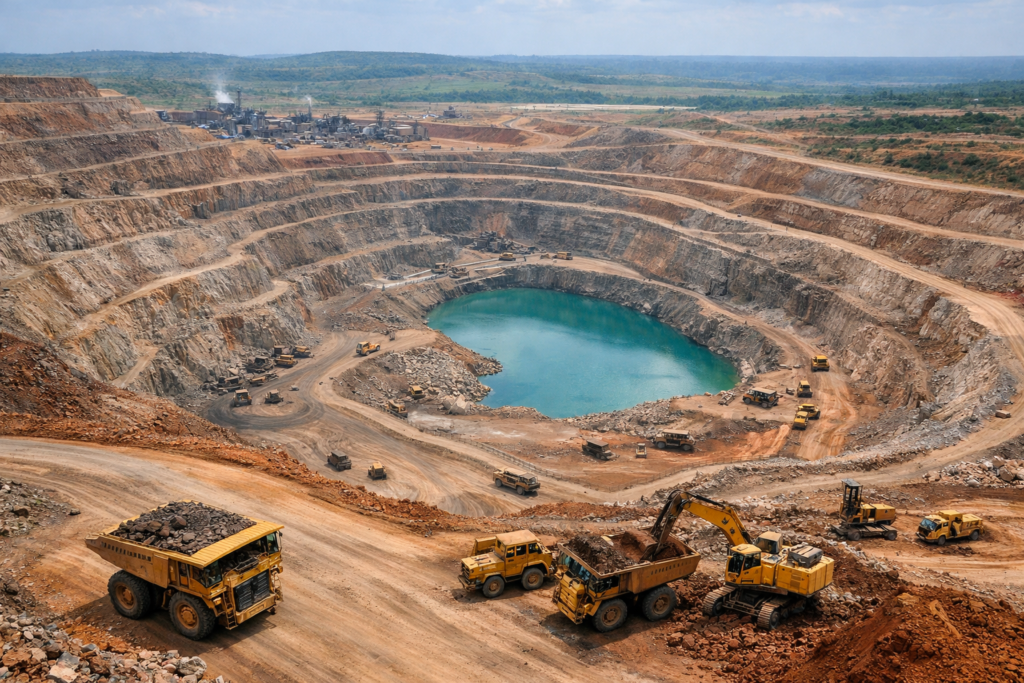
Zambia’s Copper Industry: Scale and Structure
Zambia produced approximately 763,287 metric tons of copper in 2023, making it the world’s seventh-largest producer and Africa’s second-largest after the Democratic Republic of Congo.
The Copperbelt region, straddling Zambia and the DRC, contains about 6% of global copper reserves. Major mines include:
- Kansanshi Mine: ~230,000 tons annually
- Lumwana Mine: ~140,000 tons
- Mopani Copper Mines: ~100,000 tons
Copper accounts for roughly 70% of Zambia’s export earnings and contributes about 12% to GDP. But here’s the critical detail: Zambia exports predominantly copper concentrate and cathodes—raw or minimally processed material.
The value chain looks like this:
- Mining: Ore extraction (happening in Zambia)
- Concentration: Processing to 25-35% copper content (happening in Zambia)
- Smelting: Refining to 99%+ purity (mostly happening in China, India, Europe)
- Manufacturing: Transformation into wire, cables, components (happening globally, not in Zambia)
- Integration: Installation in telecom networks, data centers (happening where digital infrastructure is built)
Zambia captures value at stages 1-2. The rest—where margins are higher and employment is created—happens elsewhere.

Interior of hyperscale data center showing rows of server racks with copper power distribution units and cable management overhead.
Why Zambia Doesn’t Host Data Centers: The Barriers Are Real
The common refrain is that Zambia “should” leverage its copper to host regional data infrastructure. But let’s examine why this hasn’t happened and why it’s harder than it sounds.
Barrier 1: Power Reliability
This is the dealbreaker. Data centers require 99.99%+ uptime. Zambia’s electricity supply has chronic problems:
- Load shedding: Rolling blackouts have been common for years, intensifying during droughts (hydropower generates ~80% of Zambia’s electricity)
- Installed capacity: ~3,000 MW total, with peak demand exceeding 2,300 MW
- Industrial competition: Copper mining itself consumes ~1,000 MW—nearly a third of national generation
The copper connection creates a zero-sum problem: Mining copper requires massive electricity, but the digital infrastructure that could add value to that copper also needs electricity. As long as power is constrained, these uses compete rather than complement.
Barrier 2: Connectivity Costs and Latency (And the Hidden Opportunity)
Zambia is landlocked. Fiber connections to undersea cables require transit through Tanzania (SEACOM, EASSy cables) or South Africa. This traditionally adds:
- Latency: 30-50ms additional round-trip time compared to coastal countries
- Transit costs: Zambia pays for fiber bandwidth through neighboring countries
- Political risk: Dependence on stable relationships with transit partners
For latency-sensitive applications (financial trading, real-time gaming, video calls), this is a significant handicap.
But here’s the flip side: Zambia borders eight countries—more than any other African nation except Tanzania. This landlocked position could become a “land-linked” advantage if Zambia positions itself not as an endpoint but as the Digital Switchboard of Southern Africa.
The Lobito Corridor: A rail and infrastructure project connecting Zambia’s Copperbelt to the Atlantic port of Lobito in Angola represents a potential game-changer. If fiber-optic lines are laid alongside the new tracks (as current plans indicate), Zambia gains:
- Atlantic access: Direct connection to Atlantic undersea cables, reducing reliance on Indian Ocean routes through Tanzania/South Africa
- Bi-coastal redundancy: Traffic can route through either ocean, making Zambia a natural failover hub
- Transit revenue: Instead of paying for passage, Zambia could charge for it
Combined with the February 2026 commissioning of the Zambia-Mozambique strategic fiber interconnection, this creates what some are calling a “Digital Suez Canal” across Southern Africa—traffic routing through Zambia rather than around it.
Barrier 3: Capital, Expertise, and Ecosystem
Building a data center requires:
- $500-800 million in capital for a mid-sized facility
- Specialized cooling systems (Zambia’s climate is relatively cool, which helps, but not enough to offset other factors)
- Fiber network infrastructure
- Skilled technicians (HVAC specialists, network engineers, power systems experts)
- Redundant power sources (generators, UPS systems, often requiring natural gas or diesel)
More importantly, data centers cluster in ecosystems. AWS has 33 availability zones, most concentrated in Northern Virginia, Oregon, Ireland, and Singapore. These locations offer:
- Proximity to major internet exchange points
- Competitive electricity markets
- Deep talent pools
- Legal/regulatory certainty
- Access to multiple submarine cable landings
Zambia has none of these advantages, and fixing one or two doesn’t overcome the compound effect of lacking all of them.
Barrier 4: The Copper Doesn’t Actually Stay Local
Even if Zambia built data centers, they wouldn’t use Zambian copper in any meaningful way. Here’s why:
Data centers buy components (PDUs, UPS systems, cable assemblies) from global manufacturers—Schneider Electric, Eaton, Panduit. These companies source copper on global commodity markets. The copper might originate in Zambia, but it’s been refined in China, manufactured into components in Malaysia, and purchased through global supply chains.
There is no mechanism for “local copper preference” in data center procurement, and creating one would likely increase costs by 15-30%, making the facility uncompetitive.
The Energy Trap: A Zero-Sum Game for the Future
The most invisible part of the paradox is that Zambia’s mineral wealth doesn’t just fail to support its digital growth—it actively competes with it. This isn’t an accident of geography; it’s a structural trap built on three pillars:
1. The Subsidized Extraction vs. The Digital Tax
Zambia’s electricity is a finite bucket. Currently, the mining sector is the first to drink, consuming nearly a third of the nation’s 3,000 MW total output. Because copper is the primary source of foreign exchange, the government grants mines a “preferential” tariff of roughly $0.05-0.06 per kWh.
Meanwhile, a potential data center operator or a local tech startup pays the “commercial” rate—$0.15-0.18 per kWh, often triple the mining cost. In effect, Zambia is taxing its digital future to subsidize its industrial past.
The Political Economy: This isn’t just bad policy—it’s a wealth transfer. The major mines (Kansanshi, Lumwana, Mopani) are owned by multinational corporations: First Quantum Minerals (Canada), Barrick Gold (Canada/UK), and previously Glencore (Switzerland). The subsidized electricity effectively transfers value from Zambian taxpayers (who pay higher rates and suffer blackouts) to foreign shareholders who extract profits in hard currency. When ZESCO (Zambia’s power utility) runs deficits, the government borrows to cover shortfalls—socializing losses while privatizing gains.
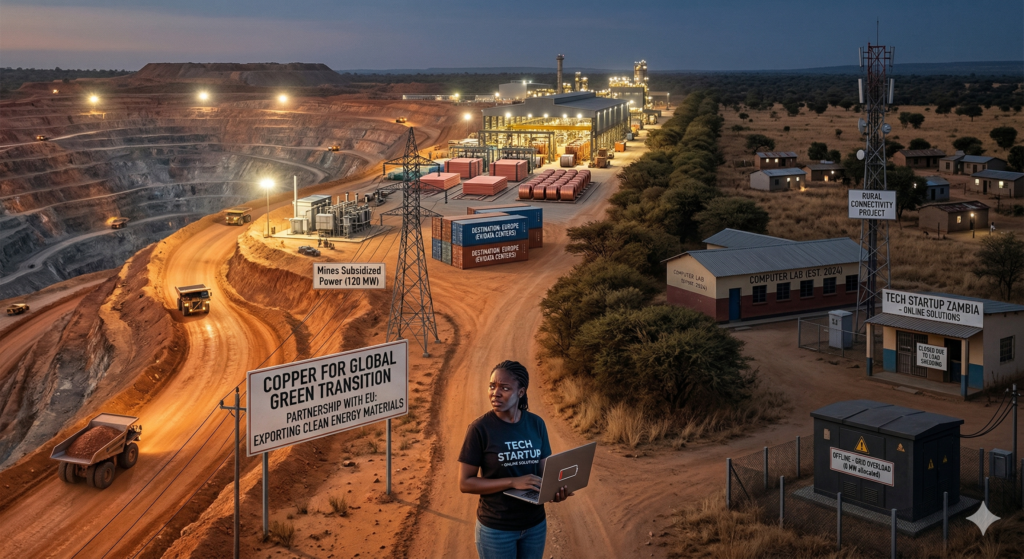
A copper processing mine is brightly lit and active, with trucks carrying ore and signs for ‘Green Transition’ exports. And, a dark Zambian village and a tech startup building sit in shadow with a dead battery icon.
2. The Green Transition Conflict
The global push for Electric Vehicles (EVs), solar installations, and AI-driven data centers has sent copper demand into overdrive. The International Energy Agency projects that clean energy technologies will require 40% more copper by 2030 than current production levels.
As the West demands more copper for its “Green Revolution,” Zambia is pushed to ramp up production. But every new megawatt diverted to a mine to meet global climate goals is a megawatt that cannot power a local server, a school’s computer lab, or a rural cell tower.
The Climate Justice Paradox: Zambia is sacrificing its own digital development—limiting its ability to participate in the knowledge economy, educate its population online, or build climate-resilient infrastructure—to provide the materials for the Global North’s green transition. European data centers get powered by renewable energy using Zambian copper for transmission, while Zambian startups code in the dark during load shedding.
3. The Hydro-Dependency Deadlock
Zambia relies on hydropower for over 80% of its energy, primarily from the Kariba Dam (shared with Zimbabwe) and Kafue Gorge. In a world of climate volatility, this creates a terrifying feedback loop:
- Drought hits: Water levels at Kariba drop (as happened severely in 2019, 2023, and 2024)
- Power is rationed: To keep the economy from collapsing, the government ensures the mines stay on
- The Digital Shadow grows: Small businesses, ISPs, and the few existing local servers are the first to be cut, plunging the digital economy into darkness to keep the copper flowing
To put this in perspective: a mid-sized data center requires 20-50 MW of continuous, ultra-reliable power—that’s 1.5-2.5% of Zambia’s entire grid capacity for a single facility. Hyperscale facilities (Google, AWS, Microsoft) require 100-300 MW each.
The copper connection creates a zero-sum problem: Mining copper requires massive electricity, but the digital infrastructure that could add value to that copper also needs electricity. As long as power is constrained, these uses compete rather than complement each other.
The Structural Reframe: We often hear that “Zambia is rich in copper, so it should be rich in tech.” The reality is the opposite: Because Zambia is focused on copper, it is energy-poor for tech. The metal is a constraint on development, not a catalyst for it.
Digital Dependency Layered on Mineral Dependency
Most of Zambia’s internet traffic doesn’t stay in Zambia. Here’s what actually happens:
- International transit: Zambia routes traffic through IXPs (Internet Exchange Points) in Johannesburg, Nairobi, or directly to European/US hubs
- Content delivery: Netflix, YouTube, Facebook—all served from CDN nodes in South Africa or Kenya, not Zambia
- Cloud services: AWS doesn’t have an Africa region north of Cape Town; Azure has Johannesburg. Zambian businesses using cloud services are routing to South Africa
- Mobile money: Even domestic mobile money transactions often route through systems hosted externally
Zambia has no Tier 1 or Tier 2 data centers. Most facilities are small telecom-owned sites for base station controllers and minimal enterprise hosting.
This creates a dual dependency:
- Revenue dependency on copper exports → fluctuating commodity prices, external demand
- Service dependency on imported digital infrastructure → paying for connectivity and cloud services built elsewhere
And crucially, these dependencies reinforce each other. Copper revenues go toward debt service and operational costs, not long-term digital infrastructure investment.
The Debt Cycle: How Copper Finances the Wrong Infrastructure
Zambia’s debt situation illustrates the problem:
- Total external debt: ~$18.6 billion (as of restructuring negotiations in 2024)
- Debt-to-GDP ratio: ~120%+—higher than Kenya (68%) or Ghana (88%), approaching Sri Lanka’s pre-crisis levels (119% in 2021)
- Major creditors: China (~30% of bilateral debt), Eurobond holders, multilateral institutions
- Critical milestone: Zambia became the first African nation to default during the COVID era (November 2020), entering a three-year restructuring process that concluded only in June 2024
Much of this debt financed infrastructure, but not the kind that builds digital capacity:
- Roads connecting mines to borders (good for copper exports, less relevant for data centers)
- Power plants with offtake agreements to mines (prioritizing industrial users)
- Copper processing facilities (adding marginal value, not changing the fundamental export orientation)
Meanwhile, fiber networks and data infrastructure received minimal state investment and were left to private telecoms (Airtel, MTN, Zamtel), which optimize for consumer mobile services—not industrial-grade data infrastructure.
The cycle works like this:
- Borrow to finance mining-adjacent infrastructure
- Use copper revenues to service debt
- When copper prices fall, fiscal crisis emerges
- Cut public spending, including on digital/educational infrastructure
- Remain dependent on copper exports to recover
- Repeat
Breaking this cycle doesn’t happen by keeping copper domestic. It requires fundamental changes to energy policy, debt structure, and industrial strategy.
What’s Actually Happening: Zambia’s 2026 Pivot
Moving from theory to reality, Zambia is currently standing at a crossroads. By 2026, the strategy has shifted from “waiting for the grid” to actively bypassing it through two major levers: Decentralized Solar and the Lobito Digital Spine.
1. The Solar Bypass: Decentralizing the Power Struggle
Zambia has realized that a single, centralized grid can no longer serve both the power-hungry mines and the digital economy. The “Bypass Strategy” involves decoupling tech infrastructure from the national grid.
The 1GW Solar Surge: In early 2026, Zambia signed landmark agreements to develop 1,000 MW of solar capacity. Crucially, pilot projects (like the 100 MW farm in Itezhi-Tezhi) are designed to be rapid-deployment, with 8-10 month completion windows—dramatically faster than traditional hydropower or coal projects.
Constituency-Level Resiliency: The Presidential Constituency Energy Initiative is installing 2 MW solar plants in all 156 constituencies. While small individually, collectively this represents 312 MW of distributed generation that doesn’t compete with mining for centralized grid capacity.
The Digital Payoff: This allows local tech hubs, schools, and clinics to remain online during national load shedding. For the first time, digital access is being untethered from the “Copperbelt-first” power priority. A startup in Livingstone can operate independently of whether Kansanshi Mine is running at capacity.
Estimated cost: $2-3 billion over 5-7 years Realistic impact: Enables 100-200 MW of reliable data center load plus improves commercial/residential reliability
2. The Lobito Digital Spine: From Landlocked to “Land-Linked”
The Lobito Corridor is often discussed as a rail project for copper export, but its transformative potential lies in the fiber-optic backbone being laid alongside the tracks.
The Atlantic Shortcut: By connecting Zambia’s Copperbelt directly to the Atlantic port of Lobito in Angola, the corridor reduces data latency for European and North American traffic significantly. Instead of routing through South Africa or Kenya to reach these markets, Zambian data can “plug in” directly to Atlantic undersea cables.
Cross-Border Fiber Interconnects: The February 2026 commissioning of the Zambia-Mozambique strategic fiber interconnection, combined with Lobito routes, creates “bi-coastal” digital redundancy. If a cable snaps in the Indian Ocean (as happened with the EASSy cable in 2020), traffic can reroute through Zambia to the Atlantic.
Strategic Result
Zambia is positioning to become what some analysts call a potential “Digital Suez Canal” across Southern Africa—a critical transit corridor that could handle regional redundancy and failover traffic. Major ISPs and content delivery networks (Liquid Intelligent Technologies, Vodacom, MTN) are already evaluating peering arrangements to route through Zambia as backup capacity. Whether this potential materializes depends on execution of the infrastructure and competitive pricing against established South African routes.
Estimated cost: $300-500 million for full fiber deployment Payoff: Reduces regional latency by 10-20ms, creates recurring transit revenue, positions Zambia as a Tier 1 IXP hub
3. Policy Evolution: Removing the Barriers
To make these physical links work, Zambia has introduced “Soft Connectivity” reforms in 2026:
Zero Duty on Tech: The government removed all import duties on digital infrastructure equipment. This lowers capital barriers for ISPs and private data center operators who previously found it prohibitively expensive to import specialized cooling systems and server racks.
Open Access Regulations: New “Open Access” rules for fiber mean that a single company cannot monopolize the backbone. Multiple ISPs can now lease “lit fiber” along the Lobito and TAZARA routes, fostering competition and lowering costs for end users in Lusaka.
Independent Power Producer (IPP) Framework: Tech companies can now contract directly with solar farms for power, bypassing ZESCO’s grid entirely. This is critical—it means a data center can secure 99.99% uptime through dedicated renewable sources without competing with mines for grid capacity.
Reality Check: These projects are progressing, but the “Energy Trap” still exists. The goal isn’t to replace mining but to ensure the digital economy has its own dedicated “lanes” of power and connectivity that mines cannot crowd out.
The Human Infrastructure: Building the Skills to Run It
Building physical corridors is only half the battle. To prevent this infrastructure from becoming another “extractive” project—where foreign experts build it and foreign companies own the data—Zambia is shifting focus to the human capital required to operate and maintain it.
As of 2026, the Zambian government and private sector have pivoted toward a Competency-Based Education and Training (CBET) model, moving away from purely academic degrees toward high-intensity technical certifications.
Priority Skills for 2026
To break the “Copper Paradox,” Zambia is prioritizing four critical skill “stacks” that allow the country to maintain and own its digital pathways:
1. The Fiber & Connectivity Stack
With the Lobito Corridor and Zambia-Mozambique link coming online, demand has shifted from general IT to specialized telecommunications engineering.
- Target skills: Splicing and maintenance of long-haul terrestrial fiber, GPON (Gigabit Passive Optical Network) design for “last-mile” city connectivity, submarine cable landing station operations
- The goal: Moving from being a consumer of bandwidth to a Regional Transit Authority that manages data flows for the entire SADC region
- Real example: Liquid Intelligent Technologies now requires fiber splicers who can work on the Lobito route. In 2021, they imported technicians from South Africa. By 2026, they’re hiring Zambians trained at the Copperbelt University ICT Center.
2. Renewable Energy & Microgrid Management
Because the “Solar Bypass” strategy relies on decentralized power, Zambia needs a new class of “Energy-Digital” engineers.
- Target skills: Hybrid power system integration (solar + battery + grid), SCADA (Supervisory Control and Data Acquisition) systems for remote monitoring of solar farms, energy-efficient data center HVAC management
- The local advantage: Training MSMEs (Micro, Small, and Medium Enterprises) in Eastern Province to maintain rural mini-grids ensures digital access isn’t just a “Lusaka luxury”
- Career pathway: A technician trained to maintain a 2 MW constituency solar plant can transition to managing cooling systems for a 20 MW data center—skills are transferable
3. Cybersecurity & “Digital Sovereignty”
As Zambia becomes a regional data hub, it also becomes a target. In 2025/2026, the SMART Zambia Institute launched a massive “train-the-trainer” program focusing on protecting national digital assets.
- Target skills: Threat intelligence, incident response for critical infrastructure (power grids and fiber backbones), FinTech security to protect the country’s booming mobile money ecosystem
- Strategic outcome: Ensuring the “Digital Suez Canal” through Zambia is secure enough for international banks and cloud providers to trust their traffic routing through it
4. The TEVET Revolution: 100,000 Strong
The scale of this shift is visible in enrollment numbers. Technical Education, Vocational, and Entrepreneurship Training (TEVET) institutions have surged from 38,000 students in 2021 to nearly 100,000 in 2026.
The Reframe: In the old model, a Zambian student studied mining engineering to work for a copper company owned in Toronto or London. In the 2026 model, that same student might study Network Systems & Energy Management to work for a regional ISP, a solar-powered data center, or start their own fiber installation company.
The constraint was never copper—it was always expertise. Even with perfect power and connectivity, Zambia can’t operate advanced infrastructure without trained people. The difference is that digital skills are accumulating and transferable, while mineral extraction skills become obsolete when the ore runs out.
Addressing the Skeptic: Why This Isn’t Just Commodity Nationalism
A reasonable objection to all this: “Every country thinks they should add value to raw materials. Why is copper different from wheat or iron ore? Should Zambia also mill all its grain and smelt all its metal domestically?”
Fair question. Here’s why digital infrastructure is different:
- Network effects are extreme: Internet infrastructure becomes more valuable when it’s interconnected. A data center in isolation is nearly worthless; one connected to global networks is extremely valuable. This means there’s a threshold effect—below a certain level of infrastructure investment, you get nothing; above it, returns accelerate.
- Marginal costs approach zero for digital services: Once infrastructure is built, serving additional users costs almost nothing. This is unlike commodity processing, where each ton of copper refined requires proportional energy and inputs.
- Strategic sovereignty matters differently: Food security justifies domestic grain milling even if it’s less efficient. Digital sovereignty (control over data flows, platform access, infrastructure resilience) has similar strategic value but requires technical capacity, not just ownership.
- The skills are transferable and accumulating: Training someone to operate a copper smelter creates skills useful only in smelting. Training someone in network engineering, cloud architecture, or data center operations creates skills valuable across the entire digital economy.
The goal isn’t to capture copper value—it’s to use copper revenues to build capabilities that outlast commodity cycles.
Case Study: What Actually Happens When You Try This
Let’s look at a real example: Konkola Copper Mines (KCM) attempted to integrate downstream by building a copper smelter in the early 2000s.
What happened:
- Smelter required 120 MW of dedicated power
- Operational costs exceeded projections by 40%
- Global copper prices fell in 2008-2009
- Smelter became a financial drain
- KCM entered financial distress, eventually nationalized, then sold
Why it failed:
- Energy costs in Zambia couldn’t compete with Chinese smelters powered by coal
- Capital markets priced in political risk, raising financing costs
- No domestic demand for refined copper—still had to export
- Added operational complexity without changing competitive position
The lesson: Vertical integration in commodity processing is harder than it looks and often destroys value rather than capturing it.
Now imagine trying something even more complex and capital-intensive like a data center, with even more dependencies on reliable power, connectivity, and expertise.
The Larger Reframe: From “Copper Pays for the Internet” to “Copper Competes with the Internet”
The original framing—”Zambia supplies copper that powers the internet but doesn’t control digital pathways”—was emotionally resonant but analytically weak. Here’s the reframe:
Zambia’s copper wealth and digital development are in tension, not alignment.
The reason is simple: both require electricity, capital, and policy attention. In a resource-constrained environment, copper mining wins this competition because:
- It generates immediate foreign exchange
- It employs tens of thousands directly
- It creates powerful political constituencies
- It’s proven and understood technology
Digital infrastructure, by contrast:
- Requires upfront investment with delayed returns
- Creates fewer direct jobs initially
- Benefits are diffuse and long-term
- Requires expertise the government may lack
This is why “copper countries” struggle digitally—not despite their mineral wealth, but because of how that wealth shapes economic structure and policy priorities.
Turning the Paradox into a Platform
Zambia’s journey from 2023 to 2026 demonstrates that the “Copper Paradox” isn’t a permanent sentence. By recognizing that copper mining and digital development compete for the same scarce resources—electricity, capital, and policy attention—the country has begun building a “parallel track” for its digital future.
The critical realizations:
- Copper is a competitor, not an enabler: Mining crowds out the power and resources needed for digital infrastructure
- The landlocked disadvantage can become a land-linked advantage: Eight borders mean eight opportunities for transit revenue
- Infrastructure without expertise is just another extraction: Foreign-built, foreign-operated systems don’t build local capacity
- Solar bypass breaks the zero-sum game: Decentralized renewable power lets digital and mining coexist
The red metal still powers the world’s internet. The question is not whether Zambia will continue powering the world’s data—copper prices and global demand ensure it will. The question is whether it will ever power its own.
Related article: Africa’s AI Minerals and a Non-Aligned Tech Policy
