For decades, the scramble for Africa was defined by physical borders and mineral rights. Today, a new map is being drawn—not in ink, but in fiber-optic glass and silicon. While the continent is home to the world’s youngest, fastest-growing digital population, the question of who owns the ‘pipes’ and ‘vessels’ of this revolution remains fraught. With 70% of 4G networks built by Chinese giants and 50,000 kilometers of new subsea cables owned by American hyperscalers, Africa’s digital future is being underwritten by foreign capital. For policy makers, the challenge is no longer just ‘connectivity’; it is whether Africa can achieve digital sovereignty in a landscape owned by everyone but itself.
Executive Summary
Africa’s internet infrastructure is fragmented across global technology firms, multinational telecoms, African operators, and governments, with no single entity in control. While this fragmentation has driven rapid connectivity expansion, it has also created uneven leverage over pricing, data sovereignty, and economic value capture. Submarine cables remain predominantly foreign-owned, but terrestrial networks show growing African control. The September 2025 launch of the Continental Internet Exchange marks progress toward digital sovereignty, yet fundamental questions about ownership, governance, and equity remain unresolved. The next phase of Africa’s digital development is not about expanding connectivity. It’s about governing who controls it.
Africa’s internet feels weightless. It appears in signal bars, mobile apps, and cloud platforms, giving the illusion of something abstract and borderless. In reality, it is built on heavy, physical infrastructure: submarine cables laid across ocean floors, fiber stitched across borders, mobile towers rising from cities and rural plains, and data centers humming quietly behind secured gates.
The question of who owns Africa’s internet is not philosophical. It is structural. Ownership determines price, access, resilience, and sovereignty. And in Africa, that ownership is fragmented across multiple layers, actors, and interests.
This article explains how Africa’s internet is built, who controls its critical components, and why that control matters far beyond connectivity.
The Physical Reality of the Internet
The internet does not float in the air. It moves through infrastructure.
Most African internet traffic enters and exits the continent through submarine fiber-optic cables. From coastal landing stations, traffic travels inland via national and regional fiber backbones, then reaches users through mobile networks and last-mile infrastructure. Increasingly, that traffic terminates in data centers, where content is stored, processed, and routed.
Strategic Choke Points
This layered system has several critical control points:
- International connectivity through submarine cables
- National backbone networks and fiber infrastructure
- Mobile access, spectrum allocation, and tower networks
- Data centers and exchange points
Ownership at each layer shapes how open, affordable, and controllable the system becomes.
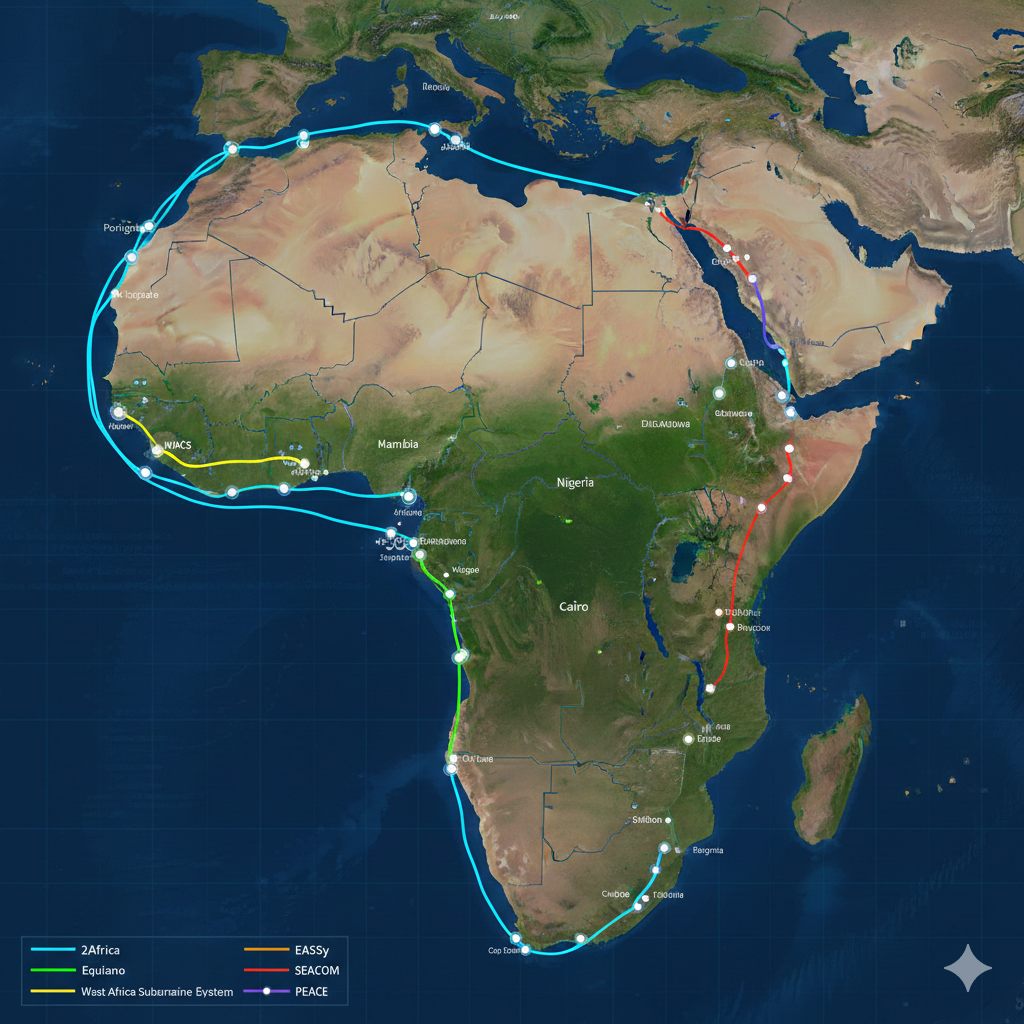
Major submarine cable systems
Submarine Cables: The Global Gateways
The Dominance of Undersea Infrastructure
More than 99% of Africa’s international internet traffic flows through undersea cables, though this dominance may gradually shift as satellite internet (Starlink and others) expands across the continent. As of late 2025, numerous active systems connect the continent, including major new additions like 2Africa. This marks dramatic expansion from the bandwidth-scarce early 2000s.
Yet ownership at this layer remains heavily international.
Who Controls the Cables
Global technology firms have become dominant investors. Google’s Equiano cable is fully owned by the company, running from Portugal to South Africa with multiple West African landings. Meta leads the 2Africa consortium, one of the world’s longest cables, alongside partners including MTN, Orange, Vodafone, and Telecom Egypt.
Older consortium-owned systems such as WACS, EASSy, and SEACOM persist, with some (notably EASSy) featuring substantial African ownership and development financing. Chinese firms have also contributed to cables like PEACE. China’s broader role in African digital infrastructure, from Huawei’s mobile networks to Digital Silk Road financing, represents a significant ownership dimension with geopolitical implications.
The Cost of Concentrated Control
When the West Africa Cable System (WACS) suffered a major outage in 2024, internet speeds dropped by up to 40% across multiple countries, and businesses reported losses running into millions of dollars daily. The incident exposed how concentrated control over submarine cable infrastructure translates directly into economic vulnerability. This is especially acute for landlocked countries like Zambia and Zimbabwe, which depend entirely on coastal neighbors’ cable landings and transit agreements.
This capacity surge has lowered wholesale international bandwidth costs by approximately 60-70% over the past decade. But control over primary gateways remains concentrated, with routing, pricing, and access decisions often shaped outside the continent.
Africa has gained bandwidth faster than leverage.
Terrestrial Fiber and Mobile Networks: Growing African Control
Once traffic enters the continent, ownership patterns shift toward greater African leadership.
African Infrastructure Companies Lead on Land
Pan-African operators like Cassava Technologies and its subsidiary Liquid Intelligent Technologies operate over 110,000 kilometers of fiber across more than 20 countries. This represents one of the largest independent networks on the continent and marks a significant shift: African firms now control substantial portions of the backbone that moves data across borders.
Mobile Operators as Digital Gatekeepers
Major telecoms including MTN, Airtel Africa, Orange, and Vodacom control extensive mobile and fiber infrastructure, often alongside national incumbents like Ethio Telecom, Telkom South Africa, and Maroc Telecom. Governments sometimes retain backbone ownership but lease capacity to private operators; elsewhere, private investment dominates entirely.
Mobile towers are increasingly managed by independent tower companies like IHS Towers, Helios Towers, and American Tower. While these often carry foreign capital, they operate locally and have begun to shift the economics of network expansion. This allows operators to focus on services rather than infrastructure maintenance.
For most Africans, internet access is mobile-first: over 80% access the internet exclusively through smartphones. Mobile operators thus serve as digital gatekeepers, influencing spectrum use, pricing, geographic expansion, and how user data is handled.
The Spectrum Sovereignty Paradox
Governments retain control over spectrum licensing, one of the few layers where African states maintain full regulatory authority. Yet this power often creates tension: spectrum auctions generate significant revenue for cash-strapped governments, but high licensing costs are inevitably passed to consumers through higher data prices.
Nigeria’s 2021 5G spectrum auction raised $547 million; operators immediately signaled that premium 5G services would cost significantly more than 4G to recoup investments.
Why Data Remains Expensive
Despite massive infrastructure investments and expanded capacity, internet access remains costly for many users. This is not solely due to low incomes, but due to structural factors embedded in how the system is financed and operated.
Pricing accumulates from multiple layers:
- International bandwidth purchases from cable consortia
- National backbone access fees
- Spectrum licensing costs and regulatory fees
- Taxes on devices, SIM cards, and data services
- Debt servicing on infrastructure financing
The Long-Term Burden of Infrastructure Debt
When governments or operators borrow billions to build fiber networks or purchase spectrum, those repayments extend over decades and are passed directly to consumers. Internet access becomes a long-term fiscal commitment as much as a utility.
A Tale of Two Markets
In Rwanda, where government policy prioritized open-access fiber infrastructure and competitive wholesale pricing, average mobile data costs dropped to among the lowest in East Africa, around $0.75 per GB in 2024. In contrast, countries where incumbent operators control both backbone and retail markets often see prices 3-5 times higher for comparable service, even when underlying infrastructure costs are similar.
The Hidden Layer: Data Centers and Traffic Control
The Strategic Importance of Data Centers
Internet traffic increasingly terminates in data centers for storage, processing, and routing. This makes these facilities as strategically important as cables.
Africa’s data center sector is expanding rapidly, with industry reports indicating growth towards several hundred facilities across dozens of countries by 2025. Investment has surged from South African hubs (Teraco, Africa Data Centres) to new facilities in Kenya, Nigeria, Egypt, and Morocco.
Yet major cloud platforms hosting critical services (AWS, Microsoft Azure, Google Cloud) remain dominated by foreign hyperscalers, even when they build African data centers.
The Sovereignty Challenge
Even locally sited facilities often feature external ownership and governance structures. This raises pressing policy challenges:
- Data protection: Where is citizen data actually stored and processed?
- Cybersecurity: Who has physical and digital access to critical infrastructure?
- Financial oversight: Can regulators audit transactions processed on foreign-controlled systems?
- National security: What happens to election data, health records, or government systems hosted externally?
Digital sovereignty depends as much on processing location and control as on cable landings.
The Continental Internet Exchange: Keeping African Traffic in Africa
A transformative development is the growth of internet exchange points (IXPs), which enable local and regional traffic to stay within Africa rather than routing inefficiently through Europe or North America.
The CIX Launch: A Continental Milestone
Building on the African Union’s long-standing African Internet Exchange System (AXIS) project, the Continental Internet Exchange (CIX) officially launched on September 1, 2025. This landmark initiative establishes a continent-spanning network of interconnected IXPs and data centers with initial hubs in Nairobi, Lagos, and Cape Town.
The CIX’s goals are clear and consequential:
- Reduce latency: Keep intra-African traffic on the continent, improving speeds for regional services
- Cut costs: Eliminate expensive international transit fees for traffic between African countries
- Enhance data control: Strengthen digital sovereignty and security by minimizing foreign routing dependencies
What This Means in Practice
Before the CIX, an email sent from Lagos to Nairobi might route through London or Frankfurt, adding latency, cost, and exposure to foreign jurisdiction. With interconnected continental peering, that traffic can now stay entirely within Africa.
This represents genuine progress toward efficiency and sovereignty. However, global links remain essential for worldwide internet access, cloud services, international commerce, and content delivery. The CIX strengthens Africa’s position but does not eliminate the need for balanced external connectivity.
So, Who Owns Africa’s Internet?
No single entity controls it.
Africa’s internet is a layered system owned and operated by:
- Global technology firms and cable consortia (Google, Meta, telecom groups)
- Multinational telecom operators (MTN, Orange, Vodacom, Airtel)
- African infrastructure companies (Liquid, IHS Towers, Helios Towers)
- Governments with partial, shared, or indirect control
- Private investors and development financiers (pension funds, development banks, private equity)
The Ownership Breakdown
Estimates suggest that foreign entities control roughly 60-70% of submarine cable capacity landing in Africa, though African operators have increased ownership stakes in recent systems. On terrestrial fiber and mobile infrastructure, African companies and governments likely control 50-60% of assets, with significant regional variation. Data centers show more balanced ownership, but hyperscaler cloud dominance means control over critical processing remains concentrated externally.
This fragmentation has driven rapid connectivity growth and substantial capital inflow. But it yields uneven control over value capture, governance standards, and accountability mechanisms.
Connectivity has advanced faster than sovereignty.
What Africa’s Internet Ownership Means
For Users
Ownership directly influences pricing, reliability, and equity. Fragmented infrastructure delivers uneven gains. Coastal and urban areas advance faster than rural or landlocked regions. Lagos and Nairobi enjoy fiber speeds comparable to European cities; rural areas in Chad or Niger struggle with expensive, unreliable connectivity.
Consumers often bear long-term infrastructure financing costs through higher retail prices, even as wholesale capacity costs decline. The benefits of expanded infrastructure have not translated proportionally into affordable access.
For Startups and the Private Sector
Control over fiber, data centers, and cloud infrastructure shapes hosting costs, latency, and scalability for African digital businesses. Limited local control increases reliance on foreign platforms, raising costs and reducing competitiveness.
An African fintech startup hosting on AWS in Cape Town faces higher latency serving customers in West Africa than a European competitor using the same platform. A Nigerian e-commerce company pays international rates for cloud storage that could theoretically be provided locally. These structural disadvantages compound despite overall connectivity growth.
For Governments and Regulators
Infrastructure is a strategic asset, as fundamental to sovereignty as ports, roads, or power grids. Fragmented ownership constrains government leverage over data protection enforcement, cybersecurity standards, pricing regulation, and infrastructure resilience during crises.
Financing choices made today (whether concessional loans, commercial debt, or equity partnerships) will shape fiscal space, policy autonomy, and sovereignty for decades. A fiber network financed through high-interest commercial loans may deliver connectivity quickly but burden public budgets long-term, limiting resources for education, health, or future digital investments.
Policy Recommendations
1. Prioritize Local and Regional Ownership Incentives
Governments should structure cable landing licenses, data center permits, and cloud procurement to favor joint ventures with substantial African equity stakes. Tax incentives, development finance, and public anchor tenancy can shift ownership patterns without excluding necessary foreign capital and expertise.
Example: Rwanda’s open-access fiber model and preferential treatment for operators committing to local partnerships has attracted investment while retaining policy control.
2. Harmonize Continental Frameworks
The African Union and Regional Economic Communities should accelerate work on harmonized approaches to data localization, open-access infrastructure mandates, and cross-border peering standards. The CIX launch demonstrates what coordinated action can achieve; similar coordination is needed on regulatory frameworks.
3. Align Infrastructure Financing with Sovereignty Goals
Favor concessional financing from development institutions over expensive commercial debt, especially when tied to requirements for local equity participation, skills transfer, and open-access provisions. Long-term fiscal sustainability must be weighed against short-term connectivity gains.
4. Invest in Technical Capacity and Regulatory Sophistication
Digital sovereignty requires more than infrastructure ownership. It demands skilled regulators, cybersecurity professionals, and technical experts capable of governing complex systems. Public investment in these capabilities is as important as investment in fiber and spectrum.
Example: Kenya’s Communications Authority has developed sophisticated spectrum management and data protection oversight capacity, enabling more effective governance even amid fragmented infrastructure ownership.
5. Leverage Spectrum Control Strategically
Since spectrum licensing remains firmly under government control, use this leverage to extract commitments on rural coverage, affordable pricing tiers, and local content partnerships rather than maximizing short-term auction revenue.
Conclusion
The story of Africa’s internet is no longer primarily about cables and coverage. The question has shifted from “Can Africa get connected?” to “Who will control Africa’s connection?”
Infrastructure that feels weightless (that appears as signal bars and app icons) rests on heavy, physical systems: cables, towers, and data centers worth tens of billions of dollars. Those systems are owned, financed, and governed by actors with different interests, time horizons, and accountability structures.
Fragmented ownership has delivered rapid progress. Africa is more connected in 2025 than seemed imaginable two decades ago. But that progress has come with trade-offs: external dependencies, uneven leverage, fiscal burdens, and sovereignty constraints that will shape the continent’s digital future for generations.
The challenge now is not building more infrastructure. It is ensuring that the infrastructure being built (and the data flowing through it) serves African interests, remains under sufficient African control, and delivers value that stays on the continent.
The question is not whether Africa will be connected, but whether Africa will control its connection.
Related: analysis of China’s Digital Silk Road and its implications for African digital infrastructure.