
The U.S.-led Pax Silica initiative is building a trusted technology alliance. It spans critical minerals, semiconductor manufacturing, and AI infrastructure. Yet Africa — the continent supplying the cobalt, tantalum, platinum, and copper at the very base of that stack — was left out entirely. This analysis examines what that omission means, why it happened, and what it will cost if left uncorrected.
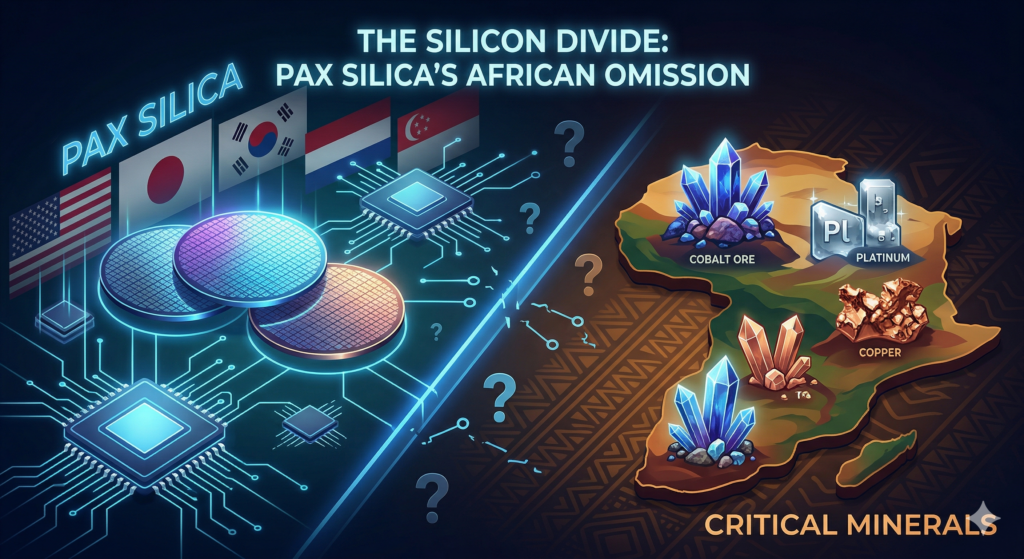
An infographic showing a glowing blue semiconductor circuit on the left and a map of Africa filled with raw mineral crystals like Cobalt and Copper on the right, separated by a digital barrier.
On December 12, 2025, the U.S. Department of State convened a summit in Washington, D.C. There, Under Secretary for Economic Affairs Jacob Helberg presided over the signing of the Pax Silica Declaration. Members committed to a secure, resilient supply chain spanning critical minerals, semiconductor manufacturing, AI infrastructure, and logistics.
The name is deliberate. Pax is Latin for peace — the same root behind Pax Romana and Pax Americana. Silica refers to silicon dioxide, refined into the silicon at the heart of every modern chip. The coalition’s aims were ambitious: share IP protections, coordinate export controls, co-invest in fabrication, and build joint trusted-supplier lists. In policy circles, the phrase Silicon Shield circulated widely — a defensive perimeter of technology sovereignty.
“If the 20th century ran on oil and steel, the 21st century runs on compute and the minerals that feed it.” — Under Secretary Jacob Helberg
Since then, the coalition has grown fast. Seven nations signed at launch. Qatar and the UAE joined in January 2026. India signed on February 20, bringing explicit credit for mineral processing capacity. Sweden joined on March 17, becoming the first EU member state to sign. As of writing, the bloc has eleven signatories — with more expected.
Even so, one absence stands out. Africa — the continent holding the raw materials without which no semiconductor can be built — was not invited at all.
The Seven Founding Signatories and Their Roles
To begin with, the founding coalition was more carefully curated than early headlines suggested. The seven founding signatories were the United States, Japan, South Korea, Singapore, the United Kingdom, Israel, and Australia. The Netherlands and the UAE attended the inaugural summit but did not sign. Taiwan participated as a special guest only.
Each member plays a distinct role. The Netherlands contributes ASML — the sole global supplier of extreme ultraviolet (EUV) lithography machines. Without ASML, no advanced chip can be manufactured. Japan and South Korea add memory manufacturing, advanced packaging, and firms like Samsung, SK Hynix, and Tokyo Electron.
Meanwhile, the UAE and Qatar bring sovereign wealth fund liquidity and data center investment. The UK attracted $23.6 billion in venture capital in 2025 alone. Singapore anchors the Asia-Pacific logistics node. Finally, Australia serves as the coalition’s primary mineral partner, with lithium and nickel reserves under Western-aligned governance.
The Taiwan Problem
No analysis of Pax Silica is complete without addressing Taiwan. Taiwan produces around 60 percent of all chips globally. Close to 90 percent of the most advanced chips come from TSMC alone. Yet Taiwan is not a signatory. It endorsed the declaration’s principles through a separate joint statement, but Washington’s One China policy makes formal membership politically impossible. As a result, the world’s most critical chipmaker sits awkwardly outside the alliance it helped make necessary.
Even so, the coalition retains extraordinary control over the intellectual and manufacturing layers of the technology economy. What it does not control is the physical substrate — the minerals — those factories require. That is precisely where Africa enters the analysis.
The Physical Substrate of the Digital Economy
Technology-policy conversations tend to focus on what is most visible: fabrication plants in Taiwan and Arizona, chip design studios in California, software stacks humming in data centers. This is, essentially, the intellectual layer of the digital economy — and it is what Pax Silica was built to protect.
Beneath it, however, lies a physical substrate. It consists of hundreds of thousands of tonnes of raw materials, extracted, refined, alloyed, and deposited in layers thinner than a human hair. Without that substrate, the intellectual layer simply does not exist. Notably, Africa holds roughly 30 percent of the world’s known mineral reserves — including a disproportionate share of those most critical to semiconductor manufacturing and AI hardware.
Cobalt: The Energy Foundation
No mineral better illustrates Africa’s indispensability than cobalt. The DRC produces between 70 and 75 percent of global cobalt output. Notably, that figure has stayed stable even as demand has surged with the spread of lithium-ion batteries. Cobalt is essential for the nickel-manganese-cobalt (NMC) cathode chemistries that power consumer electronics, edge-AI devices, and the mobile inference hardware that Pax Silica aims to standardize.
Furthermore, no commercially scalable high-energy-density battery has yet achieved full cobalt independence. Engineers are working on alternatives, but the transition timelines run in years, not months. For the medium-term window in which Pax Silica is trying to establish supply chain sovereignty, DRC cobalt is not optional. It is structural.
There is also a compounding geological dimension that policy documents consistently understate. Much of the DRC’s cobalt does not come from primary cobalt mines. Instead, it emerges as a by-product of copper mining in the Katanga and Lualaba provinces. Consequently, any attempt to de-risk cobalt supply without engaging the copper supply achieves nothing. The two materials share the same ore bodies. In short, the geology does not accommodate ideological preferences.
Copper: The Nervous System of Data Centers
AI data centers demand extraordinary volumes of copper — for power distribution, GPU interconnects, cooling systems, and the busbars managing electrical loads in the hundreds of megawatts. For context, a single hyperscale AI training facility can contain tens of thousands of kilometers of copper wiring.
The DRC’s advantage here is not just volumetric. Its copper ore grades in the Copperbelt average approximately 2.5 percent by weight. By comparison, the global average sits at 1.2 to 1.4 percent — roughly half that level.
Higher ore grades translate directly into less energy per tonne, lower processing costs, and a smaller carbon footprint. For a coalition that claims to prioritize green AI infrastructure, excluding the world’s most energy-efficient copper source is a significant credibility problem.
Platinum Group Metals: Catalysis and Clean Energy
South Africa holds approximately 80 to 90 percent of the world’s recoverable platinum group metal (PGM) reserves. These include platinum, palladium, rhodium, ruthenium, iridium, and osmium — all concentrated in the Bushveld Igneous Complex. In other words, one country controls the vast majority of a material category with no adequate substitute.
PGMs serve two distinct roles in Pax Silica’s hardware roadmap. First, they act as catalysts in green hydrogen production. The coalition plans to power AI data centers partly through hydrogen fuel cells, which use platinum in proton exchange membrane (PEM) processes.
No commercially scalable alternative catalyst exists today. Second, ruthenium and iridium serve in atomic layer deposition (ALD) processes for chip nodes below five nanometers. Both functions are non-negotiable for the coalition’s stated goals.
Tantalum: Inside Every Electronic Device
The DRC and Rwanda rank among the world’s largest sources of tantalum, extracted from coltan ore. Specifically, manufacturers use tantalum in high-performance capacitors found in virtually every electronic device. These capacitors provide the stable power delivery that advanced semiconductors require.
Together, the DRC and Rwanda supply approximately 60 percent of global tantalum output. Without trusted access to this supply, the coalition’s Silicon Shield remains physically incomplete.
Manganese, Chromium, and Industrial Infrastructure
South Africa’s dominance in manganese and chromium receives less attention — but it matters just as much. South Africa produces over 35 percent of global manganese output. It also holds the world’s largest known manganese reserves in the Kalahari Manganese Field.
Manufacturers use high-purity manganese in the specialized alloys required for fab cleanrooms, ultra-high vacuum systems, and cryogenic cooling. Similarly, chromium goes into the specialty steels used in fab construction and server farm superstructures.
Taken together, this reveals a systematic blind spot in Pax Silica’s risk framework. The coalition focused heavily on materials that go directly into chips. It paid far less attention to the materials that go into the factories that make chips. The physical infrastructure of semiconductor manufacturing is itself a mineral-intensive system — and Africa sits at its foundation.
Pax Silica set out to build a fortress of technology sovereignty. It forgot to secure the quarry.

An African engineer in a high-tech lab setting, working on a holographic display of a mine’s “Digital Twin
Why Africa Was Excluded
To understand Africa’s exclusion from Pax Silica, we must first set aside the fiction that the coalition’s membership criteria are purely technical. They are not. They are political, layered, and in several respects contradictory.
1. The Trusted Partner Standard and Governance Concerns
Pax Silica builds its entire language around the word trusted. The coalition recruits trusted partners, builds trusted technology ecosystems, and protects against coercive dependencies from adversarial states. In practice, that framing creates a vetting system most African nations cannot currently pass.
Governance transparency is a genuine concern — several major African mining jurisdictions have faced corruption risks, contract disputes, and inconsistent rule of law. These are real operational barriers, not merely pretexts.
However, the consistency of that standard deserves scrutiny. The December 2025 coalition included the UAE and Qatar. Both face sustained international criticism over migrant labor practices. If the governance bar applied uniformly, those memberships would require the same scrutiny as DRC inclusion. When standards apply selectively, they lose both their moral authority and their practical utility.
2. Chinese Ownership of African Mining Assets
The more structurally significant barrier is Chinese corporate ownership. Over the past two decades, Chinese state-linked firms have built deep positions across African mining. CMOC Group — the world’s second-largest cobalt producer — operates the Tenke Fungurume mine in the DRC.
Across the continent, Chinese firms hold major stakes in cobalt, copper, nickel, and rare earth operations. Under Pax Silica’s security criteria, supply chains with substantial Chinese ownership are disqualified — regardless of what the host government prefers.
This creates a profound paradox. Africa’s mineral wealth gets excluded not because of Africa’s choices, but because of China’s prior investments. African governments often welcomed those investments because Western alternatives were simply not on offer.
Yet instead of addressing that root cause, Pax Silica chose exclusion. Structured buyout programs, greenfield co-investment, and conditional inclusion with time-bound ownership transitions were not seriously explored before the December 2025 summit.
3. ESG Standards as a Technical Gatekeeping Mechanism
Beyond Chinese ownership, Pax Silica’s framework requires sourced minerals to meet Western ESG benchmarks. These cover environmental impact, labor practices, community consent, and anti-corruption compliance.
Specifically, Australian lithium or Canadian nickel passes this bar with ease. Much of the DRC’s cobalt, however, does not. Artisanal and small-scale mining in the DRC often involves child labor, hazardous conditions, and weak environmental enforcement.
The problems the ESG standard identifies are real. Nevertheless, its selective application creates a structural double standard. Western nations industrialized their mining sectors over generations, well before ESG criteria existed.
African nations must now meet those same criteria without the institutional investment, regulatory capacity, or economic runway to do so — and face exclusion in the meantime. In effect, ESG becomes a laundering mechanism for a geopolitical decision. It gives the exclusion of African minerals a technical-sounding rationale while concealing the absence of any serious coalition investment in helping African jurisdictions reach compliance.
4. The Processing Capacity Gap
Pax Silica’s membership logic rewards frontier industrial capability: chip design, advanced fabrication, photolithography equipment, AI infrastructure, and capital markets. African nations, positioned almost exclusively as raw material extractors, do not meet that threshold.
This, however, is a circular trap. Africa lacks processing infrastructure partly because decades of development economics discouraged it, favouring raw material export over domestic industrialization. By requiring frontier manufacturing capability for membership, Pax Silica reinforces the same extractive hierarchy that created Africa’s current position.
5. Deliberate Non-Alignment in the U.S.-China Tech Competition
Many African nations deliberately refuse to pick sides in the U.S.-China technology competition. Indeed, the African Union and most of its member states have been explicit: they seek partnerships with all major powers, not alignment with one against the other.
Pax Silica, by design, demands that members choose a side. Nations must align with the U.S.-led bloc and decouple from Chinese technology dependencies. For African governments that watched what Cold War-era forced alignment cost their sovereignty, that trade-off is unacceptable.
The Deepest Tension: The Beneficiation Conflict
Beneath the governance and ownership debates lies a more fundamental disagreement: the question of beneficiation. Since 2022, African governments across the mineral-producing tier have demanded the right to process their own minerals domestically, rather than export raw ore for refining abroad.
This is not a new demand. It is the latest chapter of a debate stretching back to the colonial extraction economy. The economics are straightforward. A tonne of raw cobalt ore is worth a fraction of battery-grade cobalt sulfate.
Raw copper concentrate is worth a fraction of refined copper cathode. As a result, African nations that export raw materials and import finished goods participate in a terms-of-trade relationship that systematically transfers value off the continent.
Pax Silica’s current model does not accommodate African beneficiation. The coalition’s preferred architecture routes raw materials to processing hubs in Australia, the Netherlands, South Korea, and Japan. That is economically rational for coalition members — it keeps high-value processing profits within the membership. Yet it directly conflicts with policies that several African governments have already enacted into law.
Zimbabwe moved first, banning the export of unprocessed lithium ore in 2022. Namibia followed with restrictions on unprocessed critical mineral exports. The DRC has repeatedly signalled its intention to require greater local processing. Therefore, any coalition that conditions participation on raw material exports is structurally incompatible with the direction of African resource policy. The window for engagement is closing as those policies solidify.
The Strategic Costs of Getting This Wrong
The BRICS+ Offtake Scenario
The most immediate risk involves offtake agreements. An offtake agreement is a long-term contract in which a producer commits to sell a specified volume of material to a buyer at predetermined conditions. China’s Belt and Road Initiative has spent two decades building exactly this kind of infrastructure across Africa.
Chinese state-owned enterprises now hold offtake agreements across copper, cobalt, manganese, and PGM production. Furthermore, the BRICS+ framework — which now includes several African nations — provides diplomatic scaffolding for deepening these ties.
To illustrate the risk, consider what happens if the DRC signs exclusive offtake agreements with BRICS+ entities for cobalt and copper production through 2035 or 2040. The scenario Pax Silica most fears — dependence on adversarial supply chains — becomes self-fulfilling.
Through its own exclusionary design, the coalition would have created the vulnerability it set out to eliminate. The window for buyouts, co-investments, and alternative offtake arrangements is open now. It may not stay open for long.
Mineral Diplomacy and the Non-Aligned Pivot
A subtler but more durable risk is the emergence of a non-aligned mineral diplomacy bloc. Following the December 2025 summit, several African Union member state foreign ministries signalled their intention to evaluate offers from multiple technology blocs.
African governments are not ideologically committed to China, the United States, or the EU. Instead, they are committed to their own priorities: industrial upgrading, job creation in processing and manufacturing, and maximum value capture from natural endowments.
Even if such a bloc never formally aligns with China, it still undermines Pax Silica’s goals. Minerals sold on the spot market or through non-exclusive arrangements can reach any buyer — including those the coalition considers adversarial. Supply chain trust requires exclusivity or at minimum predictability. Neither is achievable without genuine engagement.
The Carbon Footprint Paradox
A third risk concerns the coalition’s own climate commitments. By excluding African mineral producers and rerouting raw materials through third-country hubs, Pax Silica actively increases the carbon intensity of its supply chain. For example, shipping copper concentrate from the DRC to a smelter in Finland adds significant shipping emissions.
It also increases processing energy requirements, since non-African smelters handle lower-grade imported concentrate. For a coalition that publicly champions green AI infrastructure, this internal contradiction will become increasingly difficult to defend.
Permanent Lock-In at the Bottom of the Value Chain
For Africa itself, the most immediate danger is economic. Under the current structure, African nations extract cobalt and tantalum and sell them at commodity prices. Meanwhile, value accumulates in the refining, fabrication, and design stages that Pax Silica members control.
The AI revolution’s profits flow to the nations at the table — not to those who supplied the raw ingredients. The critical mineral sector is one of Africa’s greatest opportunities to industrialize and capture domestic value. If Pax Silica locks in a two-tier system, that opportunity gets foreclosed.
Pax Silica can shift supply chain dependencies. It cannot eliminate them — not without Africa.
What a Course Correction Could Look Like
Pax Silica is not condemned to strategic failure on the African minerals question. The coalition is less than six months old. The exclusion decisions of December 2025 are policies, not physical facts — and policies can be revised. Course correction does, however, require clarity about what the actual obstacles are and what kinds of agreements could address them.
Structured De-risking, Not Simple Exclusion
The Chinese ownership problem in DRC mining is real — but it is not immovable. A coherent response would involve a dedicated Pax Silica investment facility. Such a facility, analogous to the U.S. Development
Finance Corporation or the EU Global Gateway, would offer buyout financing to African governments and mining companies seeking to diversify away from Chinese ownership. Notably, the DRC’s government has already signalled openness to such arrangements. The Zambian government, which renegotiated several Chinese mining contracts in the early 2020s, provides a working template.
The goal here should not be the elimination of Chinese investment from African mining. That objective is neither achievable nor appropriate for sovereign nations. Rather, the goal should be genuine competition and optionality. DRC and South African producers need credible alternative buyers and partners, so that reliance on Chinese financing does not trap them into captive supply relationships.
Conditional Inclusion with Transition Pathways
A more sophisticated membership architecture would distinguish between full members and partner-track nations. Full members meet all governance, ownership, and transparency criteria. Partner-track nations, by contrast, work toward those criteria on a defined timeline, with full membership conditional on meeting agreed benchmarks.
The EU’s accession process and NATO’s Membership Action Plan both operate on exactly this model. A DRC or South Africa on partner-track status would integrate into the coalition’s supply chain architecture while following a clear governance improvement roadmap.
Genuine Beneficiation Integration
The most difficult — but also most important — adaptation concerns beneficiation. If Pax Silica genuinely aspires to be a long-term supply chain architecture rather than a short-term geopolitical exercise, it must accommodate African industrial ambitions. In practice, that means accepting that value-added processing will increasingly happen in Africa.
This could take several forms. Co-investment in DRC copper refining, with offtake agreements for refined cathode rather than raw concentrate. Joint ventures in South African PGM refining, with technology transfer provisions that build local capability. Alternatively, a Pax Silica processing certification standard that African facilities can qualify for would make their output eligible for trusted supply chain status even when produced on the continent.
A formal critique of the Pax Silica framework reveals a strategic “hollow center”: a high-tech coalition built on a foundation of sand if it fails to integrate its primary resource providers. For the coalition to remain viable through 2026 and beyond, it must transition from a consumer-supplier hierarchy to a co-investment partnership.
The following critique outlines the structural failures of the current exclusion and proposes four pillars for integration.
The “Chokepoint” Fallacy
The primary flaw in the December 2025 Pax Silica rollout was the assumption that technological “chokepoints” only exist at the top of the stack (lithography and software).
- The Reality: By excluding the DRC and South Africa, the coalition has created a reverse chokepoint. If African nations align with the BRICS+ “Resource Shield,” the “Silicon Shield” of the West becomes a paper tiger—possessing the factories but lacking the physical matter to run them.
- The “Trust” Paradox: The coalition cites “governance risks” as the reason for exclusion, yet by leaving these nations outside the tent, it cedes the opportunity to set the very transparency and ESG (Environmental, Social, and Governance) standards it claims to value.
Pillars for Integration in 2026
1. Transition from Extraction to “Beneficiation”
The most significant grievance from African partners is the “Raw Material Trap.” To integrate them, Pax Silica must move beyond mere mining.
- The Proposal: Establish Regional Processing Zones (RPZs) in South Africa and the DRC. Instead of shipping raw cobalt and manganese to Singapore or the Netherlands, the coalition should provide the capital and technology to perform mid-stream refining on-continent.
- The Benefit: This creates local jobs, reduces the carbon footprint of the supply chain, and secures “trusted” refined materials at the source.
2. The “Equity for Security” Swap
Currently, Pax Silica is a buyer’s club. To ensure long-term loyalty, it must become an equity club.
- The Proposal: Create a Pax Silica Sovereign Wealth Bridge. Member nations (like the UAE and Qatar) should co-invest with African state-owned enterprises in mining infrastructure.
- The Benefit: When African nations have an equity stake in the global semiconductor output, they have a vested interest in the stability of the Pax Silica supply chain, neutralizing the lure of “spot-market” bidding from adversaries.
3. Digital Twin & Transparency Integration
To solve the “Governance Gap,” the coalition should deploy the very technology it seeks to protect.
- The Proposal: Implement Blockchain-based Mineral Traceability as a requirement for partnership. By using AI-driven “Digital Twins” of mines in the DRC, the coalition can verify ethical labor practices and environmental standards in real-time.
- The Benefit: This addresses the US and EU’s legal requirements for “conflict-free” minerals while bringing African mining into the high-tech fold.
4. Human Capital Reciprocity
Integration should not just be about rocks; it must be about people.
- The Proposal: Launch the Silica Scholars Program. Offer technical training and “trusted” certifications for African engineers in semiconductor design and data center management.
- The Benefit: This prevents “brain drain” and prepares African economies to host the next generation of AI data centers, powered by their own minerals and green energy.
The Cost of Inaction
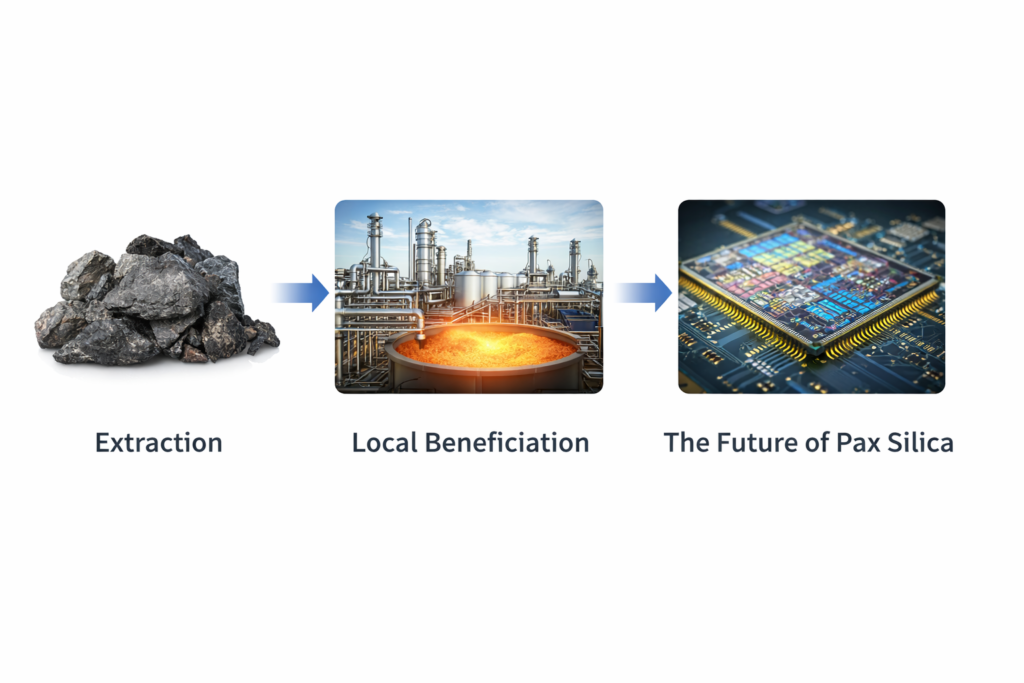
The evolution of a mineral: first as raw dark ore, then as a glowing liquid in a modern refinery, and finally as a complex microchip.
If Pax Silica remains an exclusive “G7+3” club, 2026 will likely see the emergence of a “Global South Mineral Cartel.” Such a bloc could implement export quotas or “tech-for-ore” swaps with China, effectively pricing Pax Silica members out of the market.
True “Silicon Security” is impossible without “Mineral Sovereignty.” The coalition must stop viewing Africa as a warehouse and start viewing it as a boardroom partner.
The Incomplete Shield
Pax Silica is the most ambitious attempt yet to reorganize the global technology supply chain around a U.S.-led bloc of trusted partners. Its membership logic is coherent. Its ambition is real. Nevertheless, in its current form, it resembles a country-club model of technology security. It prioritizes high-tech allies and capital hubs over the resource-rich nations that form the actual foundation of what it is trying to protect.
Africa’s exclusion reflects genuine barriers
Chinese ownership of mining assets, governance deficits, limited frontier manufacturing capability, and deliberate non-alignment in the U.S.-China competition. None of these barriers is permanent. Overcoming them, however, requires a fundamentally different approach. That means investing in processing capacity, governance frameworks, and value-addition infrastructure — not simply offering African nations a declaration to sign.
There is a particular irony in the name Pax Silica. The Roman concept of pax was built on integration, not exclusion. The Pax Romana’s durability derived from its capacity to absorb, rather than merely dominate, the peoples whose cooperation it needed. An exclusionary empire, by contrast, tends to become an empire of attrition.
Ultimately, the minerals required to build the next decade of AI hardware are, in significant measure, under African soil. The political will to supply them on favourable terms is not guaranteed. It must be earned through engagement, investment, and genuine respect for the economic sovereignty of the nations that hold those resources. Pax Silica has the institutional architecture to earn it. Whether it has the strategic imagination to do so remains, as of this writing, an open question.
The Silicon Shield controls the factory floor. It has not secured the mine. That gap is the coalition’s most consequential unresolved vulnerability.
About This Analysis
This analysis draws on publicly available geological surveys, corporate filings, trade statistics, African Union communiques, and the diplomatic record following the December 2025 Pax Silica summit. Statistical figures reflect best available estimates as of Q1 2026. The analysis represents independent strategic assessment and does not reflect the position of any government or commercial entity. Tags: Pax Silica, Africa critical minerals, semiconductor supply chain, AI geopolitics, DRC cobalt, US-China tech war, silicon supply chain Africa.
