
Kenya’s China-built digital infrastructure reveals the 2026 strategy behind Africa’s most sophisticated hybrid model. This article explains how digital infrastructure, debt restructuring, and democratic friction are reshaping East Africa’s technological future.
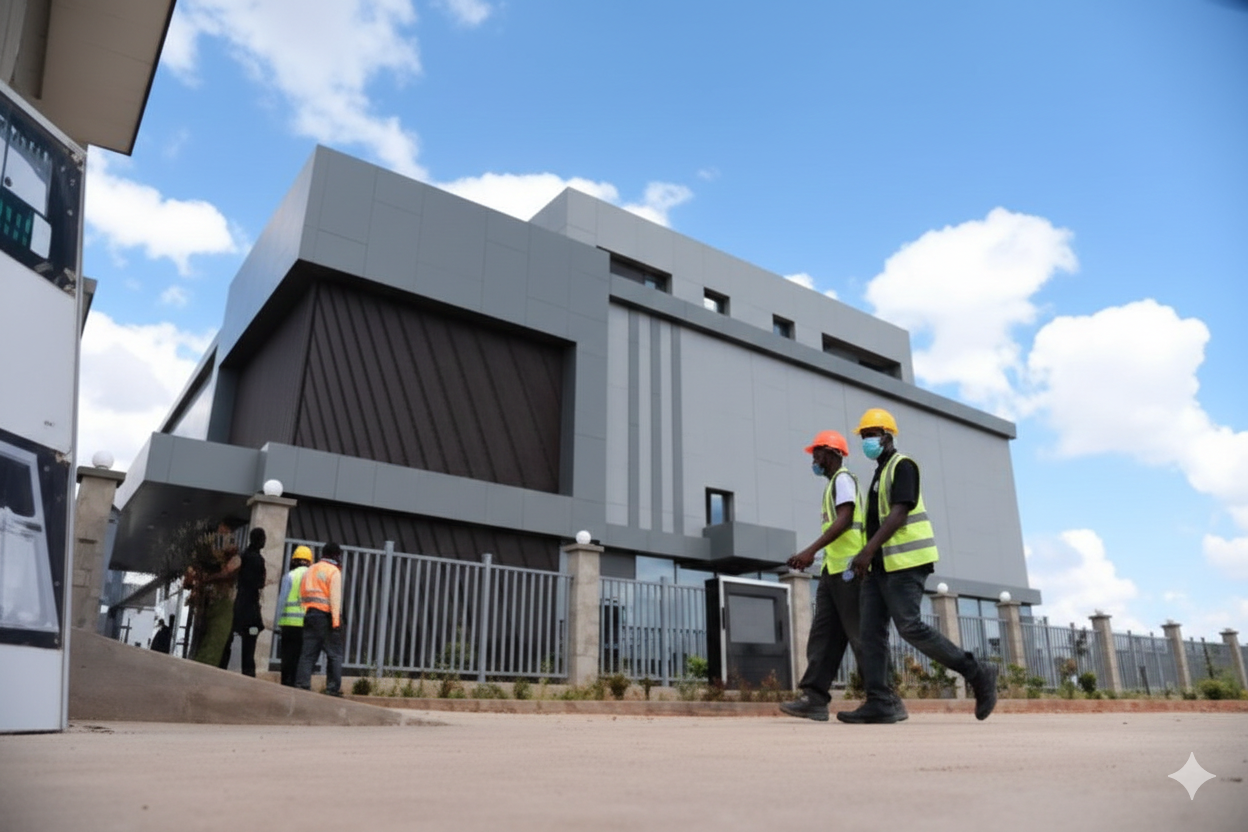
Konza National Data Center in Kenya is now fully operational in supporting government services
De-Risking vs. Management — Kenya’s Lesson for the Global South
Kenya occupies a unique position in Africa’s digital landscape.
It is:
- East Africa’s commercial and technological hub
- Home to globally admired innovations like M-Pesa
- A regional headquarters for Western tech firms
- A democracy with an active civil society and independent media
And yet, no country in East Africa has absorbed more Chinese-built digital and physical infrastructure across so many layers of the state.
Unlike Ethiopia, Kenya did not centralize telecoms under a monopoly. Unlike South Africa, it did not tightly firewall core systems.
Instead, Kenya pursued a hybrid path — liberal markets built on deep Chinese infrastructure foundations.
That choice delivered speed and scale. It also created long-term strategic entanglements.
Here’s what Western policymakers need to understand:
For many countries in the Global South, “de-risking” from China is economically impossible. The only viable option is management.
Kenya’s story reveals how a democracy navigates dependency after the infrastructure is built — through courts, debt renegotiation, diversification, and strategic hedging.
This is not a tale of Chinese domination or Western salvation. It is a story of constrained agency in a multipolar world.
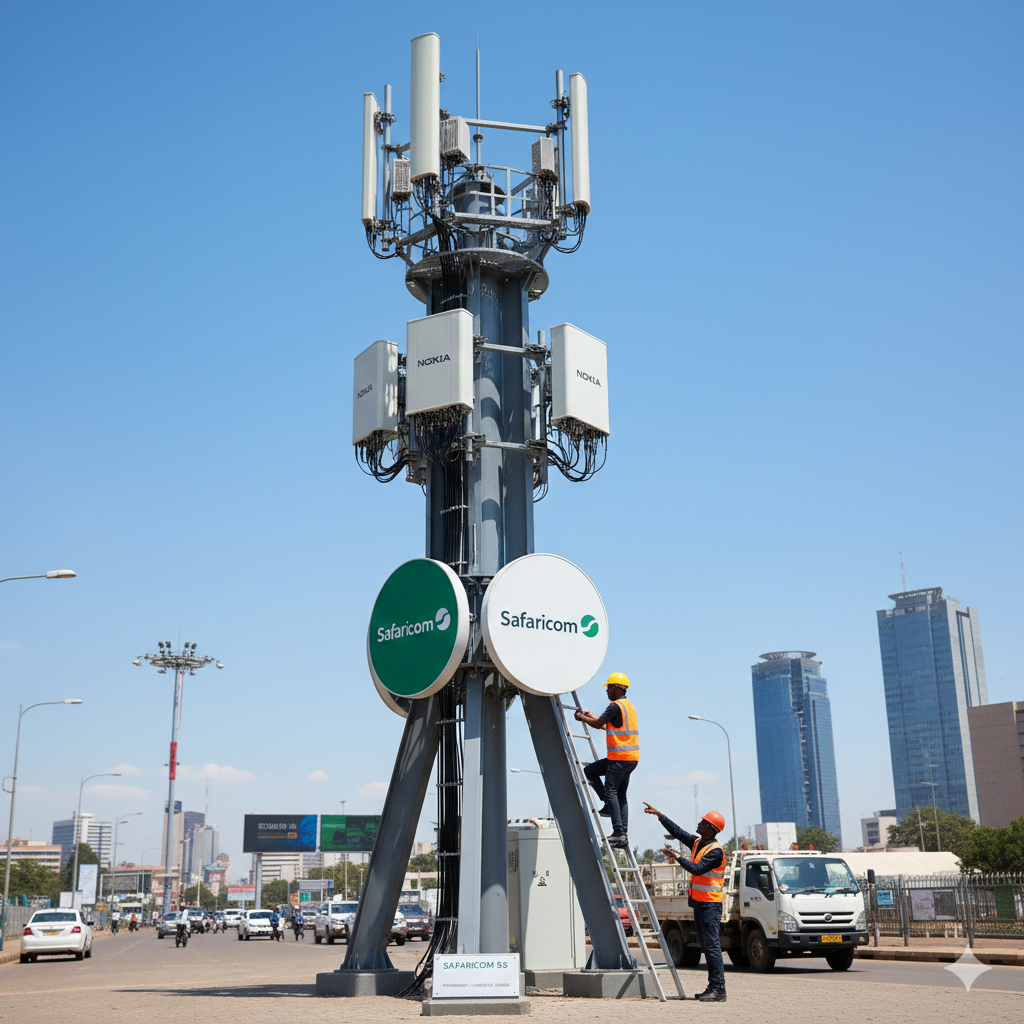
Huawei and Nokia 5G equipment installation
Telecoms: Multi-Vendor Competition on Chinese Rails
Kenya’s telecom market is formally liberalized.
- Safaricom dominates mobile and data services (approximately 65% market share)
- Airtel and Telkom Kenya provide competition
- The Communications Authority regulates rather than owns infrastructure
But beneath this market structure lies a critical fact:
Huawei equipment underpins much of Kenya’s legacy mobile network infrastructure, though diversification is accelerating.
Safaricom’s Multi-Vendor Strategy
Huawei has been Safaricom’s primary vendor for:
- 3G and 4G rollout since the mid-2000s
- Significant portions of the 5G Radio Access Network (RAN), launched in October 2022
- Core network components (historically)
However, Nokia has emerged as a key technology partner in Kenya’s 5G deployment:
- Working with Safaricom on 5G radio infrastructure
- Deploying FastMile gateways for ultra-fast fixed wireless access (FWA)
- Supporting applications in VR, AR, and UHD video streaming
- Collaborating with Airtel Kenya on foundational 5G work
This dual-vendor approach provides Kenya with more strategic flexibility than single-vendor dependencies — though Huawei’s historical dominance in 2G/3G/4G generations creates path dependencies that persist.
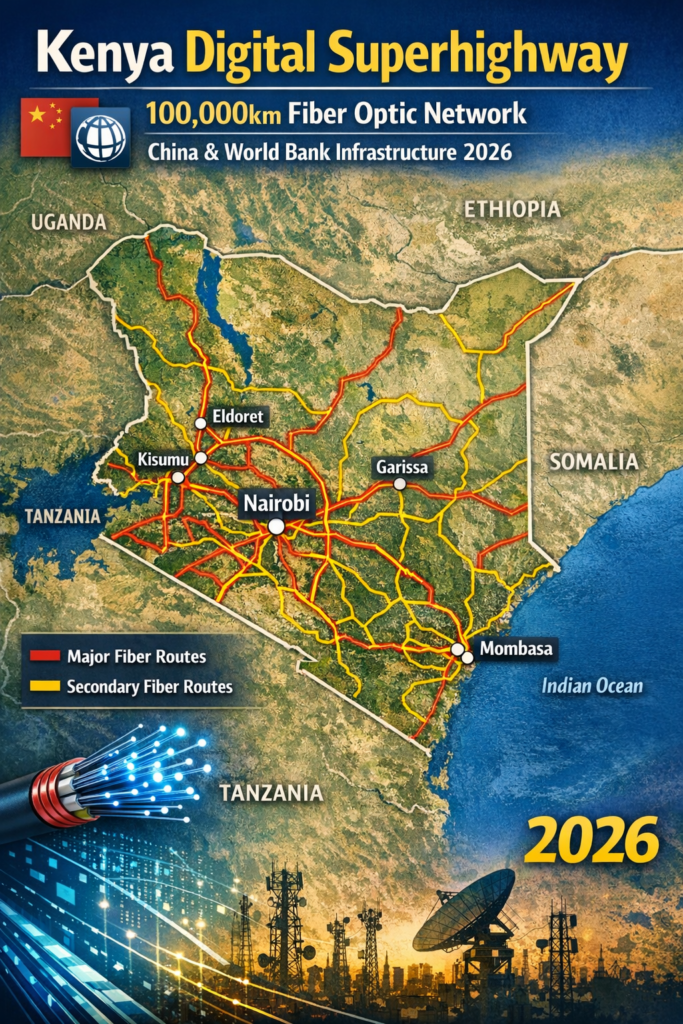
Digital Superhighway coverage in Kenya
The Digital Superhighway: Diversification in Action
President William Ruto’s administration has accelerated the Digital Superhighway Initiative — an ambitious plan to deploy 100,000 kilometers of fiber optic cable across Kenya.
The strategic architecture reveals Kenya’s evolving approach:
- Chinese firms (primarily Huawei) are laying much of the physical fiber
- Financing comes from blended sources: World Bank, African Development Bank, and private equity
- Ownership and governance remain with Kenyan entities
This represents a critical shift:
China builds the infrastructure. Kenya controls the capital structure and governance frameworks.
The Digital Superhighway demonstrates that Kenya is actively negotiating dependency rather than passively accepting it.
The Economics of Lock-In
Vendor financing made Huawei’s early dominance irresistible:
- Rapid deployment timelines
- Deferred payment structures
- Competitive pricing relative to Western alternatives
- Minimal upfront capital requirements
Kenya did not “choose China” ideologically. It chose speed and bankability.
The legacy consequences include:
- Engineers trained primarily on Huawei systems
- Maintenance contracts that reinforce vendor relationships
- Upgrade paths that favor incumbents
But unlike Ethiopia, Kenya retains operator plurality and regulatory oversight — limiting total state capture.
Kenya’s telecoms are competitive. Its infrastructure foundations reflect historical financing constraints — and emerging diversification strategies.
Surveillance: Commercial Availability Without Centralized Control
The Fragmented Landscape
Kenya’s surveillance infrastructure differs markedly from Ethiopia’s centralized Safe City model.
Rather than a unified government surveillance system, Kenya has:
- Commercial security markets with widespread Chinese equipment availability
- Municipal traffic monitoring systems
- Agency-specific CCTV installations
- Private sector security infrastructure
Chinese manufacturers, including Hikvision and Dahua, have strong retail and commercial presence in Kenya’s private security market. However, evidence of large-scale, centralized government surveillance contracts comparable to Ethiopia’s Safe City remains limited.
Most surveillance in Kenya is:
- Decentralized across multiple agencies
- Primarily commercial and private sector-driven
- Subject to procurement scrutiny by civil society
- Less systematically integrated than authoritarian models
The Civil Society Difference
Kenya’s distinction lies in democratic friction:
- Courts have challenged biometric data collection programs
- NGOs actively scrutinize digital ID and surveillance initiatives
- Journalists investigate procurement contracts
- Constitutional challenges slow and constrain implementation
The 2020 and 2021 High Court rulings halting aspects of the Huduma Namba digital ID system demonstrate this constraint in action.
This has not prevented surveillance technology adoption — but it has constrained, delayed, and fragmented it.
Kenya demonstrates how democratic institutions reshape smart-city technology deployment, even when the underlying equipment originates from authoritarian contexts.
Democratic friction is not a bug — it’s a strategic asset.

Olkaria geothermal power station with data center overlay
Data, Cloud, and the Battle for Digital Sovereignty
As networks mature, data infrastructure becomes the strategic prize.
The Emerging Battleground: Who Controls the Cloud?
Kenya’s data infrastructure landscape reveals an intensifying competition:
Huawei’s Position:
- Expanded beyond network equipment into cloud computing services
- Enterprise digital transformation partnerships
- Government digital platforms
- Data center infrastructure
This represents a shift from passive infrastructure provider to active data ecosystem participant.
But the game changed in 2025.
The Battle for Cloud Sovereignty: Olkaria as Strategic Battleground
In 2025, the U.S.-Kenya Digital Partnership marked a dramatic escalation in the competition for Kenya’s digital future.
Microsoft and G42 (UAE) committed billions to construct a green data center complex at Olkaria, Kenya’s geothermal energy hub.
The strategic logic is clear:
China built the rails (4G/5G/Fiber). The West is now fighting for the brains (AI and Cloud storage).
The Olkaria data center represents:
- Hyperscale cloud computing capacity powered by renewable energy
- Direct competition with Huawei Cloud for enterprise and government workloads
- Strategic positioning for AI model training and deployment
- Western counter-positioning in Kenya’s digital sovereignty debate
This is Kenya’s hybrid model in action:
- Chinese infrastructure enables connectivity
- Western cloud platforms compete for data workloads
- Kenyan institutions decide which platforms gain access to government and enterprise data
The competition is fierce — and Kenya benefits from having options.
Kenya’s Evolving Data Governance
Kenya’s data governance framework is developing in real-time:
- Data Protection Act (2019) established foundational rights
- Office of the Data Protection Commissioner provides oversight
- Ongoing debates over data localization requirements
- Civil society pushback on biometric data collection
Unlike Ethiopia:
- Data is not fully state-controlled
- Multiple actors compete in data services
Unlike Nigeria:
- Enforcement capacity is stronger
- Regulatory clarity is greater
Kenya sits in the middle — regulating data after infrastructure is built, not before.
This creates a critical vulnerability: governance capacity struggles to keep pace with infrastructure deployment speed.
But the Olkaria development suggests Kenya is learning to leverage competition between Chinese and Western cloud providers to strengthen its negotiating position.
Konza Technopolis: Ambition, Delays, and Recent Momentum
Konza Technopolis — Kenya’s planned “Silicon Savannah” — offers one of the clearest examples of smart-city ambitions colliding with implementation realities.
Chinese firms have been involved in:
- Fiber backbone installation
- Smart infrastructure planning
- Data and connectivity systems
- Early construction phases
The Reality of Progress
Konza’s story is one of persistent delays paired with recent acceleration.
The challenges:
- By end of 2024, only 9 of 515 surveyed land parcels had been developed
- Audits revealed billions of shillings in idle technology equipment
- Only 1,000 of 17,508 deployed virtual desktop devices are in active use
- Private sector uptake has lagged projections significantly
- Integration with Nairobi’s existing tech ecosystem remains partial
The recent momentum:
- South Korea emerged as a major infrastructure partner in 2024
- A $284.1 million financing agreement was secured for Digital Media City construction
- The National Data Centre has been completed and operationalized
- The Kenya Advanced Institute of Science and Technology (Kenya-AIST) is under construction with $8 million in Korean financing
- Multiple anchor institutions are now operational or under development
- By end of 2024, 75% of parcels had been committed by investors (though not yet developed)
The Lesson
Konza demonstrates both the promise and pitfalls of imported smart-city models.
China (and other partners) can build infrastructure quickly. They cannot manufacture innovation ecosystems.
Smart cities require:
- Talent density that develops organically
- Venture capital and entrepreneurial networks
- Regulatory agility that adapts to innovation
- Cultural gravity that attracts global attention
Infrastructure is necessary — but not sufficient.
Konza’s evolution from stalled project to gradually activating tech hub suggests that patience, diversified partnerships, and institutional persistence may yield results, even if timelines stretch far beyond initial projections.
The shift from Chinese-dominated financing to Korean and multilateral partnerships mirrors Kenya’s broader strategic evolution.

Kenya Standard Gauge Railway (SGR)
The SGR: Physical Infrastructure That Reshaped Financial Strategy
No discussion of Chinese influence in Kenya is complete without the Standard Gauge Railway (SGR).
Though not digital infrastructure, the SGR fundamentally reshaped Kenya’s fiscal and political posture toward China — with direct implications for digital infrastructure financing.
The Financial Architecture
The SGR megaproject comprised:
- Mombasa-Nairobi phase: approximately $3.8 billion
- Nairobi-Naivasha extension: approximately $1.5 billion
- Total cost: over $5 billion
Financed primarily through China Exim Bank loans at commercial rates (originally 3-3.6% above LIBOR), the project generated:
- Debt sustainability concerns
- IMF warnings (Kenya classified at high risk of debt distress as of March 2025)
- Constraints on fiscal space for other development priorities
- Western lender caution about additional financing
The 2024-2025 Debt Restructuring: A Strategic Pivot
In late 2024 and early 2025, Kenya executed a critical financial maneuver that reveals both its constraints and its negotiating capacity:
Three major SGR loans were converted from US dollars to Chinese renminbi, with:
- Loan tenure extended to 2040 (from original 2035 maturity)
- New grace period of 4-5 years before principal payments resume
- Interest rate reduced to 3% (from variable rates that had exceeded 7%)
- Annual savings of approximately $215 million in debt service costs
- Reduced exposure to dollar volatility
This was the first time China agreed to such a currency conversion with an African country.
The Yuan-ization of Kenyan Finance: Beyond Debt Relief
The currency conversion is often framed as “debt relief” — but the strategic implications run deeper.
What’s actually happening:
Kenya’s Central Bank has begun exploring holding larger Renminbi reserves to service yuan-denominated debt directly, rather than converting through dollars.
This creates a new form of dependency:
- Kenya must earn or acquire yuan to service debt
- This incentivizes trade in renminbi and yuan-denominated transactions
- It draws Kenya deeper into China’s financial orbit — not by coercion, but by economic logic
The strategic calculus:
- Dollar volatility exposed Kenya to currency risk (the shilling depreciated significantly 2022-2023)
- Yuan stability relative to dollar made conversion attractive
- China offered terms Kenya couldn’t refuse during fiscal crisis
This is dependency by pragmatism, not by force.
The long-term implications:
- Kenya may explore panda bonds (yuan-denominated debt issued in Chinese markets) for future infrastructure
- Increased yuan holdings may facilitate trade with China and Belt and Road countries
- But it also creates structural currency exposure that persists beyond individual projects
The yuan conversion reveals that China’s influence operates through financial architecture, not just physical infrastructure.
The Mombasa Port Myth — Debunked
It’s worth addressing explicitly: the widely circulated claim that Mombasa Port was pledged as collateral for SGR loans was definitively debunked when loan contracts were released in 2022.
The port was never at risk of seizure.
However, the perception of that risk alone influenced:
- Kenya’s international credit ratings
- Western lender confidence
- Public opinion on Chinese financing
The myth mattered — even though it was false.
Debt Service Reality: The 2025-2026 Picture
For the 2025-2026 fiscal year, Kenya owes China Exim Bank:
- $741 million in principal
- $222 million in interest
- $41 million in penalties for previous delayed payments
SGR-related debt service accounts for more than 80% of Kenya’s bilateral debt payments in any given period.
The Indirect Digital Impact
The SGR’s fiscal shadow had downstream consequences for digital infrastructure:
Kenya became more reliant on vendor financing for digital projects as traditional development finance became constrained.
The SGR indirectly deepened Chinese leverage in:
- Telecoms equipment procurement
- Cloud services adoption
- Smart city infrastructure
- Digital government platforms
The railway reshaped not just Kenya’s physical landscape — but its strategic options for digital infrastructure financing.
Yet the 2024-25 restructuring also demonstrates negotiating capacity.
China did not seize assets. It restructured terms.
This suggests Kenya retains leverage — constrained leverage, but leverage nonetheless.
Digital ID and Biometric Systems: When Courts Push Back
Kenya’s Huduma Namba program exposed the tension between:
- Digital efficiency aspirations
- Civil liberties protections
- Foreign-built systems
The Constitutional Challenge
In 2020 and 2021, Kenya’s High Court halted aspects of the digital ID rollout over:
- Privacy concerns and lack of consent mechanisms
- Inadequate data protection impact assessments (DPIAs)
- Insufficient legal safeguards for biometric data
- Questions about system security architecture
- DNA and GPS data collection deemed “intrusive and unnecessary”
Chinese firms were not uniquely responsible for these deficiencies — but they were embedded within the ecosystem providing:
- Hardware components
- System integration services
- Technical architecture design
The Broader Lesson
The Huduma Namba episode reinforced a critical insight:
Governance capacity matters more than vendor nationality.
A poorly governed system built by Western firms poses similar risks to one built by Chinese firms. A well-governed system can mitigate vendor-specific risks through oversight, auditing, and regulatory enforcement.
Kenya’s challenge is building institutional capacity to govern systems it did not design and cannot fully audit.
But the court victories demonstrate that democratic friction works — even against government pressure to accelerate implementation.
Comparing Kenya’s Hybrid Model to Regional Peers: The 2026 Landscape
| Dimension | Kenya (The Negotiated Hybrid) | Ethiopia (State-Led Integration) | South Africa (Market-Driven Hub) |
|---|---|---|---|
| Dominant Vendor | Multi-Vendor: Huawei (4G/5G) + Nokia (5G/RAN) | Mono-Vendor: Primarily Huawei/ZTE for backbone | Globalized: Diversified (Ericsson, Nokia, Huawei) |
| Debt Strategy (2026) | Active De-risking: Successfully converted $3.5B in SGR debt to Yuan (CNY) | Struggling: Ongoing negotiations with Beijing to convert $5.4B to CNY | Private Equity: Minimal sovereign debt tied to digital rails |
| Data & AI Anchor | Olkaria Green Hub: Microsoft/G42 Geothermal Data Center (2025/26) | Centralized Data: State-managed “Fayda” ID and centralized storage | Hyperscale Core: AWS, Google, and Microsoft established regions |
| Governance Mode | Democratic Friction: Courts & Data Commissioner audit AI and ID systems | Centralized Capture: High state control over digital public infrastructure | Legislative-Led: Mature POPIA (Privacy) and AI regulations |
| Education Hub | Kenya-AIST (2026): South Korea-backed academic launch at Konza | Internal R&D: Government-run AI institutes focused on surveillance | University-Led: Research driven by established academic institutions |
| Cloud Sovereignty | Layered Competition: Huawei vs Microsoft/G42 at Olkaria | Huawei-dominated with limited alternatives | Multi-cloud (AWS, Azure, local providers) |
| Currency Exposure | Strategic Yuan Integration: $3.5B debt conversion (Jan 2026) | Dollar and Yuan (seeking conversion) | Primarily Dollar/Euro |
| Civil Society Role | Institutional Watchdog: ODPC audits AI credit scoring apps | Weak (Limited oversight mechanisms) | Strong (Constitutional Court interventions) |
| Strategic Flexibility | Medium-High (Navigating through diversification) | Low (Locked into Chinese ecosystem) | High (Multiple partnership options) |
Key Insights from the Comparison:
The Debt Angle: Kenya isn’t just “in debt” — it’s actively using currency swaps as a tool of statecraft. Ethiopia is now attempting to copy Kenya’s yuan conversion strategy, validating Kenya’s approach.
The Infrastructure Angle: The shift from “Chinese hardware” to “Western/Middle-Eastern compute” (Microsoft/G42) supports the theory that Kenya is layering dependencies to avoid total capture.
The Governance Angle: Kenya’s “messy” democracy is actually a competitive advantage for long-term digital stability. Courts and regulators create friction that prevents worst-case surveillance scenarios.
Kenya is neither captured nor autonomous. It is strategically entangled with negotiating capacity — and as of 2026, that capacity is growing.
Strategic Implications: Kenya’s Real Choice
Kenya’s challenge is not removing Chinese infrastructure — that is economically unrealistic and politically unfeasible.
The challenge is:
1. Strengthening Regulatory Capacity
- Train regulators in network architecture and data governance
- Build auditing capacity for legacy systems (especially Huawei core networks)
- Develop technical expertise within government agencies
- Mandate transparency in vendor contracts
2. Diversifying Future Layers
- Prioritize multi-vendor strategies for 5G and future 6G
- Leverage competition between Huawei Cloud and Microsoft/G42 at Olkaria
- Develop domestic capabilities in AI governance and data management
- Support local tech ecosystems (Nairobi’s startup scene)
3. Leveraging Regional Frameworks
- Coordinate through East African Community (EAC) standards
- Develop regional positions on data governance and cloud sovereignty
- Pool resources for technical auditing of Chinese systems
- Negotiate collectively with infrastructure vendors
4. Managing Currency and Debt Exposure
- The 2024-25 yuan conversion demonstrates negotiating capacity
- But increasing yuan exposure creates new dependencies
- Future strategy should balance currency risk across dollar, euro, and yuan
- Explore blended finance models that reduce reliance on single creditors
5. Democratic Friction as Strategic Asset
- Courts, NGOs, and journalists provide oversight that limits worst-case scenarios
- This friction should be preserved and strengthened, not circumvented
- Huduma Namba challenges demonstrate effectiveness
- Civil society capacity-building should be strategic priority
Kenya can still choose how dependency evolves, even if it cannot eliminate dependency entirely.
Strategic Outlook 2026: The “Brains” After the “Rails”
As of early 2026, Kenya’s digital trajectory has shifted from a period of passive absorption to one of active orchestration. The “Hybrid path” is no longer just a description of Kenya’s infrastructure; it has become its primary survival strategy in a polarized global tech economy.
1. The Great Currency Pivot: De-risking via the Yuan
The January 2026 debt repayment cycle marked a historic milestone: the first major activation of the US-dollar-to-Renminbi (CNY) conversion for SGR loans.
By converting an estimated $3.5 billion in debt, Kenya successfully slashed its semi-annual interest burden by nearly 35% compared to 2025.
The 2026 Reality:
This wasn’t an ideological “pivot to the East,” but a cold financial hedge against a volatile dollar. The arithmetic was compelling:
- Dollar-denominated loans exposed Kenya to currency volatility (the shilling fluctuated dramatically 2022-2024)
- Yuan stability relative to the dollar made conversion attractive
- Interest rate reduction from variable (7%+) to fixed (3%) saved hundreds of millions
However, it creates a new “Yuan-trap” potential:
- Kenya must now aggressively export tea, coffee, and services to China to earn the CNY needed for debt servicing
- Or remain reliant on currency swaps that embed Kenya deeper into China’s financial architecture
- This isn’t dependency by coercion — it’s dependency by balance sheet logic
2. The Olkaria Shift: Western “Cloud Sovereignty” vs. Chinese Hardware
While Huawei remains the king of Kenya’s hardware layer, 2026 has seen the West fight back at the compute layer.
The $1 billion Microsoft-G42 geothermal data center in Olkaria — despite early 2025 construction delays — is now moving toward its “East Africa Cloud Region” activation.
The Hybrid Result: A “Layered Superpower” Model
We are witnessing unprecedented infrastructure stratification:
- Huawei provides the 5G rails (physical connectivity)
- US-UAE capital (Microsoft/G42) provides the AI brains (compute and cloud services)
- Korean partners provide education infrastructure (Kenya-AIST)
- Italian firms provided horizontal infrastructure at Konza
Kenya is effectively playing all sides to ensure that no single foreign entity owns the entire stack from cable to cloud.
This is what digital sovereignty looks like in 2026: not isolation, but quality of entanglements.
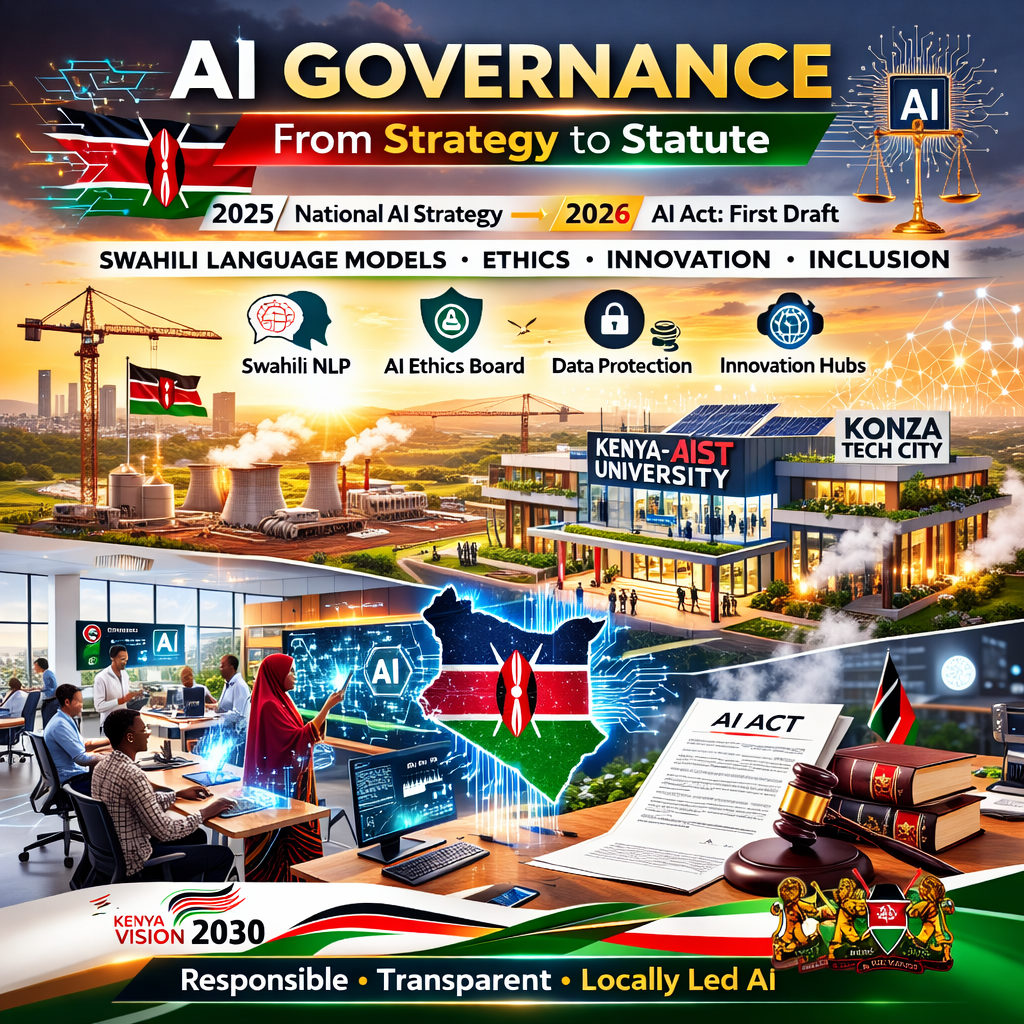
Swahili language models at AIST University
3. AI Governance: From Strategy to Statute
In March 2025, Kenya launched its National AI Strategy (2025–2030). By early 2026, this has evolved into the first drafts of a formal AI Act.
Domestic Agency in Action:
Unlike the “black box” deployments of early facial recognition systems, the 2026 focus is on Local Language Models (LLMs):
- Collaborations at Konza Technopolis — bolstered by the 2026 academic launch of the South Korean-backed Kenya-AIST — aim to develop Swahili-first AI for agriculture and healthcare
- This represents a shift from importing Western or Chinese AI to building contextual, locally-governed systems
Democratic Friction Continues:
The Office of the Data Protection Commissioner (ODPC) has become a global “watchdog” model:
- Recently audited AI-driven credit scoring apps to ensure they don’t mirror opaque social credit systems
- Enforced transparency requirements on algorithmic decision-making
- Challenged government deployment of facial recognition without legal frameworks
Kenya’s democratic institutions are governing AI before it governs Kenya — a stark contrast to authoritarian digital models.
4. Konza’s “Multi-Polar” Maturation
Konza is no longer “China’s smart city.” By 2026, it has become a tapestry of global partnerships:
- China remains the provider of the Tier III National Data Centre
- South Korea is the architect of the Digital Media City and the Kenya-AIST university
- Italy provided the “horizontal” (underground) infrastructure
- The US (via Microsoft/G42) is the anchor for high-end AI research
This diversification wasn’t planned from the outset — it emerged from fiscal constraints, strategic hedging, and institutional persistence.
Konza demonstrates that patient, multi-partner development can succeed where single-vendor megaprojects often fail.
5. The Digital Superhighway Acceleration (2025-2026)
President Ruto’s 100,000km fiber deployment is proceeding with blended financing:
- Chinese firms laying physical fiber infrastructure
- World Bank and African Development Bank providing capital
- Private equity co-investing in last-mile connectivity
- Kenyan entities retaining ownership and governance
This is the hybrid model operationalized: China builds, but Kenya controls.
6. Debt Metrics: Room to Maneuver
Kenya’s fiscal position has stabilized enough to permit strategic choices:
- Debt-to-GDP declined from 72.0% (2023) to 65.7% (2024)
- Yuan conversion reduced annual debt service by $215-300 million
- Shilling strengthening created breathing room
- IMF classification remains “high risk” but trending toward “moderate risk”
This isn’t abundance — but it’s enough space to negotiate rather than capitulate.
Summary: The 2026 Bellwether
Kenya’s 2026 posture proves that digital sovereignty is not about isolation, but about the quality of one’s entanglements.
By diversifying vendors at every layer — Nokia for 5G, Microsoft for Cloud, Korea for Education, China for Rail — Kenya has avoided becoming a client state.
It has instead become a Digital Clearinghouse, proving that in the age of AI, a middle-power democracy can negotiate its way into the future, provided its institutions (courts and regulators) remain as robust as its infrastructure.
The “rails” are Chinese. The “brains” are increasingly Western and Middle-Eastern. The governance is Kenyan — and that’s what matters most.
Kenya as Africa’s Digital Bellwether
Kenya reveals the most likely future for much of democratic Africa.
Not monopoly. Not resistance. But layered dependency within open societies.
Chinese firms built the rails. Western firms are competing for the cloud. Kenyan institutions decide how the system operates — within the constraints those infrastructures impose.
The outcome will depend not on geopolitics alone — but on:
- Courts that challenge overreach (Huduma Namba rulings)
- Regulators who understand network architecture
- Journalists who investigate procurement
- Technologists who build alternatives
- Civil society that mobilizes against surveillance
These actors understand that digital infrastructure is governance by other means.
Kenya’s story is not about choosing China or the West. It is about whether a democracy can retain agency after the cables are laid, the cloud providers compete, and the debt is restructured in yuan.
That answer is still being written — but Kenya’s 2024-2026 maneuvers suggest the story may be more dynamic than fatalistic narratives imply.
The question is not whether Kenya is dependent.
The question is whether that dependence is negotiable, transparent, and governed — or opaque, permanent, and extractive.
Kenya’s hybrid path suggests the answer lies somewhere in between — which makes it precisely the case study the rest of Africa, and the world, should watch most closely.
For Western policymakers obsessed with “de-risking,” Kenya offers a sobering lesson:
De-risking may be impossible. But management, negotiation, and strategic diversification remain viable — if institutions are strong enough to execute them.
That’s the real test of the 2020s
