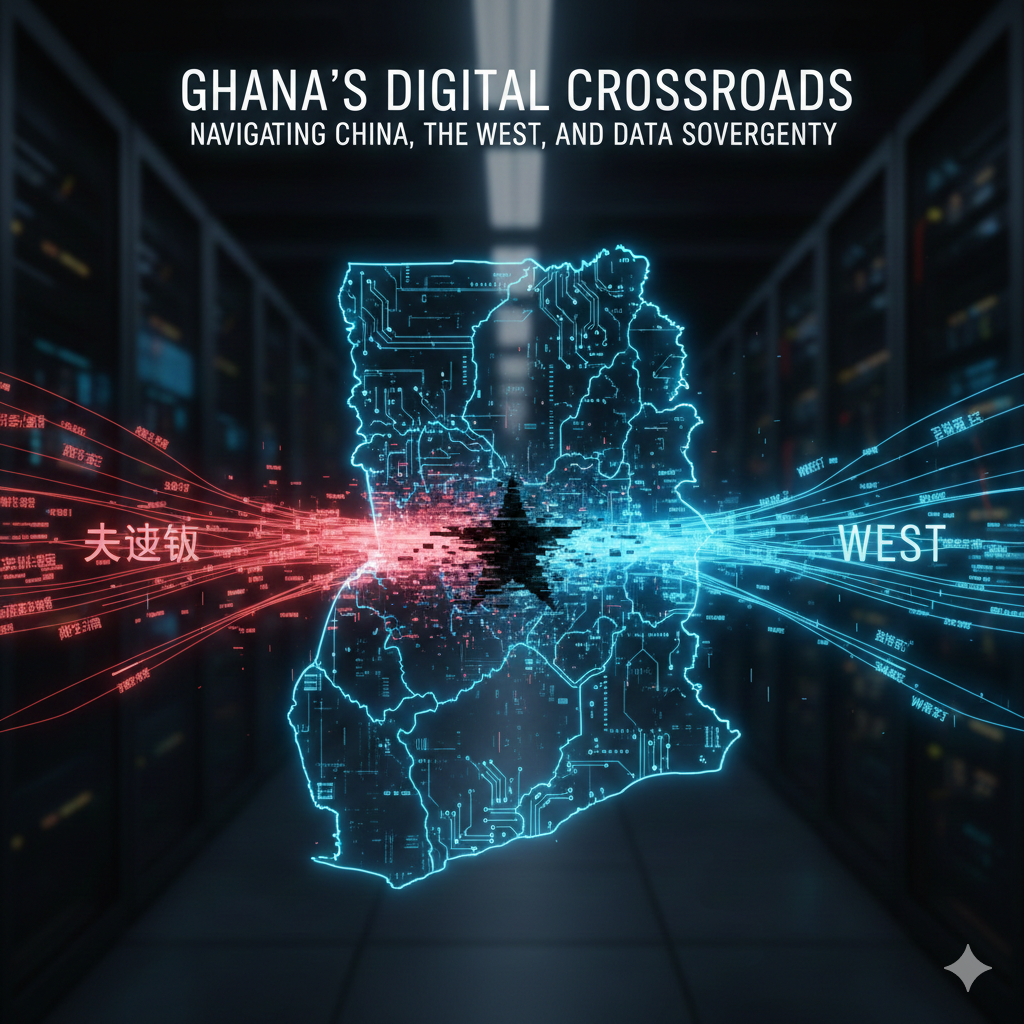

An Investigation into Who Controls the Infrastructure Behind Africa’s Digital Future
In September 2024, Ghana’s National Information Technology Agency (NITA) quietly signed a memorandum of understanding with Huawei Cloud to migrate several government databases to cloud infrastructure. The specific ministries involved weren’t disclosed. Neither were the data residency terms, the audit protocols, nor whether Ghanaian officials would have the technical capacity to inspect what happens to citizen data once it enters Huawei’s systems.
When I asked Dr. Albert Antwi-Boasiako, Director General of NITA, about these details during a November 2024 press briefing in Accra, his response was telling: “We work with partners who help us modernize quickly and cost-effectively. The technical specifications are covered in our procurement processes.”
This is Ghana’s digital dilemma in microcosm—rapid modernization built on infrastructure it doesn’t fully control, with sovereignty questions deferred in the name of developmental urgency.
The Infrastructure Behind the Success Story
Ghana’s digital transformation statistics are impressive: 138% mobile penetration as of mid-2024, 4G coverage reaching 83% of the population, and the Ghana Card biometric ID system now covering over 17 million citizens. Accra’s fintech sector processed over $12 billion in mobile money transactions in 2023 alone, according to the Bank of Ghana.
But dig into the hardware, and a pattern emerges. According to data from the Ghana National Communications Authority (NCA), Huawei equipment powers an estimated 65-70% of the country’s 4G network infrastructure as of 2024. MTN Ghana, the country’s largest operator with 28 million subscribers, relies almost entirely on Huawei for its radio access network. Vodafone Ghana and AirtelTigo have similar dependencies.
This wasn’t an accident—it was economics. In interviews with three telecom procurement officials (who spoke on condition of anonymity due to contractual restrictions), the math was consistent: Huawei’s equipment came in 25-30% cheaper than Ericsson or Nokia alternatives, with vendor financing that spread payments over 5-7 years. For a government managing debt restructuring and an IMF program, that pricing gap was decisive.
“We weren’t choosing China over the West ideologically,” one official told me. “We were choosing what we could afford to deploy at scale.”
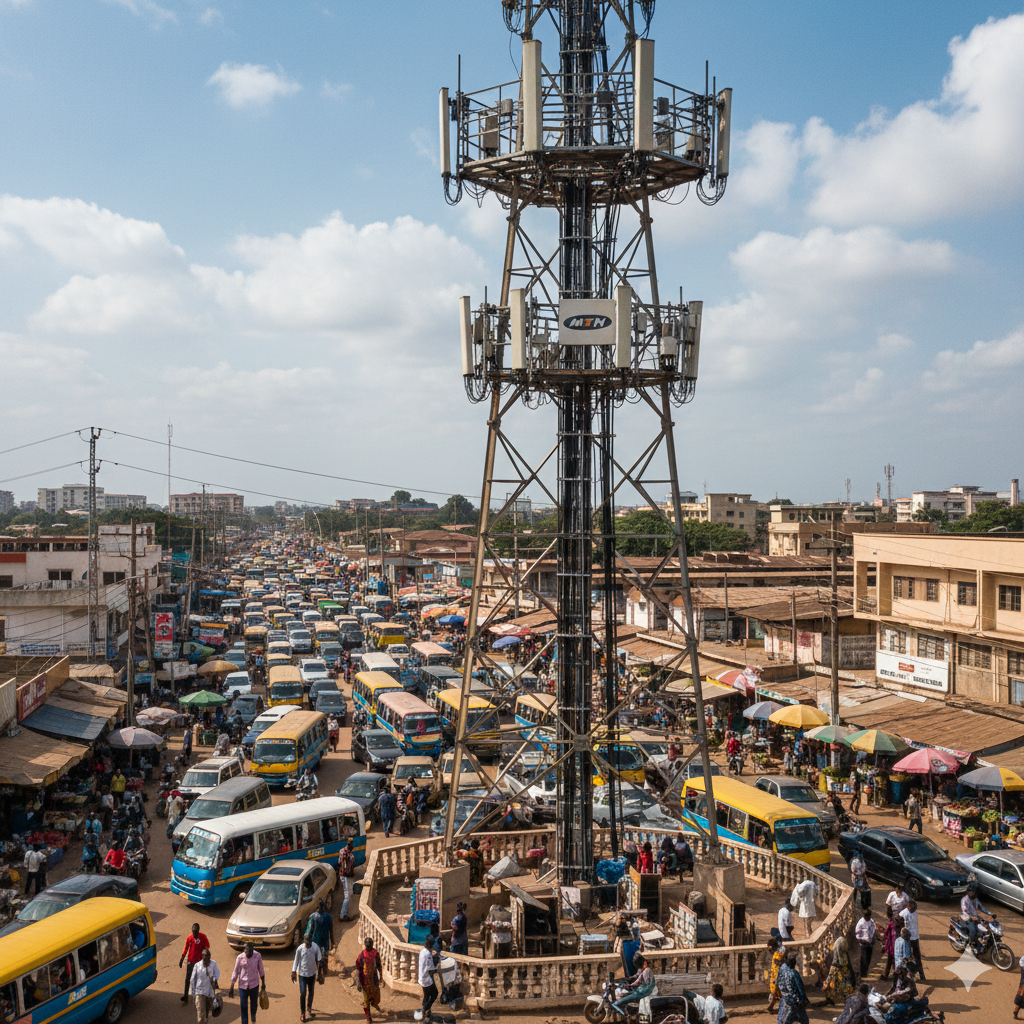
A telecommunications tower overlooking a busy street in Accra, Ghana, representing the 4G infrastructure that powers the country’s high mobile penetration.
The human dimension of this infrastructure is often overlooked. Since 2018, Huawei has trained over 3,500 Ghanaian ICT engineers through its “Seeds for the Future” program and partnerships with universities including Kwame Nkrumah University of Science and Technology. These engineers now staff Ghana’s telecom operators, government IT departments, and tech startups. They’re fluent in Huawei’s systems—and less familiar with alternatives.
The Cloud Question: Where Sovereignty Meets Reality
Ghana’s next digital frontier isn’t towers and fiber—it’s cloud computing and data-intensive systems. This is where sovereignty questions become harder to defer.
The country’s Data Protection Act, passed in 2012, was written before cloud computing matured in Africa. It contains no provisions for cross-border data flows, no definitions of “critical national data,” and no audit requirements for foreign cloud providers. A draft Cloud Computing Policy has circulated within NITA since 2022 but hasn’t been finalized.
Meanwhile, the cloud migration is already happening:
| System | Cloud Provider | Data Sensitivity | Known Residency |
|---|---|---|---|
| Ghana Card database | Undisclosed | High (biometric) | Unknown |
| GRA tax systems | Hybrid (local + foreign) | High (financial) | Partially local |
| Port management (GPHA) | Cloud-based | Medium | Unknown |
| National Health Insurance | Local servers + backup | High (medical) | Tema data center |
This table is based on public procurement records, ministry statements, and three sources with direct knowledge of government IT systems. The “unknown” entries are particularly concerning—for systems handling the biometric data of 17 million citizens or the financial records of every taxpayer, there’s no public clarity about where that data lives or who can access it.
Kofi Mensah, a cybersecurity consultant who has advised two Ghanaian ministries (and agreed to speak on record), put it bluntly: “We’re uploading our sovereignty to the cloud without knowing which country’s courts can subpoena it. The 2012 law never anticipated this.”
The Chinese Calculation
To understand why Ghana continues deepening its Chinese infrastructure partnerships, you need to understand Beijing’s offer—and why it’s compelling beyond just price.
The Full-Stack Proposition
China’s approach through companies like Huawei, ZTE, and Alibaba Cloud isn’t piecemeal. It’s a bundled ecosystem: telecom networks, cloud platforms, surveillance systems, smart city infrastructure, and e-government applications that integrate seamlessly. This “full-stack” model offers efficiency—everything works together—but it also creates switching costs. Replacing one component often means replacing entire systems.
Ghana is seeing this play out in real time. When Accra launched its “Safe City” surveillance project in 2023—installing 10,000 cameras across the capital—Huawei was the prime contractor. The cameras integrate with Huawei’s Video Cloud platform, which uses AI for facial recognition and traffic management. The system works well, according to Ghana Police Service statements, but it’s now functionally impossible to swap out without rebuilding from scratch.

Ghanaian ICT engineers participating in a technical training session.
The Training Pipeline
Perhaps more significant than the hardware is the human infrastructure. Of the 3,500+ Ghanaian engineers trained through Huawei programs, many now occupy mid-level technical positions across government and industry. They’re comfortable with Huawei’s network management systems, familiar with its cloud architecture, and often personally connected to Chinese technical staff.
This isn’t nefarious—every tech company builds user loyalty through training. Microsoft does it with certifications, Cisco with network academies. But it does create path dependency. When Ghana’s ministries need to hire cloud engineers or network specialists, the talent pool is already oriented toward Chinese systems.
The Western Alternative—And Its Own Sovereignty Problems
A common assumption is that switching to Western cloud providers would solve Ghana’s sovereignty concerns. It wouldn’t.
The U.S. CLOUD Act (Clarifying Lawful Overseas Use of Data Act), passed in 2018, allows American law enforcement to compel U.S.-based tech companies to produce data stored anywhere in the world—including on servers physically located in Ghana. Microsoft, Amazon Web Services, and Google are all subject to this law.
In 2023, AWS opened a “Local Zone” in Lagos, Nigeria, marketing it to West African governments as a sovereignty solution. But as legal experts note, data stored in AWS Lagos is still under AWS’s terms of service—and potentially subject to U.S. legal demands. True sovereignty would require infrastructure owned and operated by Ghanaian entities, subject only to Ghanaian law.
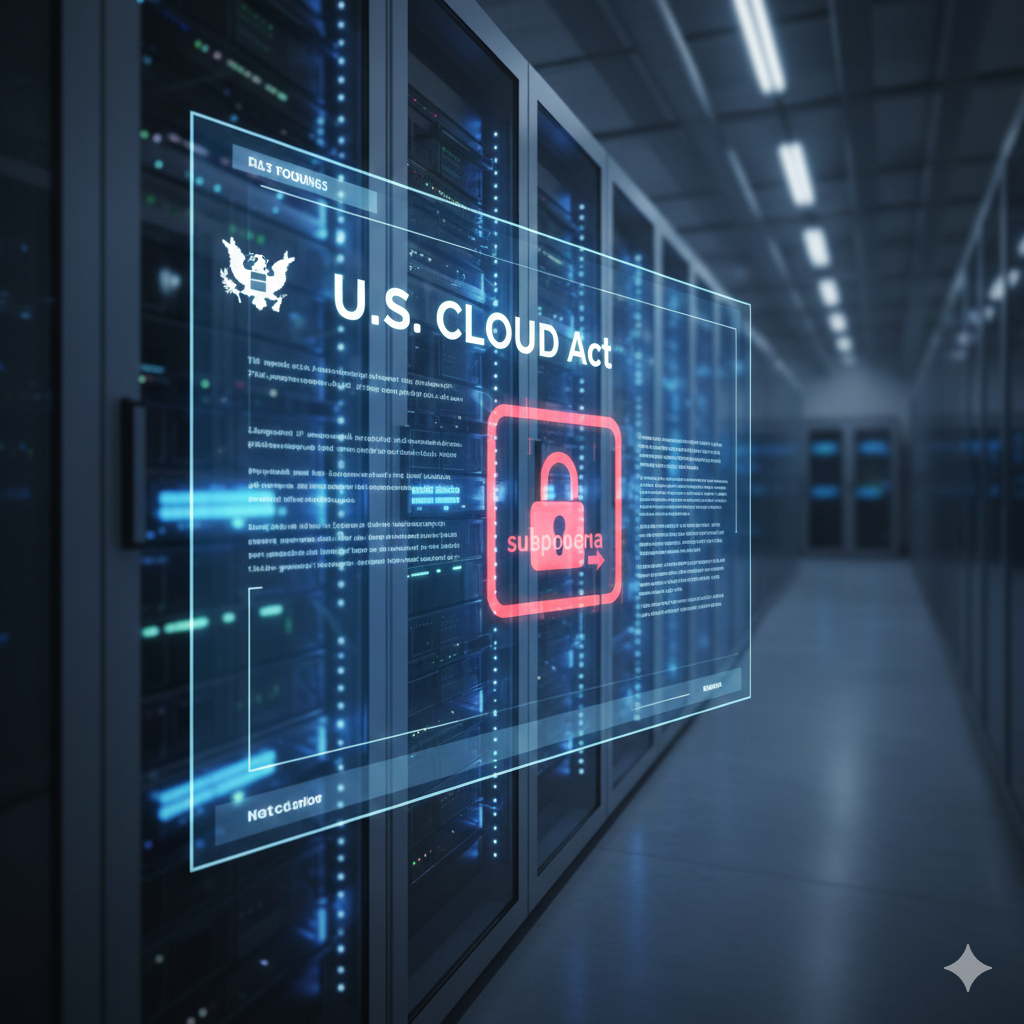
Conceptual representation of a cloud server rack with a digital overlay of the U.S. CLOUD Act
The economic gap is also real. When the Ministry of Health solicited bids for a national health data platform in early 2024, the three finalists were:
- Huawei Cloud: $8.2 million over 5 years, vendor financing available
- Microsoft Azure: $12.7 million over 5 years, upfront payment required
- Local consortium (MainOne + Ghana Tech Lab): $11.4 million over 5 years, grants needed
Huawei won. “Sovereignty is important,” a ministry official told me, “but so is launching this decade.”
Case Study: What Ghana Can Learn from Rwanda
Rwanda offers an instructive contrast. Kigali has pursued an aggressive multi-vendor strategy, deliberately avoiding dependence on any single country’s technology ecosystem.
Rwanda’s approach:
- Telecom infrastructure: Split between Huawei (40%), Ericsson (35%), and Nokia (25%)
- Cloud services: Mix of AWS (for some e-government), Alibaba Cloud (for e-commerce), and local data centers for sensitive systems
- Smart city projects: Competing pilots from Chinese, Israeli, and European firms
- Legal framework: 2021 Data Protection Law with explicit cross-border data transfer restrictions
The result isn’t perfect, but it’s more resilient. No single foreign power can leverage infrastructure control for political pressure. The cost? Higher complexity, more expensive procurement, and slower integration—but greater long-term sovereignty.
Ghana hasn’t adopted this model, partly due to cost constraints and partly due to existing vendor lock-in. But as Rwanda shows, middle-income African countries can negotiate balanced digital partnerships—if they’re willing to accept short-term trade-offs.
The Surveillance Question Nobody’s Answering
Both Ghanaian officials and Huawei representatives consistently make the same point: there’s no documented case of Chinese government surveillance through Ghana’s networks.
This is technically true. It’s also an inadequate standard.
Modern sophisticated surveillance—whether by China, the United States, or any other capable actor—doesn’t leave obvious fingerprints. The Snowden revelations showed that NSA access to global communications was invisible to most governments and companies involved. Similarly, well-designed backdoors in telecommunications equipment wouldn’t be detectable through normal network monitoring.
The relevant question isn’t “Has surveillance been proven?” but “What structural safeguards exist to prevent it?”
On this question, Ghana’s position is weak—for both Chinese and Western equipment. The country lacks:
- Independent technical capacity to audit source code in network equipment
- Secure facilities for testing imported hardware for backdoors
- Legal frameworks requiring vendors to submit to Ghanaian security vetting
- Domestic expertise in advanced cybersecurity sufficient to monitor for sophisticated intrusions
These gaps exist regardless of whether Ghana uses Huawei or Ericsson, AWS or Alibaba Cloud. The sovereignty problem isn’t primarily about which country’s equipment is installed—it’s about Ghana’s limited capacity to verify what that equipment actually does.
A Roadmap: From Dependence to Agency
Ghana’s digital sovereignty challenge won’t be solved by choosing sides in a US-China rivalry. It requires building domestic capacity and regulatory frameworks that work regardless of which foreign partners provide infrastructure.
Here’s what that could look like in practice:
1. Finalize and Enforce a Modern Data Protection Framework
Ghana’s 2012 Data Protection Act needs urgent updating. A revised law should:
- Define “critical national data” (biometric databases, financial systems, security infrastructure) that must be stored within Ghana or in jurisdictions with data-sharing treaties
- Establish audit requirements: any cloud provider handling government data must submit to annual third-party security audits, with results shared with Ghana’s Cyber Security Authority
- Regulate cross-border data transfers with clear legal standards for when foreign governments can access Ghanaian data
Kenya’s 2019 Data Protection Act and South Africa’s Protection of Personal Information Act offer regional models Ghana could adapt.
2. Build Domestic Cloud Infrastructure for Sensitive Systems
Ghana doesn’t need to build everything locally, but certain systems—biometric databases, tax records, national security communications—should never be stored exclusively on foreign-controlled cloud platforms.
The government should:
- Expand the Tier III data center in Tema (currently underutilized) to handle more government workloads
- Require that Ghana Card, GRA, and security ministry data be stored on-premises with encrypted backups in Ghanaian-controlled facilities
- Support private-sector data centers through tax incentives and guaranteed government contracts
This isn’t about rejecting cloud computing—it’s about keeping the most sensitive data under Ghanaian jurisdiction.
3. Mandate Multi-Vendor Procurement
No future government IT contract should allow a single vendor to dominate core systems. Procurement rules should require:
- For telecom networks: No vendor exceeding 40% market share in any category (RAN, core network, transmission)
- For cloud services: Hybrid architectures using at least two providers, with ability to migrate workloads
- For smart city/surveillance: Open standards requiring interoperability between vendors
This increases complexity but dramatically reduces leverage any single company or foreign government can exert.
4. Invest in Vendor-Neutral Technical Training
Ghana’s ICT workforce is increasingly Huawei-certified. To diversify, the government should:
- Partner with universities to offer vendor-neutral cloud certifications (Kubernetes, Docker, open-source tools)
- Establish a National Cybersecurity Institute focused on security auditing and penetration testing
- Require all government IT staff to receive training in at least two major technology ecosystems
Rwanda’s ICT Chamber and Nigeria’s National Information Technology Development Agency offer models for this kind of capacity-building.
5. Publish Cloud Contracts and Audit Reports
Transparency is a sovereignty safeguard. Ghana should commit to:
- Publishing all major cloud and infrastructure contracts (with commercially sensitive pricing redacted)
- Annual public reporting on where government data is stored and who has accessed it
- Independent audits of critical systems, with executive summaries made public
If Ghana’s digital infrastructure serves the public, the public should know how it’s governed.
The Bottom Line
Ghana’s reliance on Chinese infrastructure isn’t the result of coercion or ideological alignment—it’s a rational response to limited budgets and urgent development needs. But infrastructure built out of necessity can still create long-term vulnerabilities.
The goal shouldn’t be to reject Chinese partnerships or pivot entirely to Western alternatives. Both paths lead to dependence—just on different powers. Instead, Ghana should focus on building the regulatory frameworks and technical capacity that ensure no external actor—state or corporate, Chinese or American—can unilaterally shape its digital future.
This will cost more in the short term. It will slow some deployments. But sovereignty isn’t free, and Ghana is wealthy enough—and strategic enough—to afford investing in it.
The question is whether Ghana’s leaders will make that choice before dependence becomes irreversible. Right now, the window is still open. But it’s closing.
Based on reporting conducted in Accra, November-December 2024, including interviews with officials from NITA, NCA, and three telecom operators, as well as analysis of public procurement records and policy documents. Some sources spoke on condition of anonymity due to contractual or employment restrictions.