Ethiopia shows how Chinese technology can rapidly modernize a nation — and how digital infrastructure becomes inseparable from political power.
A Network That Built a State
Few countries in Africa illustrate China’s digital influence as clearly as Ethiopia.
For more than a decade, Ethiopia’s telecommunications system — from basic mobile coverage to advanced surveillance platforms — was built almost entirely by Chinese companies. Unlike most African countries, Ethiopia had one state-owned telecom operator, one buyer, one regulator, and one political authority. This structure allowed China’s model to take root faster, deeper, and more comprehensively than anywhere else on the continent.
The result is Africa’s most complete example of Chinese-built national digital infrastructure — and one of its most consequential.
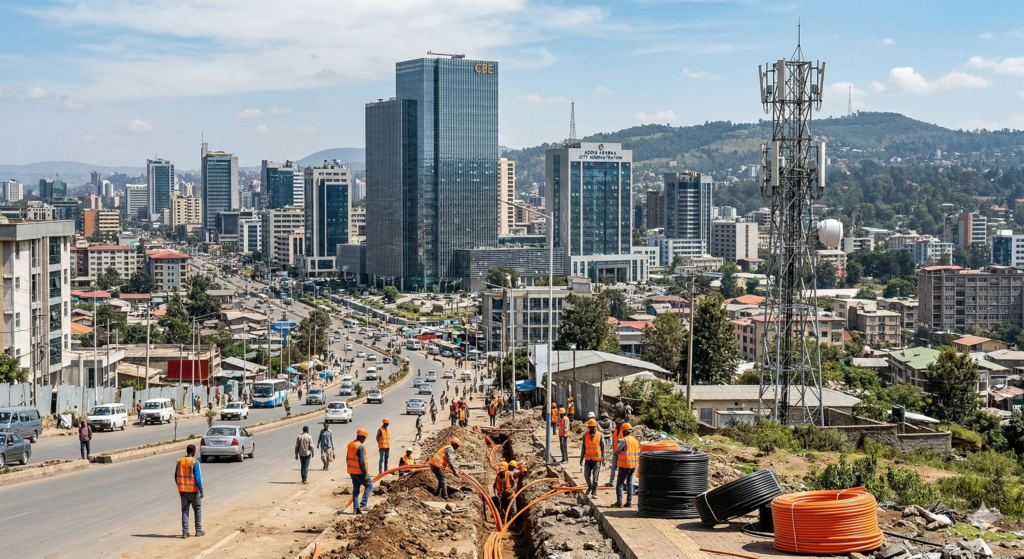
A panoramic view of Addis Ababa, Ethiopia, showing a blend of modern skyscrapers and telecommunications infrastructure representing the nation’s rapid digital transformation.
Why Ethiopia Became China’s Digital Laboratory
Ethiopia offered conditions rarely available at scale:
- A centralized, state-led development model
- A telecom monopoly (Ethio Telecom)
- Strong political alignment with China’s non-interference doctrine
- Massive unmet connectivity demand
- Limited Western competition due to governance concerns
For Beijing, Ethiopia was ideal: large population, strategic location in the Horn of Africa, and a government willing to move fast without public contestation.
For Addis Ababa, Chinese firms offered something no one else did — nationwide connectivity at speed, financed with long-term credit.
The Backbone: Huawei and ZTE Build a Nation’s Network
Between 2006 and 2024, Huawei and ZTE built nearly every layer of Ethiopia’s telecom system
- 2G, 3G, and 4G mobile networks
- National fiber-optic backbone
- Core switching infrastructure
- Data transmission systems
- Network management platforms
Known collectively as the Telecom Expansion Projects (TEPs), these contracts exceeded $4.6 billion in value across multiple phases from 2006-2013. Key deals included a $1.5 billion network expansion in 2006 (ZTE, Huawei, and China International Telecommunication Construction Corporation), a $1.6 billion joint Telecom Expansion Project in 2013 split between Huawei and ZTE, Huawei’s $700 million 4G deal in 2013, and ZTE’s $800 million broadband network the same year.
Financing came primarily through China Exim Bank export credits and vendor financing arrangements.
By 2020, Ethio Telecom served over 50 million subscribers, reaching 66.6 million by end-2021 — up from fewer than 8 million a decade earlier. This represented one of the fastest expansions in Africa, with mobile penetration rising from 10% in 2010 to 39% by 2019, and approaching 58% by 2021.

| Metric | 2010 | 2020 | 2021 |
|---|---|---|---|
| Mobile Subscribers | 7-8M | 50-55M | 66.6M |
| Mobile Penetration | 10% | ~45% | ~58% |
| Licensed Operators | 1 | 1 | 2 |
| Primary Vendors | Huawei, ZTE | Huawei, ZTE | Huawei, ZTE + diversified |
Western vendors declined participation. The margins were low, the risks high, and the political environment uncertain. Firms like Ericsson and Alcatel-Lucent couldn’t compete with Chinese financing and pricing, while Western development institutions blacklisted Ethiopia for loans due to concerns over the state monopoly and human rights record. China stepped in.
Speed vs Sovereignty: The Trade-Off
The benefits were immediate and visible:
- Rural connectivity reached previously isolated regions
- Mobile money and digital services expanded
- Government agencies digitized operations
- Ethiopia leapfrogged years of telecom development
But the costs accumulated quietly.
With a single-vendor ecosystem, Ethiopia’s telecom infrastructure became deeply dependent on Chinese hardware, software, spare parts, and expertise. Engineers were trained on Huawei systems. Maintenance contracts locked in relationships. Upgrades flowed naturally to incumbent suppliers.
This is not a flaw of design. It is the logic of integrated infrastructure.
The Surveillance Layer: Safe City in Addis Ababa
Beyond telecoms, Chinese firms built Ethiopia’s most sensitive digital systems.
Addis Ababa’s “Safe City” project, implemented by Huawei and ZTE, installed over 1,900 surveillance cameras, integrated facial recognition software, and centralized command-and-control platforms operated by federal police.
The system allows:
- Real-time monitoring of public spaces
- Automated vehicle and face identification
- Data aggregation across ministries
- Rapid deployment of security forces
The project was marketed as crime prevention and traffic management. But its deployment during Ethiopia’s civil conflict (2020–2022) raised unresolved concerns.
No independent audit has clarified:
- How the system was used during the conflict
- Whether Chinese technicians provided operational support
- Who retained administrative access
- How long data is stored and where
The opacity reflects typical security sector practices found in both authoritarian and democratic contexts worldwide. Yet in a single-vendor environment, the absence of transparency compounds dependency concerns.
War and Infrastructure: When Networks Become Strategic Assets
During the Tigray conflict, telecom networks were repeatedly shut down. Internet blackouts lasted over 720 days in Tigray, starting November 2020, becoming a tool of state control (Internet Society, 2022).
This revealed an uncomfortable truth: digital infrastructure is not neutral.
When the state controls networks, data centers, and surveillance systems — and when those systems are built and maintained by foreign vendors — technology becomes a lever of political power.
China did not direct Ethiopia’s internal decisions. But its technology enabled them.
It’s worth a brief note that while China doesn’t interfere in internal politics, the architecture itself is a form of interference. By providing the tools for “Safe Cities” and internet shutdowns, the vendor provides the capability for authoritarianism even if they never issue a single political command.
This distinction matters.
African Agency: Ethiopia’s Underreported Negotiation Wins
Ethiopia is often portrayed as dependent. The reality is more complex.
Unlike many African states, Ethiopian negotiators successfully demanded:
- Local employment quotas
- Technology transfer clauses
- Training programs embedded in contracts
- Joint operational teams
Cognitive Path Dependency
The infrastructure is in the brains of the people running it. Thousands of Ethiopian engineers were trained through Huawei academies and overseas programs. While much of this training was vendor-specific, it still built a domestic technical class capable of operating national systems.
This demonstrates a key lesson: dependency is shaped by negotiation strength, not vendor nationality.
Yet framing Ethiopia purely as victim obscures its own strategic calculations. Ethiopian officials have consistently defended partnerships with Chinese firms, citing unprecedented connectivity gains and favorable financing unavailable from Western sources. Chinese state media emphasizes mutual benefit and non-interference, contrasting with what Beijing frames as Western “digital colonialism” through restrictive governance conditions.
The question is not whether Ethiopia exercised agency, but whether that agency was sufficient to balance long-term strategic vulnerabilities.

Huawei-branded networking gear and blinking LEDs
Liberalization Changes the Equation
In 2021, Ethiopia partially liberalized its telecom sector, granting a license to Safaricom-led Global Partnership for Ethiopia — backed by Vodafone, Vodacom, CDC Group, and Sumitomo.
This introduced competition for the first time.
Safaricom did not rely exclusively on Chinese vendors. It diversified equipment suppliers and financing sources, bringing European and Indian firms into the ecosystem.
But liberalization also exposed the challenge of transition:
- Legacy networks remain Chinese-built
- Interoperability is complex
- Regulatory capacity must expand rapidly
Ethiopia now operates a dual-system telecom landscape — one state-owned, Chinese-built; one competitive, diversified.
The Diversification Challenge (2021-2025)
While Safaricom’s entry introduced competition, the transition has proven complex. By 2025, Safaricom reported financial losses despite contributing an estimated $3.1 billion to Ethiopia’s GDP through infrastructure investment and economic activity. The operator struggled with regulatory hurdles, infrastructure costs, and the challenge of competing against an entrenched state operator with Chinese-built advantages.
Meanwhile, China-Ethiopia engagement continued evolving. New memoranda of understanding signed in 2025 focus on 5G deployment and AI infrastructure development, suggesting that diversification has not meant displacement. Huawei and ZTE remain deeply embedded in Ethiopia’s core network infrastructure, and new technology layers build upon existing foundations.
This dual trajectory — competitive markets alongside continued Chinese partnerships — reflects a broader African pattern: liberalization creates options but rarely erases incumbent advantages built over decades.
Ethiopia’s path differs from other regional approaches. Kenya pursued vendor diversification from the outset, with Safaricom partnering with multiple suppliers including Huawei, Ericsson, and Nokia. Tanzania has gradually pivoted from Chinese dominance toward European alternatives for 5G core networks. Ethiopia’s late diversification means working around, rather than replacing, existing infrastructure — a more costly and complex transition.
The Diversification Cost
Contrasting Ethiopia’s pre-2021 single-vendor telecom model with the post-2021 multi-vendor landscape across metrics of rollout speed, cost, security, and political leverage.
| Feature | Single-Vendor (Pre-2021) | Multi-Vendor (Post-2021) |
| Speed of Rollout | High (Integrated) | Moderate (Interoperability lags) |
| Cost | Lower (Bulk financing) | Higher (Premium for diversity) |
| Security | Opaque (Vendor-managed) | Higher (Cross-audit potential) |
| Political Leverage | Low (State-vendor lock) | Higher (Negotiation options) |
China’s Strategic Payoff
For China, Ethiopia delivered several strategic advantages:
- Proof that Chinese vendors can build national-scale networks
- A demonstration of Safe City technology in an African capital city
- Long-term financial leverage through telecom debt
- Regional influence in the Horn of Africa
- A training ground for large-scale ICT deployment
Ethiopia became both reference case and showcase — a model Chinese firms could point to when bidding for contracts across Africa and the Global South.
Western Absence — and Late Entry
Western governments and firms stayed largely on the sidelines for years.
Concerns over governance, human rights, and state monopolies limited engagement. When liberalization arrived in 2021, China already dominated the terrain. Western investors entered a market where the rules, infrastructure, and technical standards had been shaped by a decade of Chinese deployment.
This pattern — abstain early, compete late — recurs across Africa.
While Western firms were conducting “feasibility studies” and “human rights impact assessments,” Chinese firms were already laying the fiber.
The question facing Western policymakers is whether principled abstention during authoritarian phases ultimately strengthens or weakens their ability to influence outcomes during democratic openings.
What Ethiopia Teaches Africa
Ethiopia offers lessons that resonate far beyond its borders:
Speed matters — but so does exit strategy. Rapid deployment solved immediate connectivity needs but created long-term dependencies that proved difficult to unwind.
Single-vendor ecosystems scale fast but constrain choice. Integrated systems deliver efficiency during buildout but reduce negotiating leverage during upgrades and transitions.
Surveillance capacity expands silently, not incrementally. Safe City systems were operational before public debate about their use materialized. Once deployed, reversing surveillance infrastructure is politically and technically challenging.
Negotiation strength determines outcomes more than ideology. Ethiopia’s success in securing training programs and technology transfer clauses demonstrates that African governments are not passive recipients. Yet negotiation wins during deployment do not guarantee sovereignty during operations.
Liberalization after dependency is harder than diversification early. Ethiopia’s 2021 reforms introduced competition but could not easily displace existing infrastructure. Countries approaching telecom development now face a choice: accept single-vendor efficiency or pay the premium for multi-vendor resilience.
Digital Sovereignty Is a Moving Target
Ethiopia is not locked forever into its current configuration. But reclaiming leverage will require:
- Vendor-neutral technical training through pan-African certification programs beyond proprietary systems, potentially coordinated through the African Union’s Digital Transformation Strategy
- Independent cybersecurity audits of critical infrastructure, with results made public to enable informed policy debate
- Comprehensive data protection legislation that establishes clear rules on collection, storage, access, and cross-border data flows
- Transparent rules on surveillance use including judicial oversight, public reporting on deployment, and limits on acceptable applications
- Regional cooperation on technical standards to reduce individual country dependence on any single vendor ecosystem
None of these are purely technical decisions. They are political ones — requiring state capacity, political will, and the courage to impose costs on powerful incumbents.
Ethiopia as a Warning — and a Template
Ethiopia is neither failure nor cautionary tale alone. It is both warning and template.
China helped Ethiopia connect millions, modernize government, and leapfrog infrastructure gaps that Western models left untouched. Rural communities gained access to information, markets, and services that transform daily life. Government agencies digitized operations in ways that improved efficiency and reach. These are real gains that improved real lives.
At the same time, that connectivity integrated systems enabling enhanced state oversight and created structural dependencies that limit future policy options. The technology that connected Ethiopia also concentrated power — in ways that became visible during conflict but were embedded during construction.
Ethiopia shows what happens when digital infrastructure and political authority evolve together, without strong external checks, independent oversight, or competitive alternatives.
For Africa, the lesson is not to reject Chinese technology.
The lesson is to understand it deeply, negotiate it carefully, and govern it relentlessly.
Because in the digital age, the state that controls the network controls far more than connectivity. It shapes the terms of participation in the digital economy, the boundaries of acceptable speech, the visibility of dissent, and the balance between security and privacy.
Ethiopia’s experience suggests that these questions must be asked during procurement, not after deployment. By the time surveillance cameras are installed and networks are operational, the political economy of digital infrastructure has already been set.
The next generation of African digital infrastructure — spanning 5G, artificial intelligence, smart cities, and digital identity systems — will make today’s choices look simple by comparison. The stakes are rising.
Ethiopia’s story is not finished. But it offers a clear message: digital sovereignty is not a gift. It is negotiated, built, defended, and constantly renewed. Countries that treat infrastructure as purely technical will discover too late that it was always political.