Who Owns Africa’s Internet? The Infrastructure Behind the Connection
Africa is more connected than ever. Subsea cables ring the continent, mobile towers dot its cities, and fiber routes are expanding inland. But connectivity is not just about access — it is about ownership. And on that question, the picture looks very different.
The cables, towers, and data routes carrying African internet traffic are overwhelmingly owned, financed, or operated by entities outside the continent. Africa is connected. It does not own its connection.
The Subsea Layer: Bandwidth Without Sovereignty
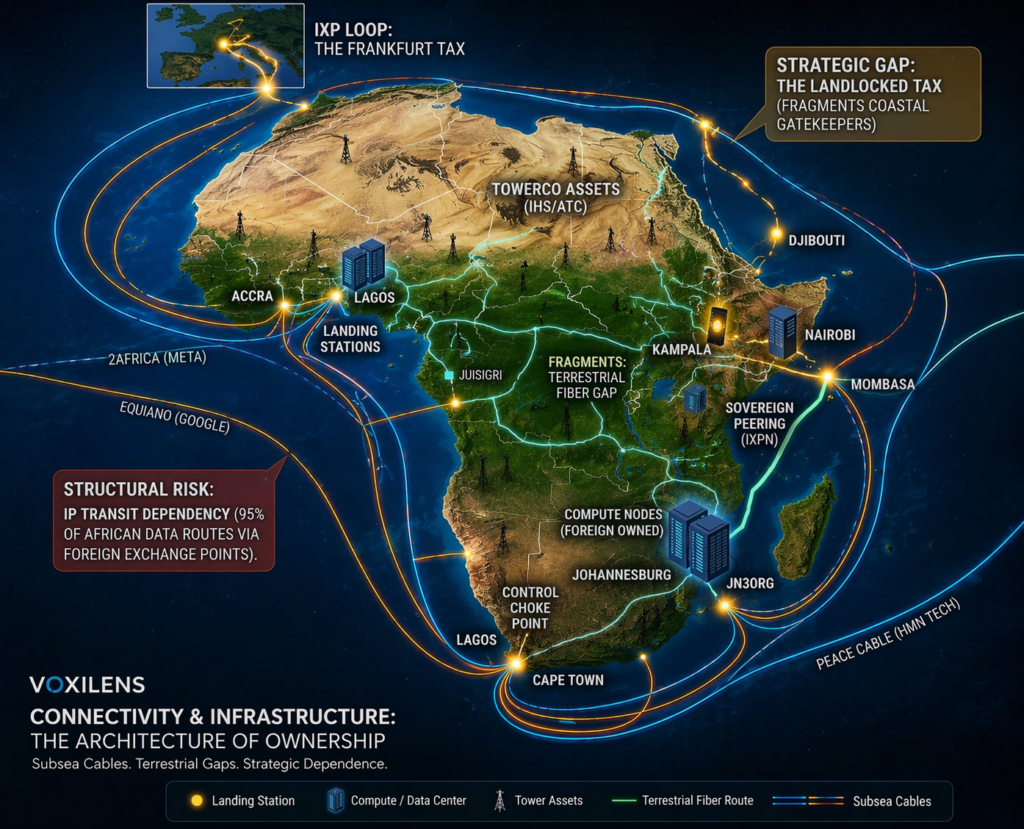
More than 95% of global internet traffic travels via subsea cables. Approximately 30 major systems serve Africa — but the ownership map is telling. China’s HMN Technologies has built or upgraded a significant share of cables serving East and West Africa.
Meta and Google have invested in dedicated systems — 2Africa and Equiano — that increase bandwidth but place control in the hands of platforms whose core business is extracting data, not protecting sovereignty. African-owned cable consortia remain the exception.
The “Kill-Switch” Dependency. Reliance on a limited number of high-capacity cables (like 2Africa or Equiano) creates a single point of failure. Without redundant, diverse routing under sovereign control, a single maritime accident or geopolitical dispute can de-link an entire regional economy from the global internet.
Ownership Asymmetry. When Big Tech platforms (Meta and Google) own the cables, they control the “Quality of Service” (QoS) priorities. There is a risk that platform-owned traffic is prioritized over local African industrial or governmental data.
The Terrestrial Fiber Gap
Subsea cables land at the coast. From there, data must travel inland — and this is where Africa’s connectivity breaks down most visibly. Landlocked countries like Uganda, Zambia, and Ethiopia depend on coastal neighbours for international bandwidth, across fragmented routes often controlled by a single state-owned operator with little incentive to reduce prices.
A business in Kampala pays significantly more for equivalent bandwidth than one in Mombasa — not because the infrastructure cost justifies it, but because the ownership structure allows it.
The “Landlocked Tax.” Nations like Zambia, Ethiopia, or Rwanda pay a premium for data transit that is unrelated to the cost of the fiber itself. Instead, pricing is dictated by the rent-seeking behavior of coastal gatekeeper states and their monopoly operators.
Fragmented Sovereignty. The lack of a unified “African Backhaul” means that data moving between neighboring countries often leaves the continent entirely. This creates a “Data Leakage” vulnerability where African traffic is subject to foreign surveillance laws in transit hubs like Marseille or London.
Towercos and the Outsourcing of Public Infrastructure
For most Africans, internet means mobile data. Over 250,000 towers across the continent have undergone a quiet ownership shift — purchased from telecoms by towercos like IHS Towers, Helios Towers, and American Tower Corporation, which lease capacity back to operators. Telecoms unlocked capital. But the physical infrastructure of mobile connectivity moved further from African public control.
Asset Financialization. As towers move from telecom operators to global Towercos (IHS, American Tower), infrastructure is managed for quarterly dividend yields rather than long-term national coverage.
The Rural-Urban Connectivity Divergence. Because Towercos prioritize high-density urban “tenancy ratios” (multiple carriers on one tower), rural and underserved areas face a widening infrastructure deficit. The physical layer of connectivity is being optimized for profit, not for universal access or national security.
The Internet Exchange Point Problem
An Internet Exchange Point (IXP) keeps local data local — preventing an email sent across Accra from routing through Frankfurt before arriving. Nairobi’s KIXP and Lagos’ IXPN are among the continent’s most active, but many African countries still lack a functioning IXP entirely.
Building IXP density is one of the highest-leverage, lowest-cost interventions available to African governments. It receives a fraction of the financing that subsea cables attract.
The “Frankfurt Loop.” When local ISPs do not peer at a domestic IXP, a message sent between two people in the same city must travel to an exchange point in Europe and back. This wastes international bandwidth and unnecessarily increases the cost of data for the end-user.
Intelligence Vulnerability. Routing domestic traffic through foreign exchange points subjects local communication to international “lawful intercept” and signal intelligence by non-African entities. Domestic IXPs are the primary defense against this type of structural surveillance.
Why Internet Ownership Matters
When a subsea cable is cut — as happened to West Africa in early 2024 — the countries most exposed are those with the least redundancy and least negotiating power. When a foreign-owned towerco restructures its portfolio, rural connectivity can degrade overnight. And when a platform-owned cable prioritises its own traffic, African governments have no formal recourse.
In an era where data is the primary input to AI systems, who owns the pipes determines who owns the intelligence those pipes produce.
The Voxilens Connectivity Framework
At Voxilens, connectivity is a political layer, not just a technical one. We follow three questions: who owns the physical infrastructure, who controls the routing decisions, and who sets the pricing. Without sovereign infrastructure, the rest of the stack — compute, AI, data — will be built on someone else’s terms.
Once the pipes are owned, the next question is where the data is stored. Read our analysis on [Data Centers & Cloud Sovereignty] to see how connectivity dictates the geography of African intelligence.
Follow the stack: Minerals → Energy → Connectivity → Compute → Policy.
The Voxilens Glossary: Connectivity as Statecraft
In the world of infrastructure, technical definitions are often used to obscure power dynamics. We define these terms through the lens of structural influence.
1. Dark Fiber
- Thousands of miles of fiber-optic cable that have been laid but are not yet “lit” (activated) by laser pulses.
- The Dark fiber represents latent sovereignty. For a state, owning dark fiber is like owning a strategic land reserve. It allows for future network expansion without being dependent on a foreign provider’s pricing or permission.
2. Lit Capacity
- The portion of a fiber cable that is actively transmitting data using specific networking equipment.
- This is where gatekeeping happens. Whoever owns the equipment that “lights” the fiber controls the bandwidth. If a country owns the fiber but not the lighting equipment, they are tenants in their own house.
3. IP Transit vs. Peering
- Transit is paying a larger network to carry your data to the rest of the world; Peering is a mutual agreement between two networks to exchange data for free.
- Africa is currently a “Transit Continent.” Because most data routes through Europe or North America, African ISPs pay a “data tax” to foreign entities. Peering—facilitated by local IXPs—is the primary mechanism for financial and digital independence.
4. Landing Stations
- The physical building where a subsea cable comes ashore and connects to the terrestrial network.
- These are choke points. A landing station is a site of intense geopolitical interest. The security, power supply, and regulatory oversight of these buildings determine whether a nation can protect its data privacy or is subject to external surveillance.
5. Latency (The “Distance Tax”)
- The time it takes for a data packet to travel from source to destination.
- In the age of AI and high-frequency trading, latency is a competitive disadvantage. Routing local African traffic through London adds hundreds of milliseconds of latency. This “distance tax” makes African tech startups less competitive than their global counterparts.
Voxilens publishes structural analysis at the intersection of African resources, global technology, and geopolitical competition.