
As two superpowers race to shape Africa’s AI future, we break down who is investing what — from Huawei’s open-source push and DeepSeek’s surprise chatbot foothold, to Microsoft’s data centers and Starlink’s orbital bypass of Chinese ground infrastructure.
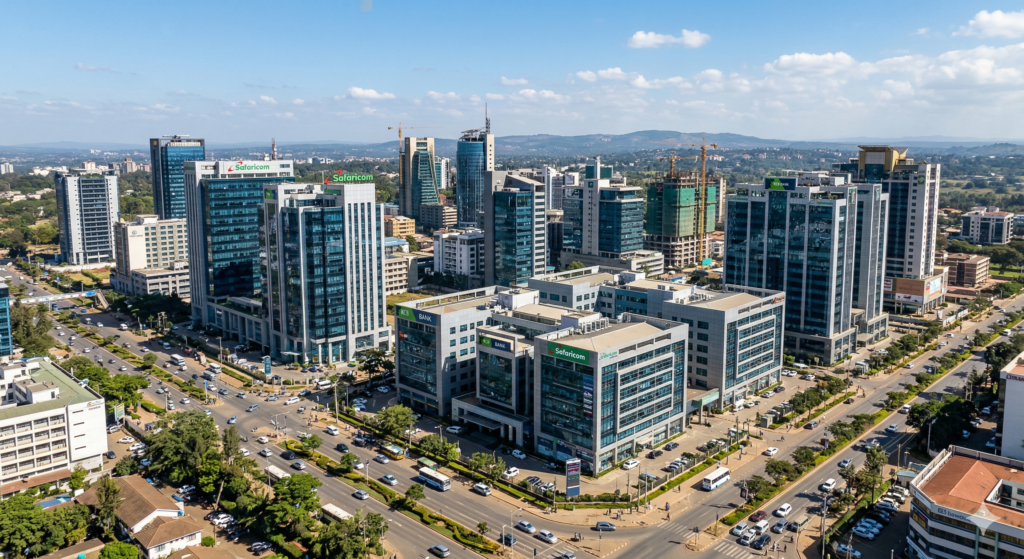
Nairobi tech hub skyline 2026 — Africa’s fastest-growing AI investment destination
At Davos in January 2026, Strive Masiyiwa cut through the diplomatic pleasantries with a warning that landed harder than he may have intended: “If you don’t invest, Africa will turn to where it can get that investment.” Both American and Chinese delegations were in the room. Everyone understood what “where it can get that investment” meant in practice.
The context is not subtle. Africa holds the world’s youngest population, sits atop critical mineral reserves essential to AI hardware supply chains, and is experiencing AI adoption growth faster than almost any other region — even starting from a lower base.
Africa’s AI adoption
Global AI adoption is accelerating, but widening the gap. Global North 24.7% vs Global South 14.1% (Microsoft 2025 AI Diffusion Report). That gap (The 10.6-point gap ) is the prize both superpowers are racing to fill — and China US AI investment in Africa in 2026 looks nothing like it did even two years ago.
This is Voxilens’s annual scorecard: a side-by-side assessment across five dimensions — infrastructure, AI model strategy, data centers, connectivity, and talent.
We also examine two themes that have sharpened considerably since last year’s edition: the rise of sovereign Chinese LLMs (DeepSeek and Qwen), and the concept of compute sovereignty — who controls the hardware that runs AI inference at scale. We close with a city-level verdict, picking Kenya’s Nairobi as the most instructive single battleground of 2026.
The scorecard at a glance: five dimensions, two powers
The table below is the quick-reference layer of this analysis. The sections that follow unpack each row in depth.
| Dimension | 🇨🇳 China | 🇺🇸 United States |
|---|---|---|
| Infrastructure volume | $700B+ Belt and Road engineering deals over a decade; 70% of Africa’s 4G built by Huawei/ZTE. Energy in 15 countries — 10× US power capacity. | Smaller cumulative volume; accelerating via DFC loan guarantees. GPU diplomacy through targeted compute grants. Focus on urban tech hubs. |
| AI model strategy | Open-source sovereign LLMs: DeepSeek and Qwen distributed through Huawei/Alibaba startup hubs. 11–20% chatbot share in Uganda, Niger, Zimbabwe, Ethiopia. | Proprietary cloud models: GPT-4o via Microsoft, Google Gemini, AWS Bedrock. Higher performance ceiling; higher API cost; inference latency disadvantage outside US cloud regions. |
| Connectivity | Huawei/ZTE terrestrial 4G/5G. Dominant in rural and peri-urban Africa. Active in 40+ countries. Low inference latency on local Huawei cloud nodes. | Starlink LEO satellite — live in 40+ African countries by end-2025. Bypasses Chinese ground infrastructure entirely. Terminal cost limits household uptake. |
| Data centers & compute sovereignty | Huawei $430M data center plan; Alibaba Cloud in South Africa. Inference on Chinese-owned hardware = Chinese compute sovereignty at the infrastructure layer. | Microsoft $1B+ Kenya; Google Cloud South Africa; AWS Cape Town. Western hyperscalers dominate enterprise tier. Data residency rules a growing leverage point. |
| Talent & skills | Huawei Seeds for the Future: 150,000+ African students trained (2025). Largest single tech skills programme on the continent by volume. | Microsoft Elevate Africa, Google Career Certificates, Meta developer programs. Fragmented but accelerating. Quality edge at senior developer tier. |
The AI stack: who owns which layer?
The most useful frame for this competition is not investment volume — it is stack position. Every AI deployment in Africa runs through at least six layers: energy, physical network, compute hardware, cloud platform, foundation model, and application.
China and the US are not simply competing for the same territory. They hold different layers with different strategic leverage.
| Layer | China’s Footprint | United States’ Footprint |
| Application | Consumer & Agri Apps: WeChat, Alibaba commerce, FOCAC agri-AI tools. | Enterprise & Startup Apps: M365 Copilot, GitHub Copilot, fintech. |
| Foundation Model | DeepSeek / Qwen (Open-weight): 11–20% chatbot share in 4 countries. | GPT-4o / Gemini / Claude: Higher performance; API-gated; higher cost. |
| Cloud / Compute | Huawei / Alibaba Cloud: $430M data center buildout underway. | Microsoft / Google / AWS: $1B+ committed; enterprise dominant. |
| Connectivity | Huawei 4G/5G (Terrestrial): 70% of Africa’s 4G; 40+ countries. | Starlink (LEO Satellite): 40+ countries; bypasses ground layer. |
| Network Hardware | Huawei / ZTE Equipment: Dominant on existing 4G/5G gear. | Cisco / Ericsson / Nokia: Security-rated; higher unit cost. |
| Energy | BRI Power: 15 countries; ~10× US power capacity invested. | DFC Clean Energy: 3 countries; smaller but growing; solar-heavy. |
Strategic Breakdown
Contested Layers: Cloud / Compute and Satellite Connectivity. This is where the 2026 battle is fiercest, as Starlink attempts to render Huawei’s ground-based dominance irrelevant.
China-Dominant Layers: Energy, Network Hardware, and Terrestrial Connectivity. China is the “General Contractor” of the African digital state.
US-Dominant Layers: Foundation Models and Enterprise SaaS. The U.S. is the “Operating System” for African high-finance and formal business.
The concept of compute sovereignty maps directly onto this stack. When a Nairobi startup calls a DeepSeek API hosted on a Huawei cloud node, inference is happening on Chinese-owned silicon. When the same startup calls GPT-4o via Microsoft Azure, inference runs on US-owned servers.
For African governments thinking about data residency, national security, and the terms of vendor dependency, this distinction is becoming impossible to ignore. Inference latency compounds the picture: locally-hosted Huawei cloud models respond faster than queries routed to a European or American data centre — and in bandwidth-constrained markets, latency is a business metric.
China’s playbook: infrastructure first, AI second
To understand China’s AI ambitions in Africa, you need to understand that the AI investment is the capstone of a strategy that began with roads, ports, and power grids — not its starting point. By the time Huawei was distributing AI toolkits in Nairobi startup hubs in 2024, it had already spent two decades building every layer beneath the model tier. This is what distinguishes China’s approach from all prior technology competition on the continent: it owns the digital backbone.
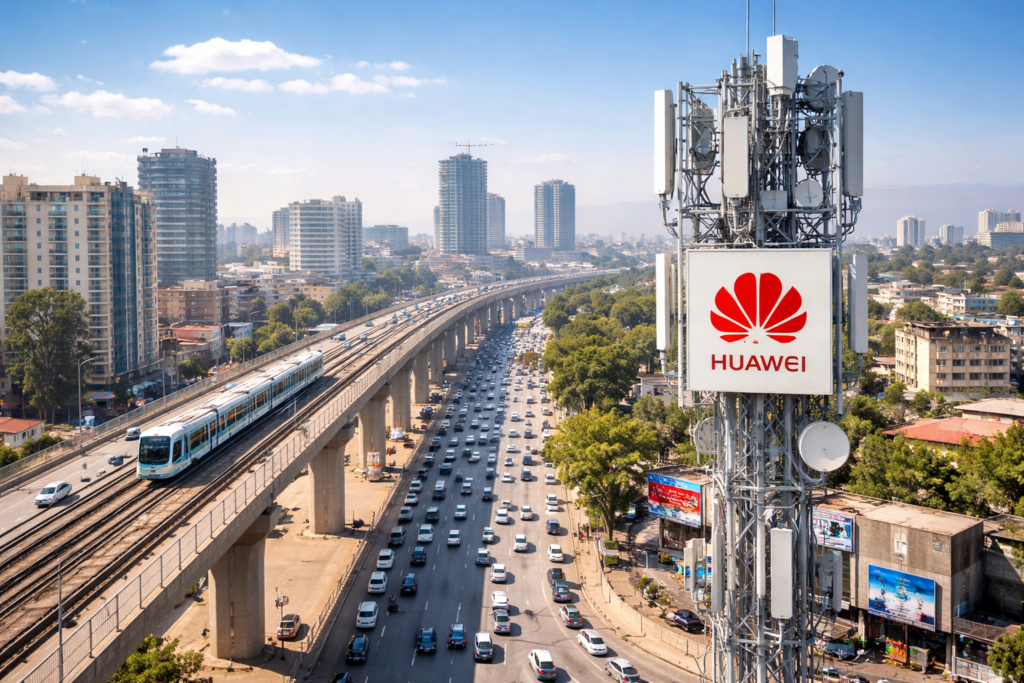
A Huawei-branded telecom tower in Addis Ababa, Ethiopia
The infrastructure foundation
China built 70% of Africa’s 4G infrastructure through Huawei and ZTE. That is not simply a technology statistic — it is an operating layer. Every AI model deployed on the continent running over a mobile network is, in most countries, running on Chinese-built infrastructure.
52 African countries have signed Belt and Road agreements, and more than $700 billion in Chinese engineering deals have flowed into the continent over the past decade. The Digital Silk Road — China’s AI-specific policy layer — sits directly on top of that physical foundation.
The energy picture is equally stark. According to ODI data from 2025, China secured energy investments in 15 African countries — generating roughly 10× more power capacity than US investments, which cover only three countries.
You cannot run AI inference at scale without cheap electricity. China is building the power infrastructure to support it under BRI financing terms that routinely include Chinese equipment procurement requirements — a self-reinforcing cycle across the stack.
On data centers, Huawei has announced a $430 million investment plan with facilities in Nigeria, Kenya, South Africa, and Egypt. Alibaba Cloud operates commercial services from Johannesburg.
The inference latency advantage this creates is real: locally-hosted models respond faster than queries routed to European or US nodes. In markets where bandwidth costs are high, latency is not just a user experience metric — it is a structural cost advantage for Chinese-origin cloud services.
The rise of sovereign Chinese LLMs: DeepSeek and Qwen
The single most important development in China’s Africa AI strategy in 2025 was not infrastructure — it was a model. DeepSeek, backed by Chinese state-linked funds through its parent company High-Flyer, emerged as a genuinely competitive open-weight large language model in early 2025. Its African footprint has grown faster than almost anyone predicted.
The data point that matters most came not from Beijing but from Redmond. Microsoft’s own 2025 AI Diffusion Report disclosed that DeepSeek now accounts for between 11% and 20% of chatbot usage in Uganda, Niger, Zimbabwe, and Ethiopia.
Microsoft published this number because its investors needed to understand the competitive threat. A Chinese state-linked model capturing a fifth of chatbot usage in African markets within a single year of mainstream availability is not a marginal signal.
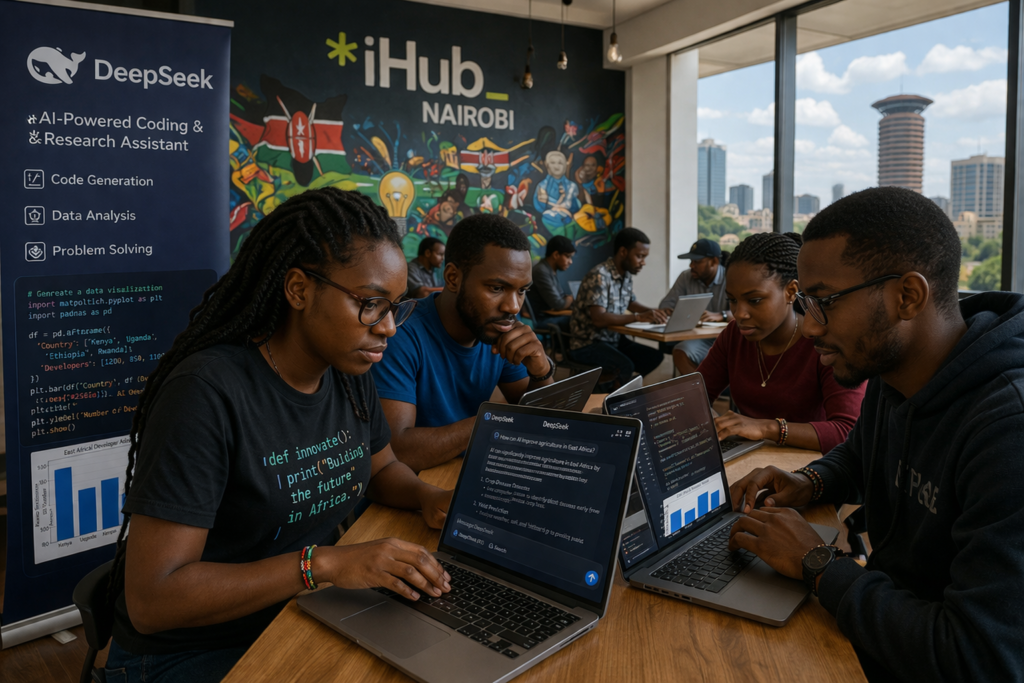
Qwen model
Alibaba’s Qwen model family is running a parallel track, distributed through startup hubs and cloud programmes across East and West Africa. Together, DeepSeek and Qwen represent a sovereign Chinese LLM strategy that differs from earlier Chinese technology exports in one crucial respect: the models are open-weight, meaning anyone can download and run them. This looks like openness. It functions as strategic entrenchment.
African developers who build applications on DeepSeek are not becoming independent — they are building dependency on a Chinese-origin model stack. When that stack runs on Huawei cloud infrastructure over Huawei 4G networks, a chain of Chinese control extends from the model layer all the way down to the physical antenna.
DeepSeek’s documented avoidance of politically sensitive topics — Tiananmen, Uyghur repression — means its spread in markets with lower media literacy and weaker data protection regulations carries risks that extend well beyond commercial competition. This is China’s deepest soft-power liability in Africa, and it is one that African civil society organisations are beginning to name publicly.
Surveillance and the governance liability
11 African nations have spent an estimated $2 billion on Chinese AI surveillance cameras (Rest of World, March 2026). Nigeria’s $470 million system is the most studied case — cameras blanketing Lagos and Abuja under a contract that gave Chinese engineers ongoing system access.
Rest of World found zero adequate legal oversight frameworks in any of the 11 countries. This is China’s structural soft-power vulnerability: the infrastructure-first approach that makes it so effective at scale also creates a visible, politically legible footprint.
African advocacy organisations, opposition politicians, and international human rights NGOs are all circling the same story, and it is only a matter of time before a governance crisis in one country reshapes procurement decisions in others.
The US playbook: cloud quality, orbital connectivity, and GPU diplomacy
The United States entered this competition later, with less physical infrastructure on the ground, and with a fundamentally different theory of victory. Where China builds the ground layer and places AI on top of it, the US is betting that cloud-tier quality. An entirely new connectivity layer from orbit, and strategic compute grants — GPU diplomacy — can leapfrog the infrastructure deficit over a five-to-ten year horizon.
Enterprise cloud and compute sovereignty
The flagship commitment is Microsoft’s multi-year investment in Kenya, publicly valued at over $1 billion, including a data center, cloud infrastructure, and AI skills programming. Google Cloud operates in South Africa; AWS’s Cape Town region is the primary Western cloud node for sub-Saharan Africa.
For African enterprises — banks, telecoms, government ministries — Western hyperscaler stacks remain the default at the high end of the market, and Western data residency and security certifications are increasingly a procurement requirement for government contracts.
The GPU diplomacy angle is newer and more targeted. The DFC has begun offering loan guarantees for AI compute infrastructure carrying requirements for US-origin hardware — Nvidia chips rather than Huawei Ascend. This is not aid: it is infrastructure financing with geopolitical conditions attached.
The effect is to give African governments a financially viable path to Western-origin compute that competes on price with Chinese BRI financing terms. It is early-stage but represents a more sophisticated tool than anything the US brought to the table in the 2018–22 period, when it was largely reduced to issuing Huawei security warnings without a credible alternative offer.
The proprietary model disadvantage is real but frequently overstated. For consumer products and SMEs where frontier performance is not required, the cost gap is the dominant factor and it favours DeepSeek. For government AI programmes, regulated financial services, and health AI, the quality and auditability of Western models often justifies the price premium. The market is segmenting on exactly these lines.
Starlink and the orbital bypass
SpaceX’s Starlink is the US’s most genuinely asymmetric move. By end-2025, Starlink was live in more than 40 African countries, providing broadband that requires no terrestrial infrastructure at all. In rural areas where Huawei’s 4G networks have not reached, Starlink is the first broadband many communities have ever experienced.
China: terrestrial dominance
Huawei/ZTE 4G/5G covering the majority of urban and peri-urban Africa. Built on BRI contracts with tied hardware procurement. Low inference latency for locally-hosted Huawei cloud models. Deep rural penetration in active BRI countries.
US: orbital bypass
Starlink LEO satellite active in 40+ countries. Requires no ground network equipment. Bypasses Chinese-built terrestrial infrastructure entirely. Terminal cost (~$300–500) constrains household uptake; commercial and government deployment is growing fast.
The geopolitical significance of Starlink goes beyond latency comparisons. A government, NGO, or journalist who wants to communicate without traversing Chinese-built infrastructure now has a practical, commercially available option.
That changes the compute sovereignty calculus in ways no amount of terrestrial investment rivalry can replicate. It is the one area where the US has a structural first-mover advantage that China cannot match through BRI-style financing.
Talent: winning on quality, losing on volume
Huawei’s Seeds for the Future programme has trained more than 150,000 African students as of 2025 — the largest single tech skills initiative on the continent by volume. Microsoft Elevate Africa, Google Career Certificates, and Meta’s developer programmes are each substantial but fragmented across vendors and more recent in their African focus.
The US is losing the volume war on talent, even as it holds a quality edge at the senior developer tier. The engineers who will architect Africa’s most significant AI systems in the next decade.
The stakes are long-term and structural. Whoever trains the developers building Africa’s AI applications in 2030 will have durable influence over which models, platforms, and cloud providers those developers default to.
Huawei understood this earlier and invested at scale accordingly. The US response — high-quality, shorter-duration programmes — is the right strategic bet only if quality at the pyramid’s apex outweighs volume at the base. The outcome of that wager will take years to become legible.
Africa’s agency: the non-aligned option
Framing this as a binary US-China contest obscures something important. Africa is not a passive arena. More than a dozen governments have published national AI strategies since 2023. The African Union’s Continental AI Strategy explicitly invokes data sovereignty and warns against dependency — without naming either superpower, but in language both would recognise. As we argued in our analysis of Africa’s AI Minerals and a Non-Aligned Tech Policy, the continent’s critical mineral reserves give it a negotiating position that neither power can afford to discount.
The minerals lever
The DRC holds an estimated 70% of global cobalt reserves. Rwanda has significant coltan. Zambia’s copper is essential for the wiring of the data centers both Microsoft and Huawei are building across the continent. As the energy demands of large-scale AI inference drive a second wave of critical mineral demand in 2026–28, the countries that hold these reserves will gain negotiating leverage not yet visible in current investment flows.
African governments that play this card strategically — withholding export licences from powers that do not respect data sovereignty commitments — can reshape the competition in ways that neither Beijing nor Washington is currently modelling.
Smart African governments are already playing both sides deliberately: accepting Huawei 5G equipment while negotiating Microsoft cloud contracts, taking Chinese data center financing while licensing Starlink spectrum. This is not confusion — it is leverage.
The risk is not being forced to choose one superpower. The risk is that the pace of infrastructure deployment on both sides will entrench technical dependencies before adequate governance frameworks exist to manage them. The surveillance governance gap Rest of World identified is a symptom of this. When technology arrives faster than law, the technology sets the terms.
On infrastructure depth and current market share, China leads — and not narrowly. The combination of 4G dominance, BRI energy investment, local data center presence, low-inference-latency model delivery, open-source sovereign LLM distribution, and the continent’s largest talent programme represents a multi-decade head start on physical investment volume.
Who is winning, and where?
The US holds real advantages at the enterprise and government tier, GPU diplomacy is creating a new financial tool that did not exist two years ago, and Starlink has opened a connectivity layer that is genuinely outside China’s ability to displace. The backlash against Chinese surveillance systems is opening political space for Western alternatives in countries where civil society is strong.
The more precise verdict is that the competition is segmenting by market tier. China is winning decisively in the developer and SME segment, in rural connectivity, and in raw talent volume. The US is holding the enterprise and government segment, and leading in the orbital connectivity market.
Neither is winning the foundation model layer cleanly — which is precisely why the DeepSeek-versus-proprietary-API contest of the next 24 months matters so much. Compute sovereignty will be decided there.
Nairobi: the most contested city in African AI
If you want to take the temperature of the entire competition in one city, Nairobi is the answer — and right now, the US is leading there by a margin. Microsoft’s $1 billion Kenya commitment has placed the city firmly in the Western cloud orbit at the enterprise tier: Azure data centres, M365 Copilot across major Kenyan banks, Elevate Africa programming running through Nairobi’s iHub ecosystem. Google and AWS have active developer communities. The Kenyan government’s national AI strategy leans explicitly toward Western data residency standards.
Yet China is not absent. Huawei operates a major innovation centre in the city, DeepSeek has meaningful adoption in local startup communities for cost reasons, and Safaricom — the dominant mobile operator powering M-PESA and the digital economy — still runs on Huawei 4G/5G infrastructure.
A Nairobi developer in 2026 may be simultaneously trained by Seeds for the Future, building on DeepSeek APIs, deploying to Azure, and running over a Huawei network. That is not incoherence — it is rational extraction of value from both sides of a geopolitical competition. It is also, in microcosm, the answer to Masiyiwa’s Davos warning. Africa is not waiting to be chosen. It is choosing both.
Related reading: Chinese Tech Infrastructure in Africa (2026)
