
How Washington’s treatment of ASML as a domestic tool of geopolitical warfare is fracturing one of America’s most critical alliances — and may accelerate the very technology decoupling it claims to prevent
A Machine That Changed Everything
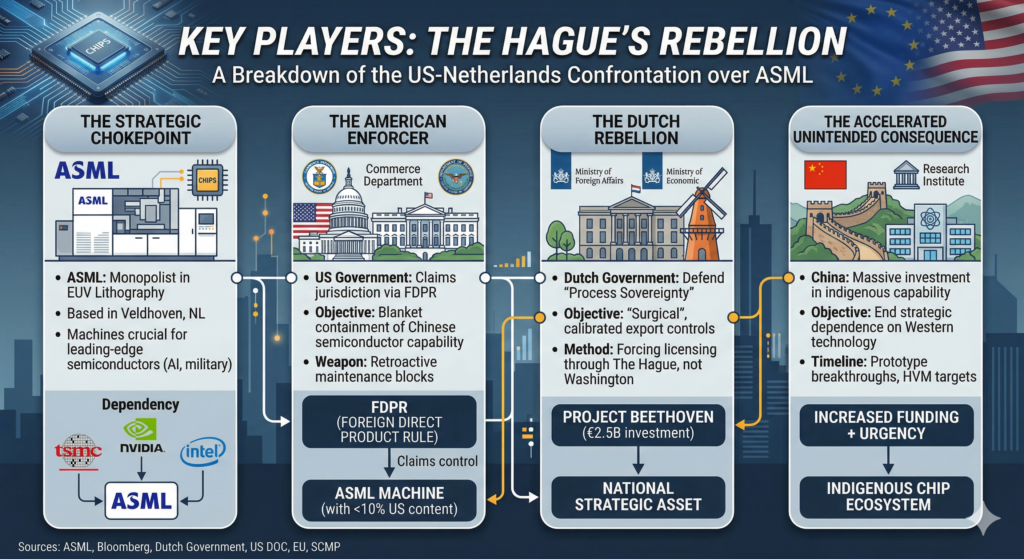
In a nondescript industrial suburb of Eindhoven called Veldhoven, workers in clean-room suits assemble what may be the most consequential manufactured object in the world. It weighs 180 metric tons. It costs roughly $380 million. Shipping it requires an entire truck convoy. Exactly one company on earth knows how to build it.
ASML’s Extreme Ultraviolet (EUV) lithography machine is not a product in any conventional sense. It is infrastructure — the physical substrate on which the entire global digital economy gets printed, layer by nanometer layer. Without it, TSMC cannot produce leading-edge chips.
Without those chips, there are no iPhones, no Nvidia AI accelerators, no advanced weapons systems, no satellites. Every path from Veldhoven leads to virtually every advanced technology in human civilization. When people discuss chokepoints in the global tech supply chain, they are, without exception, eventually talking about this building.
Why It Matters Now
This is why what happens between Washington and The Hague is no longer a bilateral diplomatic matter. A deeper question drives it: who controls the chokepoint that controls the modern world? And can America’s strategy of using that chokepoint as a unilateral geopolitical weapon survive contact with the sovereign state that actually owns it?
The Chokepoint: How the EUV Fits Into the Global Chip Chain
The EUV machine sits at a single, irreplaceable node in the global semiconductor manufacturing chain. Every path to advanced silicon passes through Veldhoven.
SUPPLIERS                       ASML                    CHIP FABS               END PRODUCTS
────────────────────            ─────────────────       ─────────────────       ─────────────────
Carl Zeiss (optics)      ─┐
Cymer / ASML (lasers)    ─┤
Trumpf (light source)    ─┼──▶  EUV Lithography   ──▶  TSMC / Samsung     ──▶  AI Accelerators
800+ global suppliers    ─┘     Machine                 Intel                   Smartphones
                                (Veldhoven, NL)          [SMIC — blocked]        Defense / Satellites
                                      │
                                ~10% US-origin
                                content triggers
                                FDPR jurisdiction
                                over 100% of the
                                machine
The jurisdictional paradox: A machine approximately 90% Dutch, German, and globally sourced in origin becomes subject to American export control law because of a ~10% US-origin technology threshold embedded in its supply chain. Washington argues this fraction grants jurisdiction over the whole. The Hague argues it does not.
The Dispute at a Glance
| Issue | US Position | Dutch / ASML Position |
|---|---|---|
| Jurisdiction | FDPR grants Washington control over any tool containing US-origin technology above a threshold | ASML is a Dutch entity subject to Dutch and EU law; sovereignty is not overridden by component origin |
| Maintenance in China | Servicing existing machines facilitates military-civil fusion and extends Chinese capability | Denying service breaches valid contracts and removes Western visibility, not Western risk |
| Economic Risk | Security interests outweigh short-term revenue loss | Restricting China revenue compresses the R&D budget required to maintain the next-generation technology moat |
| Rules Process | Allies should adopt US export control templates to ensure allied coherence | Dutch controls must reflect Dutch security assessments — surgical rather than the blunt American approach |
| Wassenaar Framework | Multilateral frameworks are too slow; bilateral pressure is operationally necessary | Bypassing Wassenaar to issue unilateral dictates treats allies as subsidiaries, not sovereign partners |
The Veldhoven-Washington Fault Line
The tensions now visible between the Netherlands and the United States did not materialize overnight. Washington began to grasp the strategic significance of ASML’s EUV technology in the mid-2010s. Here was a chokepoint of historic importance — located outside American borders, in a NATO ally’s territory, built with global components, and answering to Dutch law.
For years, both sides managed the relationship through quiet diplomacy and what insiders call the “Tripartite Agreement” — an informal arrangement between the United States, the Netherlands, and Japan coordinating export restrictions on advanced semiconductor manufacturing equipment to China.
The framework took shape in January 2023. Its implementation, however, proved protracted and contested. Dutch rules did not fully harmonize with American expectations until late 2024 and into early 2025. The friction of that process — the gaps, the carve-outs, the Dutch insistence on calibrating measures to their own legal framework — defined the 2024-2025 period far more than the agreement itself. Allied collaboration in principle became a permanent negotiation in practice.
The Breaking Point
That model has now broken down. From late 2025 into early 2026, Washington’s approach to ASML shifted from collaborative pressure to something closer to coercive dictation. The Dutch government responded with open resistance. Policy meetings in The Hague no longer ask whether to comply with American demands. They ask whether those demands are legitimate at all.
At the heart of this rupture sits a single legal instrument — one the Dutch increasingly view as the defining provocation: the Foreign Direct Product Rule.
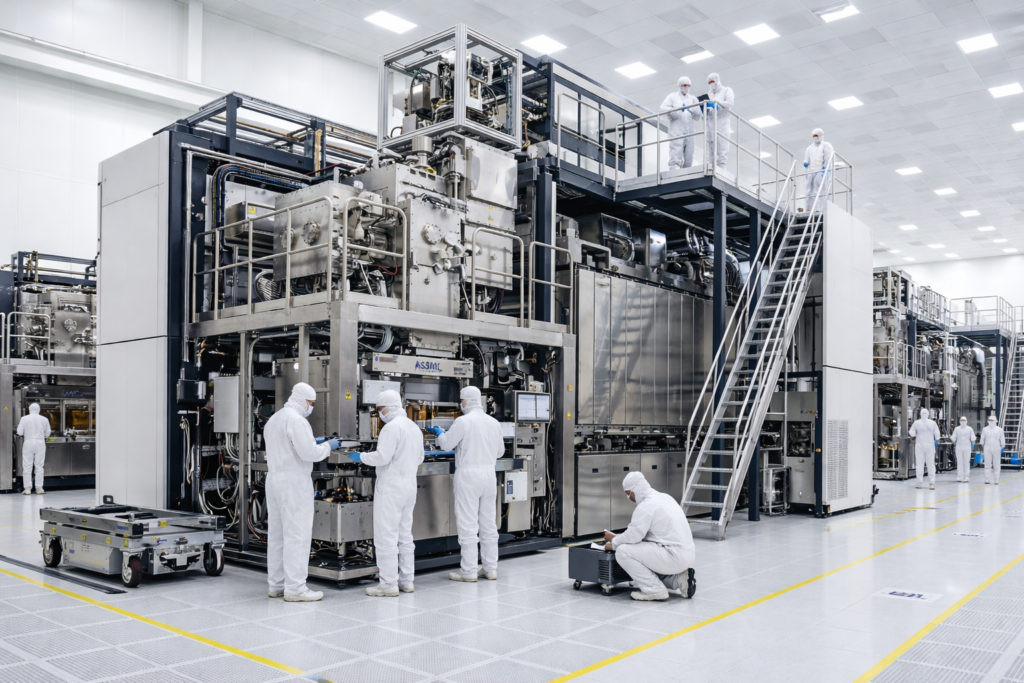
An ASML EUV machine being assembled in Veldhoven’s clean rooms
The FDPR Weapon: How Washington Claims Jurisdiction Over Dutch Soil
To understand why the Netherlands is in rebellion, start with how the Foreign Direct Product Rule actually works.
The FDPR grants the American government jurisdiction over foreign-made products if those products incorporate US-origin technology, equipment, or software above a defined threshold. In plain terms: if a Dutch company uses American software in its production process, or if a Dutch machine contains components tracing back to US technology, Washington claims the right to dictate where that machine can go. It does not matter where the machine was built, who built it, or which country’s laws govern the transaction.
Applied to ASML, this logic produces an extraordinary claim. Engineers in Veldhoven design and assemble the EUV machine under Dutch law. The machine draws precision optics from Germany’s Carl Zeiss, laser components from Cymer (a US-based subsidiary ASML acquired in 2013), and thousands of parts from hundreds of global suppliers.
US-origin content accounts for roughly 10 percent of the machine’s value. Washington’s position is that this 10 percent grants jurisdiction over the entire machine — and over every business decision ASML makes about where it goes.
The Dutch Objection
Dutch officials do not dispute the legal mechanics. They dispute the proportionality, the legitimacy, and increasingly the intent. One senior Dutch official, speaking on background, described the FDPR as “the legal equivalent of claiming that because an Airbus uses American landing gear, the US gets to decide which airports it can land at.” The Dutch view is that Washington has stretched the FDPR far beyond its original purpose — preventing technology transfer to hostile states — and into territory that amounts to dictating Dutch foreign and industrial policy.
Direct coercion arrived through a mechanism Dutch officials found particularly galling: the “informed” letter. On multiple occasions, the US Department of Commerce wrote directly to ASML — bypassing the Dutch Ministry of Foreign Affairs entirely — to instruct the company on which customers it could and could not serve. Washington was not engaging in allied consultation. It was treating ASML as a domestic American asset on temporary loan to the Netherlands.
The Service Battlefield: Contracts, Liability, and Intelligence
The FDPR is the structural grievance. The service and maintenance standoff is where the dispute became legally incoherent — and where Dutch resistance hardened beyond commercial self-interest.
ASML machines are not one-time sales. Engineers must continuously service, update, calibrate, and maintain them on-site. A machine denied service will eventually stop functioning optimally. In semiconductor manufacturing, that is effectively the same as stopping altogether. Washington began pushing ASML to halt service operations on its existing China installed base — machines Dutch entities had legally sold under valid Dutch export licenses, in some cases years earlier.
The Hague drew a red line. Retroactively restricting service on validly sold equipment is not export control in any coherent legal sense. It nullifies commercial contracts Dutch entities concluded in good faith under Dutch law. No American executive order can indemnify ASML against the contractual liability that follows. And it treats existing Chinese customers — buyers of perfectly legal DUV equipment — as retroactively sanctioned parties without due process.
Eyes on the Ground
Fouquet’s position here is more strategically interesting than it first appears. He accepts the rationale for restricting new sales of advanced equipment. But he argues ASML must retain the ability to service its China machines — not primarily for commercial reasons, but for a security reason Washington seems to have missed. Remove ASML engineers from Chinese facilities and the company loses visibility into what those facilities are doing with the machines. Cutting service does not eliminate the technology’s presence in China. It eliminates Western eyes on it.
ASML acted on this logic: it opened a new “reuse and repair” center in Beijing in 2025, citing logistics efficiency and installed-base control. The signal was pointed. ASML judges its continued presence in Chinese facilities both commercially necessary and strategically defensible — regardless of Washington’s preference.
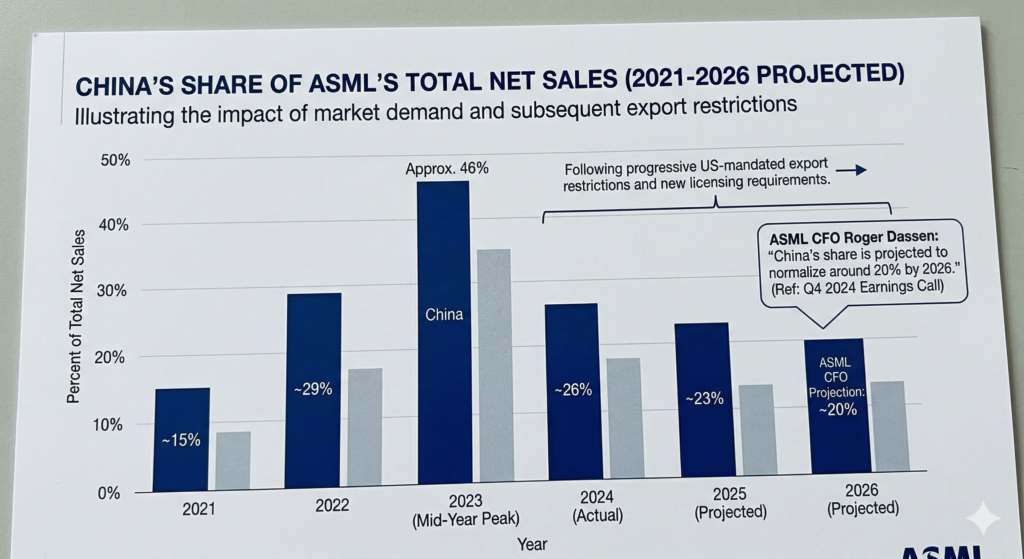
A bar chart showing China’s share of ASML’s total revenue from 2021 to 2026 — the rise to ~46% in mid-2023, the plateau, and the projected decline to ~20% in 2026.
Economics of a Chokepoint: Why the China Revenue Is Not Optional
Washington’s case for restricting ASML’s China operations is, at its strongest, coherent. China openly pursues a domestic semiconductor industry capable of producing advanced chips for military applications. ASML’s EUV technology is the single most important missing ingredient. The gap is real: Fouquet has stated publicly that China lags 10 to 15 years behind the global frontier in chip manufacturing — a gap the EUV embargo directly created.
China is racing to close it. Early 2025 reports described meaningful progress on key EUV subsystems, particularly laser sources and mirror assemblies, with teams reportedly drawing on former ASML engineers and components from secondary markets.
Analysts distinguish this carefully from a functional, production-ready system. China advances at the component level, not yet at the system-integration level that high-volume manufacturing requires. Beijing targets domestic EUV production capability by 2028; independent analysts put 2030 as more realistic, and even that requires breakthroughs not yet demonstrated. The restriction has bought time. The question is: at what cost, and to whom?
The Revenue Mathematics
China is not a marginal revenue stream for ASML. It accounted for 36 percent of ASML’s total revenue in 2024 — the company’s single largest market by geography. US-mandated restrictions have steadily cut off more equipment categories and more customer sites, and CFO Roger Dassen projected in early 2026 that China’s share would fall to roughly 20 percent of sales. That is down from nearly half of all system sales in mid-2023. The drop represents billions of euros stripped from ASML’s annual top line.
The R&D Trap
The commercial pain is significant but manageable for a company projecting €30–35 billion in 2025 revenues. The strategic damage runs deeper. ASML’s competitive moat is a technology ecosystem three decades in the making. It demands continuous, enormously expensive R&D investment to sustain.
Each new generation of lithography technology costs billions to develop and needs a sufficient customer volume to justify the cycle. High-NA EUV machines — priced above $380 million each — have a razor-thin customer base: effectively TSMC, Samsung, Intel, and a handful of others. Revenue from the broader DUV customer base cross-subsidizes that next-generation work.
Cutting China out of the customer base does not merely reduce profits. It erodes the economic foundation that next-generation development depends on. Dutch officials and ASML’s leadership have tried — without much success — to make Washington understand the paradox: export controls that starve ASML of revenue also slow the Western technological edge those controls exist to protect.
You cannot simultaneously squeeze ASML’s customer base and demand it maintains an insurmountable lead over Chinese rivals. The economics refuse to cooperate.
Fouquet has described ASML’s China business as “focused on mainstream semiconductors” that are “very different from AI.” Most of what China currently buys is mature technology for automotive chips, consumer electronics, and industrial semiconductors — not the advanced nodes needed for frontier AI training or hypersonic guidance systems. Treating all ASML-China business as strategic risk, he has implied, reflects a bluntness of instrument that serves American domestic politics more than American national security.
The Dutch Political Awakening
The Dutch political response to American pressure has passed through several distinct phases.
Under Prime Minister Mark Rutte, the approach was tactical compliance with rear-guard resistance. Rutte understood Washington’s leverage — the FDPR made outright defiance unrealistic for a NATO ally dependent on the American security umbrella. But he worked to ensure Dutch export controls were narrow, surgical, and implemented through Dutch legal mechanisms rather than adopted wholesale from American templates.
The Schoof administration, taking office in 2024, brought a sharper security orientation toward China. Dick Schoof, a former AIVD director-general, read Chinese technology acquisition through an intelligence lens broadly aligned with Washington’s own threat assessment. Under his government, Dutch resistance shifted focus. The argument was no longer primarily about the strategic merits of export controls. It became about the method of imposition — specifically, whether the Netherlands had any role beyond implementation in decisions Washington made unilaterally.
The Licensing Standoff
The 2025-2026 licensing standoff crystallized this shift. Washington pressed The Hague to mirror American DUV restrictions — a “copy-paste” approach Dutch officials publicly and explicitly rejected. Foreign Trade Minister Reinette Klever stated the Netherlands would run its own security assessments and impose its own controls: “surgical” rather than “blunt,” targeting specific fab locations and specific technologies rather than imposing blanket prohibitions. In January 2025, the Dutch government announced tightened export measures covering additional measuring, testing, and optimization equipment, effective April 1. Crucially, these rules required ASML to apply for licenses in The Hague rather than in Washington — a detail that looked technical but carried enormous symbolic and legal weight.
This is sovereignty expressed through process. Routing export license applications through The Hague rather than the US Department of Commerce asserts one clear principle: decisions about what Dutch companies can sell from Dutch territory are Dutch decisions. Allied consultation informs them; American preference does not dictate them.
Project Beethoven
Behind this political awakening sits “Project Beethoven” — the Dutch government’s €2.5 billion investment package announced in March 2024 to retain ASML’s headquarters and expand operations in the Eindhoven region. The package covers housing, transport, education, talent development, and electrical grid upgrades. ASML triggered it by signaling it might expand operations abroad, with France making aggressive overtures to host its growth. Economy Minister Micky Adriaansens called ASML “our Messi” — a star player who brings an entire team with them.
Project Beethoven is more than corporate retention. A €2.5 billion sovereign investment formally designates ASML as critical national infrastructure. That designation creates a political contradiction: you cannot spend €2.5 billion of taxpayer money to anchor a company as a national strategic asset and then allow a foreign government to direct that asset’s operations. Dutch investment in ASML demands Dutch authority over ASML — or the investment becomes tribute to Washington’s industrial policy.
Each ASML job generates an estimated 2.8 additional positions in the surrounding supply chain, according to Jeroen Dijsselbloem, then mayor of Eindhoven. ASML anchors the entire Brainport Eindhoven corridor — one of Europe’s most important technology clusters. Managing ASML as a geopolitical instrument puts not just ASML’s revenue at risk, but the economic coherence of an entire region the Dutch state has now formally committed to defend.
The FDPR’s Structural Flaw
Washington’s Coherent Case
Washington’s advocates for aggressive FDPR use make a coherent case. The rule works: China has never received an EUV machine. Fouquet himself acknowledges China’s chip manufacturing capability sits 10 to 15 years behind the frontier. The containment has held. The argument for allied deference is also genuinely uncomfortable for The Hague to dismiss: the Netherlands benefits enormously from the American security umbrella that makes its own foreign policy possible.
But the FDPR carries a structural flaw its proponents underweight. It functions by extracting compliance from allies for whom compliance is costly. Every extraction increases the incentive to eliminate the underlying dependency. The rule operates as a tax on American components in your supply chain. Pay that tax repeatedly, and eventually you restructure to reduce the taxable base.
The EU’s Countermove
This dynamic is already playing out. The prospect of an EU FDPR equivalent — asserting European jurisdiction over products made using EU technology, including chips manufactured on ASML’s EUV machines — has moved from academic speculation to active policy discussion.
A late 2025 Talos Network paper outlined how such a mechanism could require export licenses for EUV-manufactured chips, giving the EU leverage over AI chip sales in a manner parallel to American controls. The logic puts Washington in an uncomfortable position: if the FDPR legitimately exercises extraterritorial jurisdiction over technology chains, the EU holds at least as strong a claim over its own.
The ACI: Europe’s Loaded Weapon
The Anti-Coercion Instrument (ACI), which the EU adopted in December 2023 and has never used as of early 2026, represents the more immediate tool. The ACI targets exactly these situations — where third countries apply economic measures to coerce the EU or its member states into changing their policies.
Senior European officials have publicly discussed deploying it in response to American tariff threats over Greenland. Whether semiconductor export controls could trigger it remains a live legal and political question. The significant fact is that European officials now openly discuss using it against the United States — an ally. That discussion alone signals something consequential about the state of transatlantic relations.
The EU’s updated dual-use export control list, entering force in November 2025, represents one of the most substantial revisions in years. It extends controls to semiconductor manufacturing equipment, quantum technologies, and advanced computing infrastructure. Brussels is building a parallel regulatory capability — one it will exercise on its own terms, not Washington’s.
China’s Long Game
A paradox sits at the heart of American export control strategy — one neither Washington’s advocates nor its critics fully want to confront. The policy designed to permanently handicap Chinese semiconductor capability may matter most for what it has done to Chinese strategic motivation.
Before 2020, China’s approach to semiconductor self-sufficiency was aspirational but not urgent. Chinese chip makers bought ASML’s DUV machines, used TSMC’s foundry services, and purchased Nvidia GPUs for AI training. Participation in the global semiconductor supply chain was simply more economical than independence.
The progressive tightening of controls — EUV in 2020, advanced DUV in 2024, maintenance restrictions from 2025, an expanding list of restricted fab locations — systematically altered that calculus. Dependency on Western technology is no longer a commercial variable for China. It is a vulnerability that Washington can weaponize at any time. China’s response has been extraordinary in scale.
Semiconductor equipment investment reached $49.55 billion in 2024 — a 35 percent year-on-year increase, representing roughly 40 percent of global semiconductor equipment demand. Domestic manufacturers like Naura are growing at rates that would have seemed implausible five years ago. Beijing now enforces an undocumented requirement: new chip factories must source at least half their equipment from domestic manufacturers.
The Direction Is Clear
Early 2025 reports describe genuine progress on key EUV subsystems — laser sources, mirror assemblies, EUV light generation — developed by teams that include former ASML engineers using components from secondary markets. A functional production machine remains far off. The gap between working subsystems and a production-worthy EUV tool capable of high-volume manufacturing is vast. The HVM learning cycle ASML has refined across three decades, Carl Zeiss’s precision optics, Cymer’s laser systems — none of these yield to money and urgency alone. Beijing targets domestic EUV production by 2028; independent analysts put 2030 as more realistic.
But the direction of travel is unmistakable, and the pace is accelerating. The export controls have bought time — perhaps 10 years, perhaps 15. A permanent Western advantage is not among the things they have bought. Worse, they have motivated China to invest in indigenous capability at a scale and urgency it would almost certainly never have mobilized otherwise.
The question that haunts Washington but rarely surfaces aloud: would a more calibrated multilateral approach — preserving Chinese dependency on Western technology at the cost of some dual-use transfer risk — have produced more durable leverage than the hard embargo that made Chinese technological independence a paramount national objective?
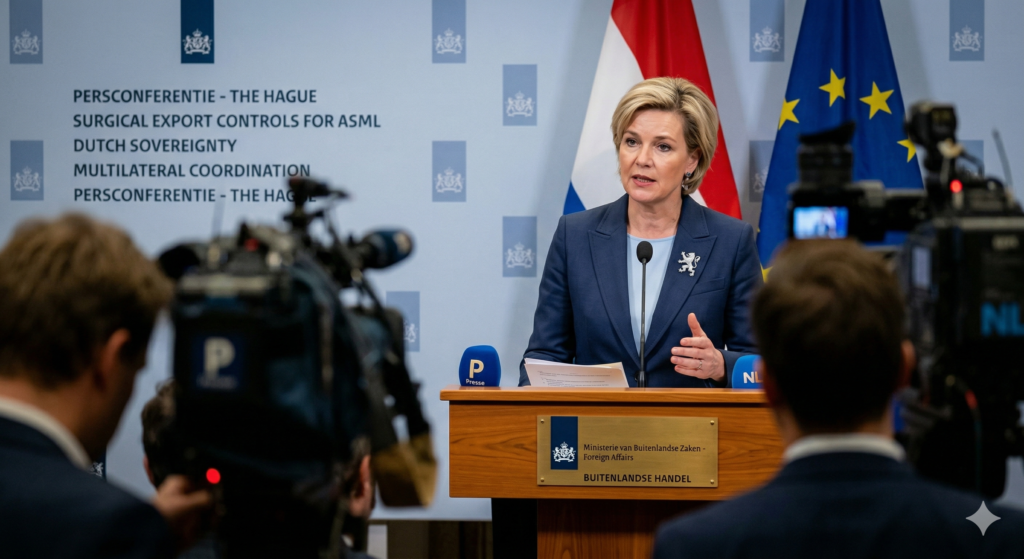
Dutch Foreign Trade Minister Reinette Klever speaks at a press conference in The Hague. Klever articulated the Netherlands’ rejection of a US ‘copy-paste’ approach to export controls, insisting on a Dutch-led ‘surgical’ framework for ASML’s export licensing.
The European Ripple
Can Europe Build Its Own Toolkit Toward Strategic Autonomy or Managed Dependence?
The ASML-Washington confrontation does not exist in isolation. It is the most vivid current expression of a broader European debate: will the continent manage its technological future as a sovereign actor, or as a dependent of American strategic preference?
The EU Chips Act, passed in 2023 with the goal of doubling Europe’s share of global semiconductor production to 20 percent by 2030, reflects the European instinct toward autonomy. Results have been only partial — the targets proved difficult to meet, and the competition for semiconductor manufacturing investment has been brutal.
American CHIPS Act subsidies, Taiwanese proximity, and Korean government support all undercut the European offer. Yet the direction is significant. Europe is building institutional infrastructure to treat semiconductors as a strategic sector, not merely a market sector.
The EU’s rapidly expanding export control architecture signals the same instinct. If Europe is going to be a serious technology power, it needs governance tools that are genuinely its own. The November 2025 dual-use list update extends controls to lithography equipment, scanning electron microscopes, atomic layer deposition tools, and other semiconductor fabrication equipment. Brussels builds a regulatory framework that parallels American rules — but does not copy them.
Supply Chain Calculus
Dutch and European officials are now explicitly naming the risk: American coercive behavior may force the EU to construct a US-free supply chain not because it wants to, but because dependence on American-origin components has become operationally dangerous. Every FDPR invocation adds a data point to a European cost-benefit calculation. How much does retaining American-technology dependency cost versus what de-Americanizing the supply chain would require? The coercion intensifies, and the calculation shifts.
Washington should find this scenario most alarming — not a dramatic, politically announced decoupling, but a gradual, commercially driven restructuring that produces, over a decade, a semiconductor ecosystem carrying meaningfully less American content. Not because Europe is hostile to the United States. But because embedding in American technology has become a strategic liability that European companies and governments hold powerful incentives to reduce.
Treating Allies Like Subsidiaries At What Cost
The ASML crisis teaches a deeper lesson about alliance relationships in a world of competing technological empires.
Over the past five years, the United States developed a theory of technology governance that is largely unilateral in exercise even when multilateral in justification. An American rule — the FDPR — reaches into non-American jurisdictions to govern non-American companies.
Washington negotiated the Tripartite Agreement under the explicit or implicit threat of FDPR application. The “informed” letters Commerce sent directly to ASML bypassed Dutch sovereignty not as an oversight but as a feature. Demanding that allied nations adopt American export control templates wholesale positions those allies not as sovereign partners but as extension agents of American policy.
The Netherlands has, with characteristic Dutch directness, begun to resist. Its resistance is not ideological. The Dutch government shares the strategic objective of limiting China’s access to the most advanced semiconductor technology. What it rejects is the method: extracting compliance through coercion rather than building genuine multilateral consensus.
Durability Is the Question
The distinction matters enormously. Coerced compliance is inherently fragile — it lasts only as long as the coercion applies and the target lacks alternatives. Multilateral consensus, negotiated among sovereign equals, is durable precisely because it reflects the actual security interests of all parties. The Wassenaar Arrangement embodies the latter model. Washington’s progressive bypass of Wassenaar in favor of bilateral pressure embodies the former.
The strategic cost of the subsidiary model is self-defeating. If European companies and governments conclude that embedding their industries in American technology chains creates vulnerability to unilateral American direction, they will invest in reducing that vulnerability.
The resulting de-Americanization will proceed quietly and commercially, over a decade. One day Washington will discover that its extraterritorial jurisdiction over the global semiconductor supply chain has eroded — not because of Chinese competition, but because its allies built their way out from under it.
What Winning Looks Like
On any honest assessment, the United States is winning the battle over ASML. China has not received an EUV machine. Its most advanced indigenous chips remain years behind TSMC’s leading edge. The EUV chokepoint has held. On the immediate strategic objective — denying China access to the most advanced semiconductor manufacturing capability — American policy has largely succeeded.
Winning the battle is not the same as winning the war. Washington conducts its semiconductor strategy as though the alliance relationships that execute it are infinitely elastic. The Dutch government will not absorb unlimited coercion without recalibrating.
ASML will not indefinitely accept management as a geopolitical instrument rather than a sovereign Dutch company. The EU will not perpetually rely on American-origin technology without seeking to reduce that reliance.
None of these assumptions are holding. The Netherlands is reasserting sovereignty over its licensing process. ASML’s CEO publicly questions the scope and legitimacy of American control. The EU is building its own export control infrastructure.
Senior European officials discuss the Anti-Coercion Instrument in the context of American pressure on an ally. China is investing at a scale that may produce indigenous EUV capability regardless of what The Hague and Washington agree to do.
The Path Back
The path back from this cliff edge is not difficult to describe. A genuine multilateral framework — negotiated among sovereign equals, respecting the Wassenaar Arrangement’s premise that allied coordination outlasts unilateralism — would likely produce restrictions somewhat less comprehensive than what Washington currently demands. They would also be considerably more durable, because they would carry genuine allied buy-in rather than coerced compliance.
What blocks that path is not strategic disagreement. The Netherlands, Japan, the EU, and the United States share a common interest in preventing China from converting advanced Western technology into a military-industrial capability that destabilizes the world.
What blocks it is Washington’s conviction that it can extract compliance from allies indefinitely without cost — that the FDPR is a permanent feature of the international landscape rather than a trust withdrawal against an account that can be overdrawn.
The account is running low. The Hague’s rebellion is the first sign that the overdraft warning has arrived.
This article draws on public statements from ASML CEO Christophe Fouquet, Dutch government official communications, and reporting from Bloomberg, Reuters, the South China Morning Post, Fortune, and Bits&Chips, as well as policy analyses from the European Council on Foreign Relations, CEPA, Baker McKenzie, Cooley, the Talos Network, and the EU Parliament’s Research Service.
