
Africa is a continent full of untapped AI potential. The narrative is familiar: young developers, growing startup scenes, and increasing digitization. Talent is abundant.
And yet, most advanced AI systems touching African lives are not built, trained, or controlled in Africa.
This is a structural reality.
Artificial intelligence in Africa is not limited by intelligence or creativity. It is limited by data, compute, and infrastructure. And in Africa, those foundations remain uneven, externally dependent, and politically consequential—even as 2024 and 2025 brought unprecedented investment and attention to the continent’s AI ecosystem.
Understanding what’s changing, and what isn’t, requires looking beyond innovation headlines to the material systems that make AI possible.

Map of Africa with digital glowing network nodes representing AI infrastructure and data connectivity
AI Is Not Software—It Is Infrastructure
We often discuss Artificial intelligence as code: models, algorithms, applications. But modern AI systems are closer to industrial infrastructure than traditional software.
They require:
- Massive datasets
- Continuous connectivity
- High-performance computing
- Stable power supply
- Secure data storage
- Cloud platforms operating at scale
Without these, AI does not scale—regardless of talent.
This is why AI development clusters in regions with dense infrastructure, not just skilled workers. Silicon Valley’s advantage was never just Stanford graduates; it was also reliable electricity, fiber optic cables, venture capital, and data center corridors. The same pattern holds globally: AI capacity follows infrastructure density.
In Africa, that infrastructure exists unevenly. Sub-Saharan Africa (excluding South Africa) has less installed electricity generation capacity than Spain, despite having 15 times the population. Intermittent power, limited fiber connectivity outside major cities, and minimal local data center capacity create hard ceilings on what’s technically possible—no matter how skilled the engineers.
AI Factories
The definition of AI infrastructure has shifted from simple data storage to ‘AI Factories.’ These are high-density data centers equipped specifically with GPUs for training and inference.
In March 2026, Cassava Technologies officially operationalized the continent’s first major NVIDIA-powered AI Factory in South Africa, with immediate scaling underway in Nigeria and Kenya. This marks a move from renting space in someone else’s cloud to hosting the ‘engine’ of intelligence on African soil.
The Data Question: Whose Information Trains AI?
Every AI system learns from data. In Africa, companies generate data at an unprecedented scale through:
- Mobile phones (over 600 million smartphone users as of 2024)
- Mobile money transactions (Kenya’s M-Pesa alone processes $280 billion to $310 billion of transactions annually)
- Digital ID systems
- Health platforms
- Education technologies
- Social media usage
Yet the ownership of this data is often unclear.
Much of it flows through platforms owned by foreign companies, governed by external legal frameworks, and stored on servers outside national borders. African users generate the data, but rarely control how it is used to train global models.
This creates a familiar pattern: raw material is exported, value is created elsewhere, finished products are imported back. Except this time, the raw material is behavioral data.
Data Sovereignty Frameworks
The ‘raw material’ metaphor is evolving. In 2025 and early 2026, frameworks like Lelapa AI’s Esethu Framework emerged to challenge the extraction model. These frameworks provide legal blueprints for data licensing, ensuring that when African linguistic or behavioral data is used to train models, the resulting ‘model weights’ and economic benefits are shared with local communities rather than being exported entirely.
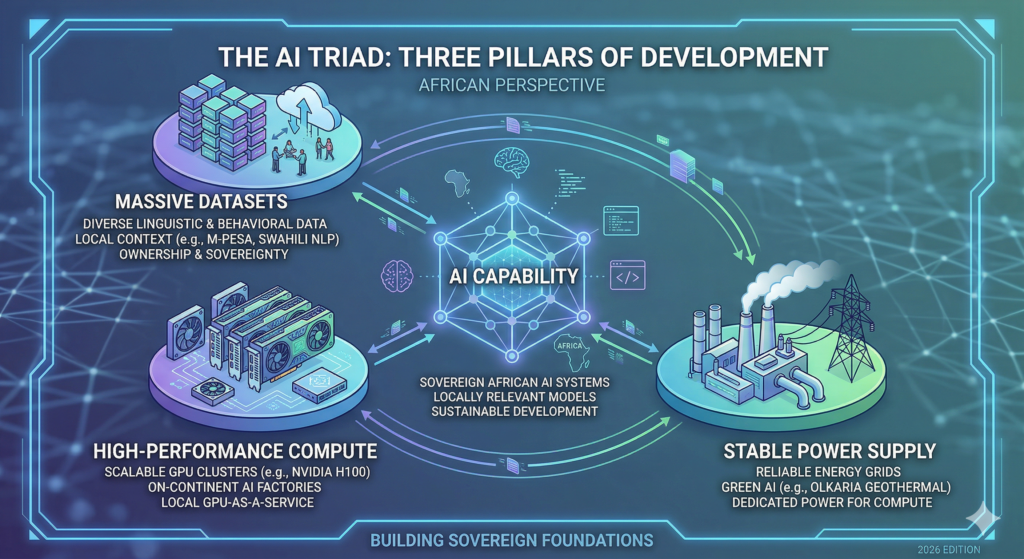
Infographic showing the three pillars of AI: Massive datasets, high-performance computing (GPUs), and stable power supply
M-Pesa: A Rare Counter-Example
Kenya’s M-Pesa represents one of the few large-scale African data ecosystems with meaningful local control. Safaricom, majority Kenyan-owned, processes massive transaction data that stays within East Africa’s regulatory framework. This data is now being used to develop AI-powered fraud detection and credit scoring models—built on African data, for African contexts, with African oversight.
But M-Pesa is an exception that proves the rule. Most digital platforms operating in Africa—Meta, Google, X, TikTok—extract data under terms-of-service agreements written in California or Dublin, stored on servers in Europe or North America, and used to train models optimized for non-African contexts.
As of 2025, Africa holds less than 1% of global data center capacity despite representing 18% of the world’s population. This gap is not just about storage—it’s about data sovereignty.
Where Africa’s AI Is Actually Trained
Despite growing interest in “local AI,” most advanced machine learning models used in African contexts are:
- Trained abroad
- Hosted on foreign cloud platforms
- Optimized for non-African data environments
Local startups often rely on rented compute from global providers. Governments deploying AI systems—in border control, taxation, or public services—frequently use externally developed tools.
This is not necessarily malicious. It is structural.
High-performance computing infrastructure is expensive. Therefore, GPUs, cooling systems, and reliable energy grids are not easily available at scale in many African countries. Even where data centers exist, they often serve as access points to global cloud ecosystems rather than fully sovereign compute environments.
But African AI Researchers Are Building Anyway
African AI researchers are producing meaningful work despite the infrastructure gap.
Small Language Models (SLMs)
Masakhane, a grassroots research collective, has built natural language processing tools for over 40 African languages, most of which major tech companies ignored. Working with limited compute, the project has created translation models, speech recognition systems, and linguistic datasets that didn’t exist before.
The narrative that ‘bigger is better’ is being dismantled by African innovators. Lelapa AI’s InkubaLM (a 400-million parameter model) has become the gold standard for resource-efficient AI. By early 2026, research proved that these targeted, smaller models—trained on high-quality local data—often outperform trillion-parameter global models like GPT-4 on specific African tasks, such as Zulu-to-English legal translation or Swahili sentiment analysis.
While African data center capacity is growing at an unprecedented rate (now reaching 360 MW of active capacity), the continent still accounts for only 0.6% of global capacity as of March 2026. The gap is not closing; it is maintaining a precarious equilibrium as the global ‘GPU arms race’ accelerates.
The constraint is not intelligence. It is electricity, hardware, and bandwidth.
Why Compute Is the Bottleneck Few Discuss
Talent can write code on a laptop. AI cannot be trained there.
Training large models requires:
- Specialized hardware (NVIDIA H100s or equivalent)
- Continuous electricity (megawatts for weeks or months)
- Cooling and physical security
- High-bandwidth connectivity
This is why compute access has become the real choke point in global AI development.
For African researchers and firms, limited compute means:
- Smaller models
- Narrower use cases
- Dependence on external platforms
- Reduced bargaining power
AI capacity, in this sense, mirrors earlier stages of internet development: access without control.
Signs of Change—But Not Yet at Scale
The compute landscape is shifting, though unevenly and slowly. In 2024-2025, several major AI infrastructure investments were announced:
The Microsoft-G42 geothermal-powered data center in Olkaria, Kenya, has moved from a $1 billion announcement to a physical construction site. It represents a new era of ‘Green AI’: leveraging Kenya’s 10GW of geothermal potential to power compute-intensive AI workloads. However, the 2026 reality remains nuanced: while the power is local and green, the high-level orchestration often remains tied to global Azure frameworks, keeping the ‘sovereignty’ debate at the forefront.
- IXAfrica and Safaricom are developing an AI campus in Nairobi with GPU infrastructure
- Cassava Technologies partnered with NVIDIA to deploy GPU systems across multiple African countries
- Raxio Data Centre is expanding operations in Uganda, Rwanda, and other East African markets
- Naver and NVIDIA announced plans for a 500MW data center campus in Morocco
These are real investments in AI infrastructure Africa. But context matters.
Most of these facilities are still under construction or in early operation. Many are foreign-controlled, designed primarily to serve regional branches of global cloud platforms (AWS, Azure, Google Cloud) rather than sovereign African compute infrastructure. And even once operational, they will represent a fraction of what’s needed to close the gap with North America, Europe, or East Asia.
The infrastructure is improving. It remains insufficient—and often not designed for African ownership.
AI in Institutions: Quiet Adoption, Big Consequences
AI in Africa is not arriving primarily through consumer apps. It is arriving through institutions.
Governments are adopting artificial intelligence in:
- Border management
- Surveillance and security
- Tax compliance
- Social welfare targeting
Banks use AI for:
- Credit scoring
- Fraud detection
- Customer monitoring
Hospitals use AI for:
- Diagnostics
- Resource allocation
- Data-driven triage
Schools increasingly rely on digital platforms that collect and process student data.
In each case, the question is not whether AI works, but who governs it, who audits it, and who is accountable when it fails.
Credit Scoring Without Transparency
In Kenya, Nigeria, and South Africa, AI-powered credit scoring systems are determining who gets loans, often using alternative data like mobile phone usage and social media activity. These systems promise financial inclusion for the unbanked.
But many are opaque. Applicants denied credit may never know why. Algorithms trained on biased historical data can replicate discrimination. And when these systems are built by foreign fintech platforms, local regulators often lack the technical capacity to audit them effectively.
The promise is efficiency and inclusion. The risk is automated exclusion without recourse.

The African Union headquarters in Addis Ababa; representing continental AI governance and policy frameworks.
The Governance Gap—Slowly Narrowing
AI governance in Africa is emerging, though it’s now continental; it remains uneven.
In February 2026, the African Union Commission (AUC) signed a landmark partnership with Google to shift the continent from ‘digital access’ to ‘digital agency.’ This includes a commitment to train 50,000 public officials in AI readiness. Furthermore, the Africa AI Council, established by Smart Africa and the AUC, is now actively harmonizing regulations across 40+ countries to ensure that AI-powered credit scoring and surveillance systems are auditable by African regulators.
As of 2026, over 36 African countries have enacted data protection laws, a significant increase from just a handful in 2018. Rwanda, Kenya, South Africa, and Nigeria have published national AI strategies. The African Union adopted a Continental AI Strategy in 2024, emphasizing infrastructure sovereignty, ethics, and regional coordination.
This is real progress in AI governance Africa. But legislation on paper is not the same as enforcement capacity.
Few countries have:
- Independent AI auditing mechanisms
- Local technical expertise to oversee complex systems
- Transparent procurement processes for AI tools
- Meaningful penalties for algorithmic harm
This creates asymmetry. Vendors understand the systems. Institutions deploy them. Citizens experience the outcomes—often without recourse.
The governance gap is narrowing. It has not closed.
Talent Is Not the Missing Piece
Africa does not lack intelligent engineers, data scientists, or researchers. It lacks:
- Affordable compute at scale
- Control over data flows
- Infrastructure financing aligned with long-term sovereignty
- Institutional capacity to govern complex systems
Focusing on talent alone obscures these deeper constraints. It also shifts responsibility away from structural investment toward individual effort—a familiar and unhelpful pattern.
While a developer in Lagos can write world-class code, their ability to compete depends on whether they can afford to rent local GPU time. The emergence of GPU-as-a-Service (GPUaaS) via African providers is the final piece of the puzzle. Talent is the spark, but sovereign, affordable compute is the oxygen.”
AI, Power, and Dependency
AI systems amplify existing power structures. When infrastructure, data, and compute are externally controlled, AI adoption can deepen dependency rather than reduce it.
This does not mean Africa should reject AI. It means AI strategy must begin with infrastructure strategy.
Questions worth asking about artificial intelligence Africa include:
- Where is national data stored?
- Who owns the compute running public systems?
- What happens if access is withdrawn?
- Who can audit algorithmic decisions?
- What role do Chinese infrastructure investments play in digital sovereignty?
These are not technical questions. They are political and economic ones.
The China Factor
Any serious discussion of African AI infrastructure must account for China’s role. Huawei has built significant portions of Africa’s telecommunications networks. Chinese firms operate data centers across the continent. The Digital Silk Road initiative has financed infrastructure projects from fiber cables to surveillance systems.
This complicates the narrative. Dependence on Western tech giants is being challenged—not by African sovereignty, but by an alternative form of dependency. Whether Chinese-built infrastructure offers more favorable terms for African countries, or simply replicates extraction under different flags, remains an open and politically sensitive question.
What is clear: infrastructure ownership will shape who controls African AI, and the choice is not binary between local control and foreign dependence. Multiple forms of dependency coexist and compete.
What an African-Centered AI Path Would Require
A realistic path toward greater AI autonomy would involve:
Infrastructure Investment:
- Public financing for regional data centers designed for sovereignty, not just cloud access
- Energy grid upgrades to support compute-intensive operations
- Fiber connectivity expansion beyond capital cities
Data Governance:
- Strong enforcement of data protection laws
- Regional data-sharing agreements that keep African data within African legal frameworks
- Transparent auditing of data flows to foreign platforms
Compute Access:
- Subsidized GPU time for research institutions and startups
- Regional compute-sharing arrangements (an “African Supercomputing Cooperative”)
- Partnerships that prioritize technology transfer, not just service contracts
Institutional Capacity:
- Training regulators in AI auditing
- Transparent procurement rules for government AI systems
- Independent ethics review boards with enforcement power
Strategic Clarity:
- Recognition that infrastructure ownership is political, not just technical
- Honest assessment of trade-offs between speed (using foreign systems) and sovereignty (building local capacity)
- Regional coordination to avoid duplication and build scale
None of this is quick. But without it, AI will remain something Africa uses, not something it meaningfully shapes.
Why Compute and Data Matter Now
As AI becomes embedded in governance, finance, health, and security, the cost of misunderstanding its foundations grows.
AI is not neutral. It reflects the systems it is built on. If those systems are owned elsewhere, trained on external priorities, and governed by foreign legal frameworks, then AI in Africa will serve external interests—even when deployed with good intentions.
The infrastructure investments of 2024-2025 show that change is possible. But change is not the same as transformation. New data centers do not automatically create sovereignty if they are foreign-owned and integrated into global cloud monopolies.
Understanding artificial intelligence in Africa, therefore, requires understanding infrastructure, ownership, and control—not just innovation headlines or talent narratives.
The young developers in Lagos, Nairobi, and Johannesburg are ready. The question is whether the infrastructure, capital, and political will exist to let them build on sovereign foundations.
