
Part One: The Case for Non-Alignment
Africa’s technology future is often framed as a choice between camps. One side emphasizes Western platforms, standards, and financing. The other highlights Chinese infrastructure, speed, and integration. But this framing is misleading.
Africa is not choosing sides in a tech war. It is navigating a multipolar system where AI-critical minerals — not ideology — increasingly determine leverage. The real question is whether Africa can pursue a non-aligned tech policy grounded in its material importance to the global digital economy — and whether it can codify that non-alignment into enforceable architecture, not just aspiration.

A close-up of raw mineral— cobalt, lithium, and copper ore
AI Minerals Are Africa’s Quiet Leverage
The language of “strategic minerals” belongs to an older geopolitical era. In 2026, the more precise term is AI minerals — the physical inputs that make artificial intelligence, cloud computing, and digital communications possible at scale. Africa supplies an outsized share of them.
Batteries and energy storage: cobalt, lithium, manganese, and vanadium.
Connectivity infrastructure: copper.
Semiconductors, high-performance chips, and defense tech: rare earths, and platinum group metals.
Power systems: nickel, and graphite.
These materials underpin AI infrastructure, cloud computing, defense systems, renewable energy, and digital communications. In a world where supply chains are fragile and contested, control over inputs matters more than platform allegiance.
There is a further dimension: AI is no longer just a consumer of these minerals. African nations are beginning to use AI-driven geological mapping to discover new deposits — closing the information gap that previously gave foreign mining companies the upper hand in negotiations. The tool that requires the minerals is also becoming the tool that finds them. This closes a historical asymmetry that has defined extraction economics on the continent for over a century.
Africa already has leverage. What it lacks is coordination — and the legal architecture to convert leverage into durable terms.
Non-Alignment Is Not Neutrality
Non-aligned tech policy does not mean refusing partnerships. It means avoiding dependency on a single ecosystem, preserving policy flexibility, sequencing infrastructure before platforms, and negotiating from material relevance rather than market size.
During the Cold War, non-alignment was political. Today, it is technological and industrial. It also has a specific technical expression: demanding interoperability. Chinese-built fiber-optic backbones must be able to plug seamlessly into Western-designed cloud stacks. This is not a technical preference — it is the mechanism that prevents ecosystem lock-in. If one geopolitical partner withdraws, the physical infrastructure must remain functional.
The practical standard is measurable: open APIs and standard data export formats that allow a government or enterprise to migrate its entire digital stack from a US-aligned cloud to a Chinese-aligned one — or vice versa — within 48 hours. Call this Plug-and-Play sovereignty. Without it, non-alignment is a posture rather than a capability.
Non-alignment without interoperability is non-alignment in name only.
Why Tech Alignment Is Risky
When tech systems align too closely with one external power, predictable risks emerge: standards lock-in, vendor dependence, data governance constraints, limited bargaining power, and reduced regulatory autonomy. These risks compound when infrastructure is debt-financed, systems are mission-critical, and exit costs are high.
AI minerals give Africa an alternative bargaining chip — but only if used deliberately. The pressure to not use them deliberately is real. Both US-aligned and China-aligned tech actors have structural incentives to prevent genuine African regional coordination — consolidated leverage is harder to negotiate around than fragmented dependencies. The pressure to keep African nations operating individually rather than regionally is not accidental. Recognizing this is a precondition for designing against it.
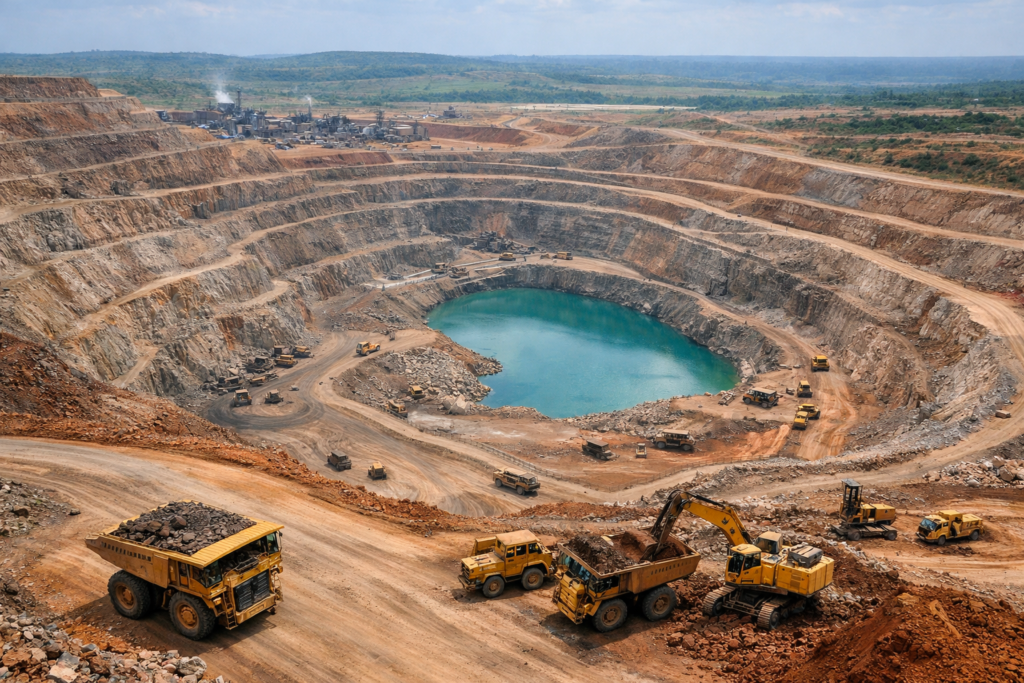
Aerial view of an open-pit copper mine in central Africa
Minerals as a Policy Anchor — The Compute-for-Copper Principle
A non-aligned tech strategy treats minerals as strategic negotiating assets, anchors for industrial policy, leverage in infrastructure deals, and inputs into domestic capability rather than raw exports.
The governing mechanism here is what might be called the Compute-for-Copper principle. Instead of neighboring countries simply paying for cloud services in Rand or Dollars, regional agreements create a Resource Credit system. A country like Zambia provides copper or hydroelectric power to the regional grid; in exchange, its government and startups receive guaranteed, low-latency compute tranches at anchor-tenant rates. This ensures that cloud gravity does not merely extract capital from smaller neighbors, but actively lowers their cost of digital entry.
There is a specific loop worth emphasizing. The battery minerals Africa exports — lithium, vanadium, cobalt — are the same inputs required to build the industrial-scale storage that stabilizes power grids. Data centers cannot operate without stable, redundant electricity. If Africa provides the minerals for the world’s batteries, it should be the first in line for the storage infrastructure required to make its own data centers viable. This is not charity — it is the terms of the deal.
Instead of asking who will build Africa’s digital systems, the better question is: what does Africa trade access for?
From Resource Diplomacy to Tech Diplomacy
Africa has long practiced resource diplomacy in energy and mining. The same logic applies to technology. Mineral access should be linked to local processing. Infrastructure access should be tied to skills transfer. Market entry should be conditioned on interoperability. Defense-adjacent technology should be subject to transparency requirements. A mining license in the DRC or Zimbabwe should be contingent on the bidder also building the high-voltage transmission lines or fiber backbones that connect the mine to the regional grid — infrastructure that outlasts any single contract.
This shifts Africa from rule-taker to rule-negotiator.
Regionalism Over Fragmentation
Non-alignment is impossible at purely national scale. AI-critical minerals are unevenly distributed: cobalt in the DRC, lithium in Zimbabwe, copper in Zambia, platinum in South Africa, rare earths across multiple regions. A fragmented approach weakens leverage. A regional one multiplies it.
Shared processing hubs, power pools, and standards frameworks make non-alignment viable. Without them, each country negotiates alone against parties with far greater institutional capacity and longer time horizons. The AfCFTA Digital Trade Protocol — currently emerging as a legal framework for digital commerce across the continent — provides the existing skeleton on which this architecture can be built. It does not need to be invented from scratch; it needs to be extended deliberately.
The Role of Infrastructure First
Platforms come and go. Infrastructure persists. A non-aligned tech policy prioritizes power generation and storage, fiber and terrestrial connectivity, data centers and internet exchange points, and skills linked to infrastructure operation rather than application use.
Once physical capacity exists, platform choices become reversible. Without it, alignment becomes permanent by default — not through deliberate decision, but through accumulated dependency.
The New African Tech Cycle: Strategic Circularity
The logic of a non-aligned tech policy is best expressed as a self-reinforcing loop — not a linear supply chain. Each phase feeds the next, and Phase 4 closes back into Phase 1, creating compounding returns rather than a one-time value extraction. Africa is not selling rocks to buy software. It is using its physical wealth to build digital sovereignty.
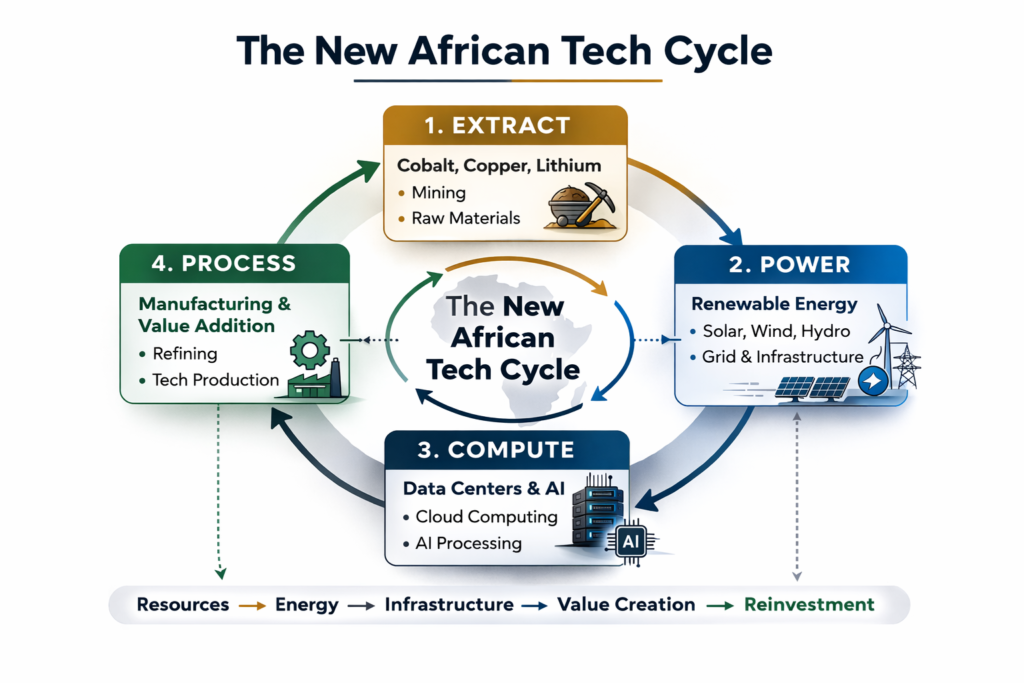
Infographic of the four phases — Extract, Power, Compute, Process
Phase 1: Extract — The AI Mineral Foundation
Leverage global demand for cobalt, lithium, and copper — but move beyond royalties. Negotiate for in-kind infrastructure. Mining licenses should be contingent on bidders building the high-voltage transmission lines or fiber backbones that link extraction sites to the regional grid. The mineral access and the connectivity infrastructure are a single negotiating unit.
Phase 2: Power — Closing the Storage Loop
Use exported AI minerals to secure first-access to Battery Energy Storage Systems. South Africa’s ongoing grid transition — driven by the unbundling of NTCSA from Eskom — becomes the continental pilot for African-mined vanadium and lithium storage technology. Stabilizing the anchor’s power supply is a prerequisite for what comes next.
Phase 3: Compute — Regional Cloud Gravity
Host the data and the processing power. South Africa provides the physical home for the hardware, but operates under Regional Data Sharing Agreements (RDSAs) that treat compute as a common utility. Neighboring states contribute renewable energy or mineral access and receive Compute Credits — guaranteed, low-latency processing capacity at anchor-tenant rates. Cloud gravity becomes a continental service, not a national monopoly.
Phase 4: Process — AI-Driven Discovery
Run African-trained AI models on the regional cloud. Critically, use this compute specifically for predictive geological mapping — identifying the next generation of deposits using African data, African infrastructure, and African-owned models. This breaks the information asymmetry that has historically allowed foreign firms to undervalue African resources before extraction contracts are signed.
Phase 4 feeds directly back into Phase 1: better information means better-negotiated licenses, which means better infrastructure terms, which means more stable power for more compute. The cycle compounds.
For this cycle to remain non-aligned, the hardware layer must be agnostic. An African startup must be able to move its AI model from a Western-designed chip architecture to a Chinese-designed one without rewriting its codebase. Interoperability is not a feature of the cycle — it is the condition of its existence.
The Cost of Doing Nothing
Without an explicit strategy, the default path is clear: minerals continue to exit raw, infrastructure remains externally governed, policy space shrinks quietly, and dependencies harden over time. Non-alignment is not the natural state — it is the designed one. The alternative designs itself.
The Central Insight
Africa is already inside the global tech system. The only open question is whether it participates as a passive supplier or as a strategic actor. AI minerals give Africa relevance. Infrastructure gives it options. Policy coherence gives it agency.
Which brings us to the country where Africa’s cloud gravity is already forming.
Part Two: South Africa as the Continental Compute Anchor
Every digital economy develops a center of gravity. In Africa, that gravity is increasingly South Africa — not because it is the most populous or fastest-growing market, but because it sits at the intersection of power, connectivity, capital, and institutional depth. This makes South Africa the continent’s most important node in the physical cloud economy.
The question is not whether South Africa will be the anchor. It already is. The question is whether it acts as a service provider to the continent or as a competitor to it.
What Is Cloud Gravity?
Cloud gravity describes the tendency of data, compute, platforms, talent, and capital to cluster where infrastructure is deepest and most reliable. Once gravity forms, it reinforces itself — each new investment makes the location more attractive to the next.
South Africa has crossed this threshold. The policy question is not how to create cloud gravity, but how to govern it so that it serves the continent rather than merely concentrating within one border.

Server racks inside a modern data center facility, illuminated by blue indicator lights.
Data Centers Are Power Stories First
Data centers follow electricity before they follow users. They require stable baseload power, redundant supply, grid proximity, and long-term planning certainty. South Africa remains one of the few African countries with industrial-scale power infrastructure, sufficient grid depth, and credible energy market reform pathways — including the ongoing unbundling of NTCSA from Eskom.
This transition matters directly for cloud investment. The battery minerals Africa exports are the same inputs needed to stabilize a reforming grid. Vanadium flow batteries and lithium storage systems built from African-mined materials could underpin South Africa’s power reliability — meaning the continent’s mineral exports and its cloud ambitions are not two separate conversations. They are one.
Why Cloud Providers Choose South Africa
Major cloud investments are not symbolic. South Africa offers strong submarine cable connectivity, legal and financial infrastructure, skilled technical labor, regional market access, and relatively predictable regulation. Once established, cloud platforms rarely relocate. This creates path dependence — and with it, influence that compounds over time. Ensuring that influence serves the region requires deliberate governance from the outset.
The Power Constraint That Shapes Everything
South Africa’s cloud future is inseparable from its power transition. Data centers compete with industry for electricity, but they also accelerate renewable investment, drive battery storage demand, and create strong economic incentives for grid modernization. Cloud growth and power reform are structurally linked — progress in one domain accelerates the other. This is not a problem to be managed; it is leverage to be used.
Regional Implications and the Data Sovereignty Tension
As cloud infrastructure concentrates, data flows toward South Africa, AI workloads localize there, talent migrates there, and policy influence follows. This creates opportunity — and real tension. Kenya, Nigeria, and Ghana are already pushing for local data residency laws, a rational response to the prospect of their citizens’ data sitting in Cape Town data centers beyond domestic legal reach.
The solution is not fragmentation — building redundant, inefficient national data centers in every country is prohibitively expensive and technically inferior. The solution is Federated Data Sovereignty, implemented through Regional Data Sharing Agreements.
The mechanism is Virtual Data Localization: data physically resides in the South African hub for efficiency, but is legally governed by a “data embassy” framework. If a Kenyan court issues a warrant for data stored in South Africa, the RDSA mandates that the host provider must treat that warrant as domestic — satisfying legal sovereignty without duplicating physical infrastructure. This is how the data sovereignty tension resolves without sacrificing the efficiency of the anchor model.
The Architecture of Regional Data Sharing Agreements
The AfCFTA Digital Trade Protocol provides the existing legal skeleton for RDSAs. Rather than building governance from scratch, the framework extends and operationalizes what is already emerging. Four components define the architecture:
1. The Compute-for-Access Swap
Neighboring states contribute copper, hydroelectric power, or other AI mineral inputs to the regional commons. In return, they receive guaranteed, low-latency compute capacity at anchor-tenant rates — Compute Credits that lower their cost of digital entry without requiring sovereign infrastructure at scale.
2. Federated Data Sovereignty
Virtual Data Localization ensures data physically held in South Africa is legally governed by the originating country’s jurisdiction. Data embassy frameworks give smaller nations full legal reach over their citizens’ information without the cost of local hyperscale infrastructure.
3. The Interoperability Mandate
Any hyperscale provider operating within the anchor must provide open APIs and standard data export formats. The benchmark: full digital stack migration between cloud providers within 48 hours. This is the technical expression of Plug-and-Play sovereignty — the only mechanism that keeps external powers honest over time.
4. The Continental Data Commons
Anonymized public-interest data — agricultural yields, transport patterns, geological surveys, health metrics — is pooled into a shared Continental Data Commons. African developers train AI models on African data using South African compute, without that data being sold to or captured by external platforms. This is what makes the AI models relevant to African conditions rather than imported approximations.
The Strategic Choice Ahead
South Africa can serve as a continental infrastructure hub or become a national platform enclave. Its decisions will shape where AI is trained, where data is stored, who captures platform rents, and how Africa integrates digitally. These are not technical questions. They are political ones, and they will be decided by default if not decided deliberately.
The non-aligned tech policy outlined in Part One depends on South Africa playing an anchor role rather than a competitive one. If South Africa treats its cloud gravity as national leverage, the continent fragments. If it treats it as continental infrastructure — governed by RDSAs, powered by African minerals, subject to interoperability mandates, and accountable to federated data sovereignty frameworks — the New African Tech Cycle becomes viable.
Final Thought
Africa’s tech future will not be decided by apps or slogans. It will be decided by where power is generated, where data is stored, where minerals are processed, and where compute is concentrated.
The blueprint exists. The legal skeleton — AfCFTA — is in place. The mineral leverage is real. The anchor is forming. What remains is the political decision to treat these as connected instruments of a single strategy rather than separate sectoral conversations.
Non-alignment is not withdrawal. It is architecture. And architecture, unlike aspiration, can be built.
Also, read our article on: Zimbabwe’s Lithium and the Battery–AI Convergence
